
How to Write Meta Descriptions That Convert (2026): The Hook + Data + Constraint CTR Playbook
Direct Answer: How to Write Meta Descriptions That Convert in 2026
To write a meta description that maximizes Click-Through Rate (CTR) and AI visibility: Implement the Hook + Data + Constraint framework within 155 characters (960px desktop, 680px mobile). Start with a compelling problem-oriented verb hook, integrate a concrete proof point or verified metric (e.g., benchmark numbers, price limits, testing date), and close with a clear constraint or target audience qualification. This formula satisfies search intent immediately and discourages Google’s algorithmic rewriting.
Why Meta Description SEO Remains a Critical Ranking & CTR Factor in 2026
While Google confirmed that meta descriptions are not a direct algorithmic ranking factor, they represent your primary organic marketing billboard in search results. Understanding how to write meta descriptions is one of the highest-leverage seo tips available because Click-Through Rate directly impacts organic traffic volume and behavioral search satisfaction.
Furthermore, in the era of generative AI search engines and Google AI Overviews, concise, data-dense meta descriptions provide essential contextual signals that answer engines scrape and cite when synthesizing direct responses.
The 2026 Meta Description Length & Truncation Reality
Search engines calculate snippet display boundaries by pixel width rather than arbitrary character counts. Because proportional fonts allocate more pixels to uppercase letters and wide characters (like ‘W’ and ‘M’), tracking character counts alone leads to premature truncation with trailing ellipses (‘…’).
Desktop SERP Display Limits
• Max Pixel Width: ~960 pixels.
• Safe Character Range: 150 – 158 characters.
• Formatting Rule: Front-load the primary target keyword and core value proposition within the first 110 characters.
Mobile SERP Display Limits
• Max Pixel Width: ~680 pixels.
• Safe Character Range: 115 – 125 characters.
• Formatting Rule: Ensure the initial mobile sentence functions as a complete, independent, actionable thought.
The Hook + Data + Constraint Framework: Step-by-Step
To eliminate generic copy and protect against algorithmic replacement, every high-converting meta description should be built with three interlocking components:
The Action Hook (First 40 Characters)
Disrupt user inertia with a decisive, active verb. Avoid passive openings like “In this article we will discuss…”. Instead, use high-momentum directives: “Compare verified benchmarks…”, “Fix 6 revenue leaks…”, “Discover why top publishers…”
The Concrete Data Point (Characters 40–110)
Searchers crave verifiable reality, not vague marketing promises. Include an exact metric, sample size, dollar amount, or testing timeframe: “…tested across 129 live domains”, “…verified 2026 pricing from $3.99/mo”, “…15 diagnostic formulas”.
The Constraint & Audience Qualifier (Characters 110–155)
Clarify exactly who the resource is built for and eliminate misaligned clicks: “…without coding experience.”, “…for affiliate publishers scaling past $5k/mo.”, “…with zero paid ad spend.”
15 High-Converting Meta Description Examples (Copy-Paste Templates)
| Content Vertical | High-Converting Template Structure | Character Count |
|---|---|---|
| Single Product Review | [Product] review (2026): tested [Key Feature], verified pricing limits from $[Price], and honest comparisons with [Competitor]. Who should buy and who should skip. |
154 chars |
| Head-to-Head Comparison | Compare [Tool A] vs [Tool B] across 5 benchmarks: speed, plan limits, workflows, and 2026 pricing. See which platform fits your exact use case. |
148 chars |
| Step-by-Step Tutorial | Learn how to [Goal] in [Number] actionable steps. Complete 2026 workflow with copy-paste templates, diagnostic checklists, and zero fluff. |
142 chars |
| Best-Of Category Roundup | Discover the [Number] best [Category Tools] in 2026. Ranked by hands-on testing, verified pricing, renewal traps, and operational bottlenecks. |
146 chars |
| Beginner Roadmap Guide | Master [Topic] in 2026: a realistic [Number]-milestone roadmap from initial setup to first $[Revenue] without paid ads or prior technical experience. |
152 chars |
AEO Optimization: How Google AI Overviews and Perplexity Parse Snippets
When answer engines like Google AI Overviews, Perplexity Pro, and ChatGPT Search evaluate search results, they do not just read metadata—they search for concise, factual summary statements that can be quoted directly as authoritative answers. To optimize for both traditional CTR and AI visibility:
- Include Entity-Rich Nouns: Explicitly mention brand names, software categories, pricing tiers, and testing protocols.
- Answer the Core Query Directly: Ensure your snippet summarizes the verdict or finding rather than teasing a cliffhanger.
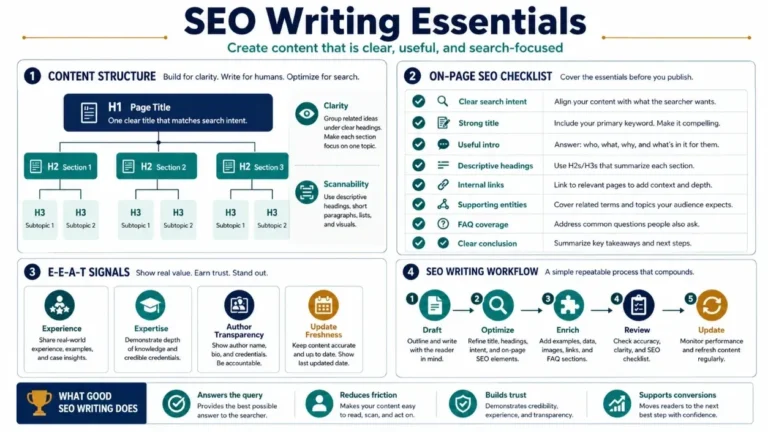
- Pair with Examples of Infographics: Visual search elements and structured tables reinforce topical depth and trigger enhanced rich media badges on mobile SERPs.
Once your descriptions are dialled in, the next lever is the drafting itself — see our roundup of the best AI writing tools for affiliate marketers for the tools that write the copy these snippets are built from.
Frequently Asked Questions About Meta Descriptions
Why does Google rewrite meta descriptions in search results?
Ahrefs’ study of 192,656 pages found that Google rewrites meta descriptions approximately 62.8% of the time. This occurs when Google determines that the existing meta description fails to match the user’s specific long-tail query, contains keyword stuffing, or lacks direct relevance to the body text. Writing intent-matched descriptions with concrete data dramatically reduces rewrite rates.
What is the ideal meta description length for mobile devices?
On mobile devices, Google truncates snippets at approximately 680 pixels, which translates to 115 to 125 characters depending on letter widths. Always place your primary keyword and core message within the first 110 characters to guarantee visibility on smartphone screens.
Do meta descriptions directly impact Google keyword rankings?
No, Google has officially confirmed that meta descriptions are not a direct ranking signal. However, they indirectly influence search visibility by driving organic click-through rate (CTR), user engagement, and providing concise semantic summaries for AI answer engines.