How Do Teachers Detect AI? 11 Detection Methods (2025)
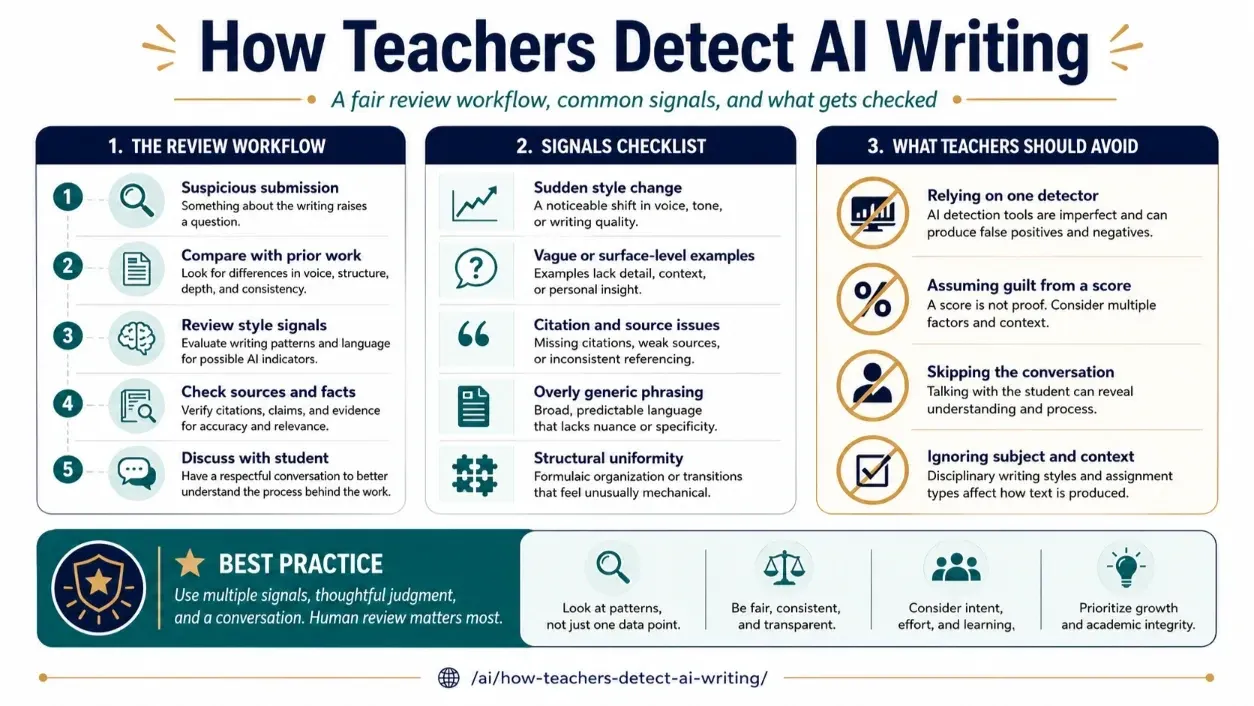
Teachers do not reliably “spot ChatGPT” with a single trick. The strongest approach is a layered evidence workflow: compare the writing to prior work, inspect drafts and version history, verify citations, ask the student to explain their thinking, and treat AI-detector results as one signal rather than a verdict.
Recommended tools for this guide
For this topic, the strongest practical stack is Originality.ai, Frase, MarketMuse. These recommendations are included only because they match the workflow covered in this article.
Originality.ai
Check AI-likeness, plagiarism risk, and editorial integrity before publishing.
Frase
Build SERP-led briefs, optimize topic coverage, and tighten content outlines before publishing.
MarketMuse
Plan topical authority, find coverage gaps, and prioritize content updates with enterprise-level workflows.
Disclosure: Some links are affiliate links. We may earn a commission if you buy through them, at no extra cost to you. Recommendations are selected for topical fit, not for commission alone.
This guide explains how teachers detect AI writing in real classrooms: ChatGPT-style essays, Turnitin AI indicators, AI detector false positives, Google Docs version history, stylometry, citation checks, student writing voice, academic-integrity policy, and process-based assessment. The goal is not to help students evade detection; it is to explain how detection works, where it fails, and how schools can handle AI-assisted writing fairly.
What teachers look for before they ever open an AI detector
The most accurate teachers start with context. A detector can flag text, but it cannot know a student’s usual writing rhythm, how the assignment was taught, what sources were allowed, or whether the student can defend the argument in conversation.
Voice mismatch
A student who normally writes short, concrete sentences suddenly submits polished paragraphs with abstract transitions, flawless grammar, and vocabulary that never appeared in earlier work.
No drafting trail
The assignment appears as a fully formed document with little revision history, no messy outline, no source notes, and no signs of normal drafting decisions.
Weak or fabricated citations
AI-written essays often cite plausible-sounding articles, misquote real sources, or use references that do not support the claim being made.
That is why AI education strategy is moving away from “catch the student” tactics and toward assessment designs that make thinking visible.
The 11 practical methods teachers use to detect AI writing
None of these methods is perfect alone. Together, they create a much stronger academic-integrity review than a single AI probability score.
AI detectors compared: what each method is good for
| Method | Best use | What it can reveal | Main limitation | Evidence strength |
|---|---|---|---|---|
| Turnitin AI indicator | Institutional review inside existing submission workflows | Sections that may resemble AI-generated writing | Should be interpreted with policy, context, and human review | Medium as a signal |
| GPTZero / Copyleaks / Originality.ai | Independent screening or editorial review | Probability-like signals based on text patterns | Scores vary by text length, topic, editing, and language background | Medium as triage |
| Version history | Checking whether the writing process exists | Pasting events, revision rhythm, drafts, and source integration | Not every student writes in the same tool | Strong when available |
| Oral defense / conference | Confirming understanding | Whether the student can explain claims, sources, and decisions | Needs consistent procedure to avoid bias | Strong with documentation |
| Citation verification | Research essays and academic work | Fake sources, unsupported claims, hallucinated references | Time-consuming on long papers | Very strong for source issues |
| Stylometry / voice comparison | Comparing against prior student writing | Unusual style shifts, sentence patterns, vocabulary jumps | Students can improve quickly; not proof by itself | Useful supporting evidence |
For a deeper AI-tool context, see our guides on AI writing detection tools and how Claude works.
False positives: the part schools must take seriously
The Stanford-linked arXiv paper “GPT detectors are biased against non-native English writers” is widely cited because it exposed a serious risk: polished, predictable, or formulaic English can be misclassified as AI-generated even when it is human-written.
OpenAI also discontinued its public AI classifier after acknowledging low accuracy. That matters because it shows a broader industry reality: detecting AI text is probabilistic, not definitive. Teachers need a documented review process, not a one-click accusation.
Signals that deserve review
- Sudden writing-quality jump
- Missing drafts or one-step paste history
- Fake citations or unsupported claims
- Student cannot explain the work
- Detector flags a long, coherent section
Signals that do not prove misconduct
- A high detector score by itself
- Excellent grammar
- Formal academic tone
- Use of common transitions
- Writing from an English learner
A safer teacher workflow for suspected AI writing
The best workflow is firm, fair, and evidence-based. It protects academic integrity without turning every strong essay into a disciplinary threat.
- Start with the assignment rules. Was AI use prohibited, allowed with disclosure, or allowed for brainstorming only?
- Collect process evidence. Save drafts, timestamps, edit history, source notes, and the submitted version.
- Run detector checks only as supporting evidence. Record which tool was used, the date, and the specific sections flagged.
- Verify sources and claims. Check whether citations exist and whether they support the argument.
- Hold a neutral student conference. Ask the student to explain the thesis, source choices, and one revision decision.
- Offer a learning-centered remedy when appropriate. Depending on policy, this may be revision, resubmission, reflection, or formal academic-integrity escalation.
If you are a student: what teachers notice most
Teachers are usually not suspicious because one sentence sounds polished. They become suspicious when the whole submission does not match the student’s known ability, contains unsupported claims, lacks drafts, or falls apart when the student is asked to explain it.
If AI tools are allowed in your course, disclose how you used them. If they are not allowed, do not submit generated text as your own. If you are falsely accused, calmly provide drafts, notes, source history, and a clear explanation of your writing process.
A clear classroom AI policy prevents most disputes
Ambiguous rules create bad outcomes. A strong AI policy tells students exactly what is allowed, what must be disclosed, and what evidence may be requested if authorship is questioned.
| Policy element | What to specify | Why it helps |
|---|---|---|
| Allowed uses | Brainstorming, outlining, grammar support, citation formatting, tutoring, or no use | Students know where the boundary is |
| Disclosure | Whether students must name the tool, prompt, and edited output | Turns AI use into a transparent process |
| Process artifacts | Drafts, outlines, source notes, revision memos, screenshots if needed | Provides evidence beyond a detector |
| Review process | Conference, source check, detector triage, resubmission rules | Reduces arbitrary accusations |
FAQ: how teachers detect AI writing
Can teachers really detect AI writing?
Teachers can often identify suspicious AI-assisted writing, but they should not rely on a detector score alone. The strongest process combines writing history, document revision records, source checking, voice comparison, and a short student conference before any academic-integrity decision.
Can Turnitin detect ChatGPT?
Turnitin includes AI-writing indicators for submitted work, but its output should be treated as a signal rather than proof. Schools should interpret it with assignment context, drafts, version history, citations, and the student’s prior writing sample.
What is the most reliable way for teachers to check AI writing?
The most reliable method is a layered review: compare the submission to previous work, inspect drafts and edit history, verify citations, ask the student to explain their argument, and use AI detectors only as one part of the evidence.
Do AI detectors produce false positives?
Yes. Research and vendor guidance both warn that AI detectors can be wrong, especially on short text, heavily edited text, formulaic assignments, and writing from multilingual or non-native English students. A detector result should never be the only evidence.
What signs make an essay look AI-generated?
Common warning signs include a sudden jump in style, polished but generic paragraphs, vague examples, fabricated citations, inconsistent understanding in follow-up questions, and no visible drafting process.
How can teachers reduce AI misuse without policing every sentence?
Design assignments around process: topic proposals, annotated sources, outlines, checkpoints, in-class writing, revision memos, and short oral defenses. These make learning visible and reduce the need for adversarial detection.
Sources and further reading
- Liang et al., “GPT detectors are biased against non-native English writers”.
- UNESCO guidance on generative AI in education and research.
- U.S. Department of Education report on AI and the future of teaching and learning.
- Cornell teaching guidance on generative AI.
- Yale Poorvu Center AI guidance for teaching.
Editorial note: this article is written to help readers understand AI-writing detection, academic-integrity review, detector limitations, and fair classroom process without encouraging evasion.
The bottom line
Teachers detect AI writing best when they stop looking for a magic detector and start looking for evidence of authorship. The strongest signal is not “this paragraph sounds like ChatGPT.” It is the combination of writing history, document process, source integrity, student understanding, and a clear classroom policy.
AI detection will keep changing. Fair academic-integrity systems should assume that detector scores are useful but limited — and that the writing process is the real evidence.

Alexios Papaioannou is the founder and lead editor of Affiliate Marketing for Success. He focuses on affiliate marketing systems, SEO, content strategy, monetization design, and the impact of AI-driven search on publishers. Editorial background, disclosure standards, and correction policy are documented on the site’s About Alexios and Editorial Policy pages.