How to Rephrase a Sentence: 7 Best AI Rephrase Tools, Tested (2026)
Learn how to rephrase a sentence the right way — then compare the 7 best AI rephrase tools (free & paid), tested. Includes an interactive playground, real screenshots, and FAQs.
AI workflows hub: how AI search changes affiliate publishing, and which AI workflows are actually worth adopting.
Two different things get called “AI” here, and they pull in opposite directions. The first is AI search — Google AI Overviews, ChatGPT Search, and Perplexity answering questions directly, which compresses the informational middle of the funnel and removes clicks you used to get for free. The second is AI tooling inside your own workflow, where the risk is producing more of exactly the generic content those engines already summarise.
What survives. Content that carries something a model cannot synthesise from consensus: original comparison, first-hand use, pricing checked against the vendor’s own documentation, and an opinion a named person is accountable for. That is also, not coincidentally, what makes a page quotable enough to be cited rather than replaced.
Answer Engine Optimization (AEO) — being selected as the direct answer
Generative Engine Optimization (GEO) — being cited inside a generated answer
AI citation readiness checklist — the signals that decide whether you get cited
How ChatGPT works — the mechanics behind the answers
How we use AI in our own publishing, and where we do not, is documented in our AI disclosure.
Human-led AI operations
AI can accelerate research, classification, drafting, analysis, and quality assurance, but publishers remain responsible for accuracy, originality, disclosure, and usefulness. The safest workflow uses AI to support documented editorial decisions—not to mass-produce thin pages, fabricate experience, or imitate sources.
Choose the right path
Design useful answers that work for readers and retrieval systems.
Open guide →Improve evidence, entities, source clarity, and AI citation readiness.
Open guide →Understand model behavior, limitations, and where verification is required.
Open guide →See how AMFS uses AI while preserving human accountability.
Open guide →Operating framework
Specify the audience, question, required evidence, exclusions, and acceptance criteria before prompting.
Prefer original documentation, current policies, primary research, and first-party observations.
Apply models to outlines, clustering, extraction, alternatives, or QA—not invented expertise.
Check numbers, quotations, names, dates, policies, products, links, and examples against sources.
Explain trade-offs, methodology, limitations, and what the evidence means for the reader.
Follow platform, legal, and editorial requirements for AI-generated or AI-assisted material.
Check search behavior, corrections, source changes, user feedback, and model-induced errors.
Google and AI-search quality guardrails
Quality basis: Google Search spam policies, people-first content guidance, and Google AI features guidance.
Direct answers
Google evaluates usefulness and policy compliance rather than the mere use of AI. Scaled low-value generation, manipulation, or content created primarily to rank can violate spam policies.
Use AI for bounded support, verify all material claims, retain human editorial responsibility, disclose material usage, and never imply testing or experience that did not occur.
Clear entities, direct answers, primary sources, semantic structure, visible authorship, methodology, limitations, and reliable crawl access improve eligibility but do not guarantee citation.
No. Create or refresh a page only when it owns a distinct intent and provides durable value beyond a templated variation.

Learn how to rephrase a sentence the right way — then compare the 7 best AI rephrase tools (free & paid), tested. Includes an interactive playground, real screenshots, and FAQs.

AI can absolutely help you earn money online — but not the way the gurus claim. Here are 10 legitimate AI income methods ranked by speed and reliability, with realistic earnings numbers and the scams to avoid.

A practical AI citation readiness checklist for SEO teams: build an evidence ledger, verify claims, structure answer blocks, and publish source-traceable commercial content.

The definitive publisher guide to winning citations on Perplexity AI: 6-factor citation algorithm, 60-day empirical testing data (+342% lift), and optimization checklist.
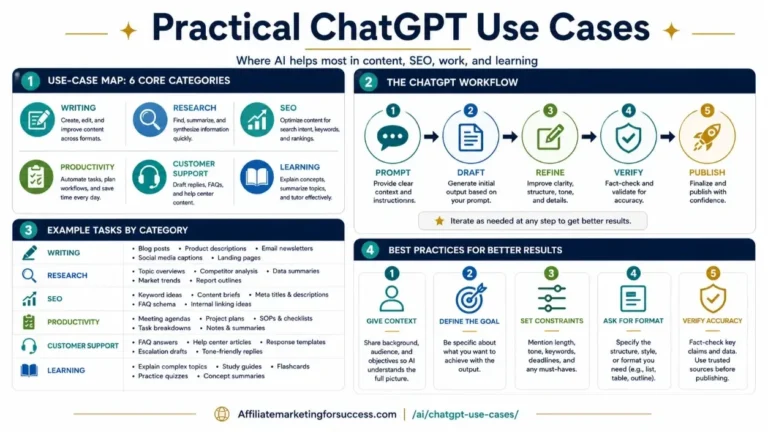
Master 50 expert ChatGPT prompts for affiliate marketing. Professional AI workflows for niche research, SEO briefs, product reviews, and email marketing.

Master AI for Affiliate SEO. Learn GEO & AEO strategies to optimize for AI Overviews, improve citations, and maintain visibility in generative search engines.

Master AI ethics for bloggers in 2026. Learn essential standards for transparency, disclosure, and fact-checking to build audience trust and protect your brand.
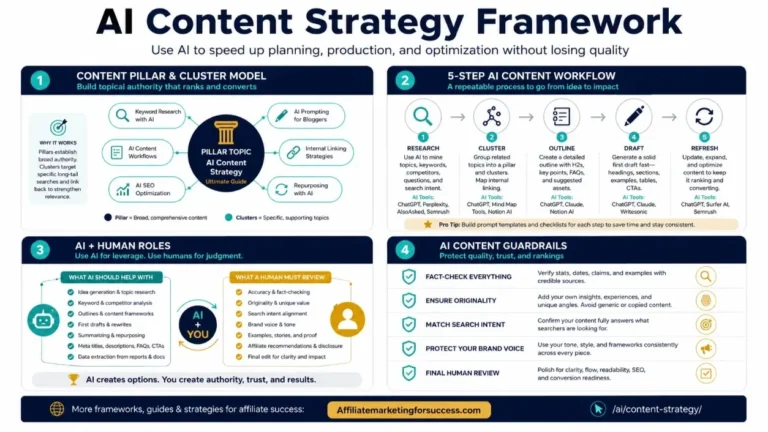
Master AI content strategy for 2026. Learn to build a human moat by combining AI efficiency with unique personal insights to dominate SEO and affiliate marketing.

Master multimodal prompt engineering for SEO. Learn frameworks for GPT-4V, Claude, and Gemini to combine text, image, and video for higher affiliate rankings.
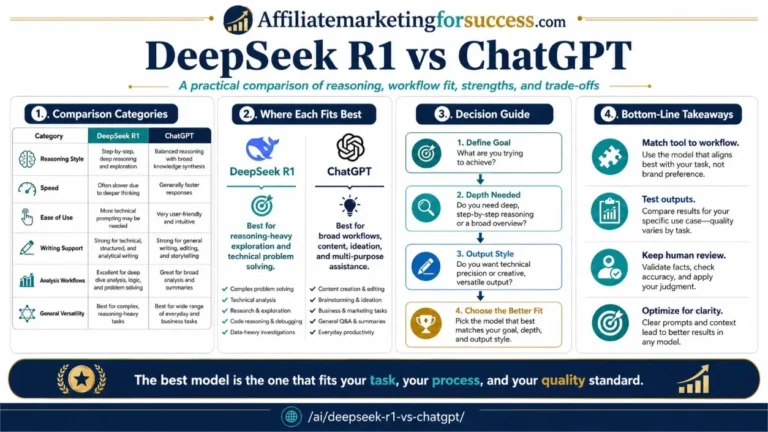
DeepSeek vs ChatGPT in September 2026: DeepSeek V4 Pro 0813 vs OpenAI GPT-5.6 Sol. Benchmarked across DeepSWE coding agent tasks, 20.7x cost gap, and ROI.