
Quick Answer: Affiliate marketing works when you build a trustworthy site around a specific niche, publish honest content that helps readers make decisions, and recommend products you would use yourself — with clear disclosures and no inflated claims.
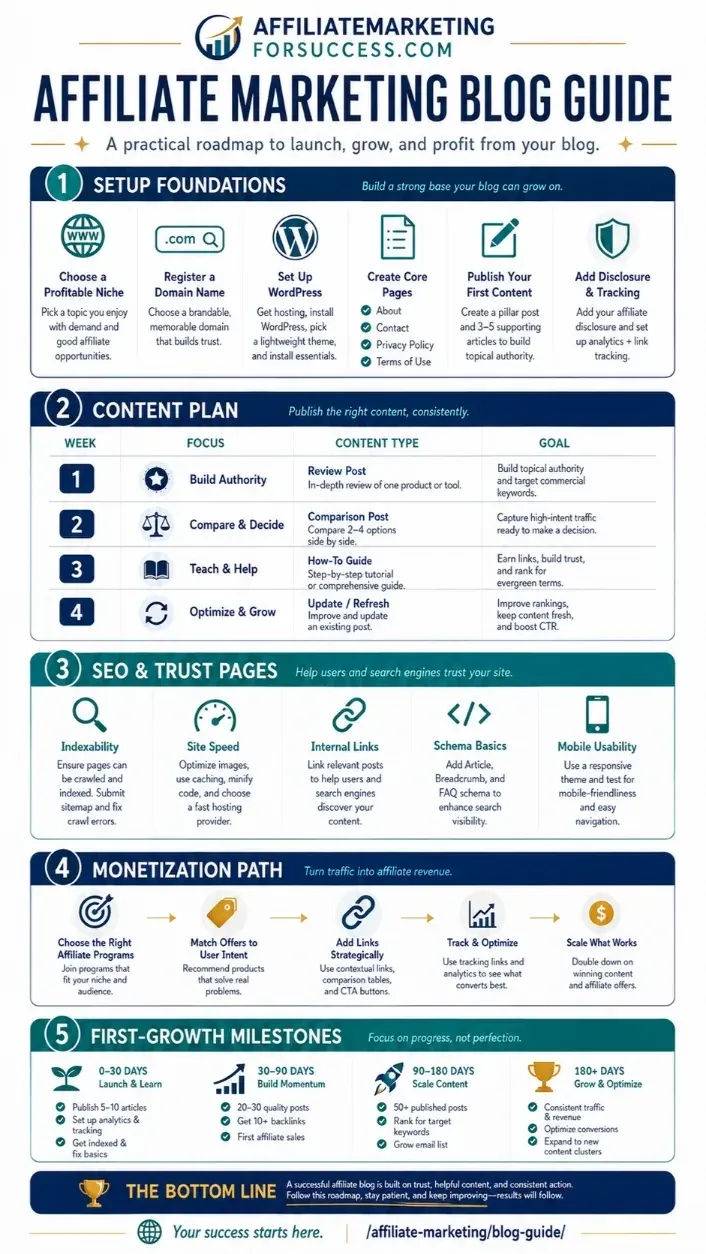
What Affiliate Marketing Is
Affiliate marketing is a performance-based business model where you earn a commission when your audience buys through your tracked links. You create content — blog posts, reviews, comparisons, guides — and include links to products or services you recommend. When a reader clicks your link and makes a purchase, the affiliate program pays you a percentage of the sale.
You are not an employee of the company. You are an independent publisher. You do not hold inventory, handle refunds, or manage customer service. Your job is to create useful content and match it honestly to products.
How the Affiliate Marketing Process Works
- You publish content — blog posts, reviews, tutorials, comparisons that serve a specific audience.
- You join affiliate programs — Amazon Associates, ShareASale, Impact, direct programs from brands you trust.
- You add tracked links to your content — using your unique affiliate IDs provided by each program.
- Readers click your links — and make purchases on the merchant’s website.
- The affiliate program tracks the sale — and pays you a commission.
- You receive payment — typically monthly, once you reach the program’s minimum payout threshold.
Business Models in Affiliate Marketing
| Model | Description | Commission Range | Best For |
|---|---|---|---|
| Review sites | Detailed product reviews with affiliate links | 3–30% | High-consideration purchases |
| Comparison sites | Side-by-side product or service comparisons | 2–20% | Research-phase buyers |
| Niche blogs | Informational content with relevant product links | 1–15% | Broad audiences, recurring content |
| Coupon/deal sites | Discount codes and promotional links | 1–10% | Price-sensitive buyers |
| Email newsletters | Curated affiliate offers sent to subscribers | 5–30% | Established email lists |
The Affiliate Marketing Trust Framework
Trust is the only sustainable competitive advantage in affiliate marketing. If readers do not believe your recommendations are honest, they will not click your links and will not return.
The three trust rules:
- Only recommend products you have used, researched thoroughly, or would use with confidence.
- Always disclose your affiliate relationships clearly and before any links.
- Be specific about what a product does well and where it falls short.
The Content Types That Drive Affiliate Revenue
| Content Type | Search Intent | Affiliate Goal | Example |
|---|---|---|---|
| Best [product category] | Commercial investigation | Compare options, link to top picks | Best WordPress hosting for affiliate sites |
| [Product] review | Commercial evaluation | Detailed honest review with buy links | Kinsta hosting review 2026 |
| [Product A] vs [Product B] | Decision support | Compare and recommend one option | Cloudways vs Bluehost for affiliate sites |
| How to [task] | Informational / learning | Recommend tools that enable the task | How to track affiliate marketing performance |
| [Product] coupon / discount | Transactional savings | Discount code links | [Host] discount code 2026 |
The SEO System for Affiliate Sites
Affiliate SEO is not different from regular SEO — but it has specific rules. Your goal is to rank for informational and commercial keywords where readers are actively researching products, then match that traffic to relevant affiliate offers.
See the affiliate SEO hub for the complete SEO system including:
- Keyword intent mapping — which keywords signal buyer intent
- On-page SEO template for affiliate content
- Internal linking architecture
- Schema markup for reviews and comparisons
- Content refresh workflow
Review Methodology
Every product review on this site follows a consistent methodology. See the review methodology for the full process, including how products are selected, tested, scored, and updated.
Monetization Paths Beyond Affiliate Links
- Email list monetization — Curated affiliate offers sent to subscribers. Email monetization hub
- Display advertising — Ad networks like AdSense for high-traffic informational pages
- Digital products — E-books, courses, templates aligned with your niche
- Sponsored content — Paid placements with clear disclosure
Common Mistakes That Kill Affiliate Sites
- Promoting too many products in one post — Focus on the two or three best options with honest reasoning.
- Writing thin, generic content — AI-generated or shallow content rarely ranks or converts.
- Not disclosing affiliate relationships — FTC violations are serious and carry real penalties.
- Promoting products you have not used — Readers trust specificity and honesty over polished marketing copy.
- Ignoring site speed and mobile usability — Slow, broken mobile layouts lose both readers and rankings.
Glossary of Key Terms
What is an affiliate link?
A tracked URL that contains your unique affiliate ID. When a reader clicks it and makes a purchase, the affiliate program knows to credit you with the sale and pay you a commission.
What is an affiliate network?
A platform that connects affiliate publishers with multiple merchants. Networks like ShareASale, Impact, and Awin handle tracking, payments, and reporting for hundreds of programs in one dashboard.
What is EPC (earnings per click)?
A metric showing how much you earn on average for each click on your affiliate links. A higher EPC means your links convert better or the products pay higher commissions.
What is a cookie duration?
The period during which an affiliate program tracks a reader’s purchase after they click your link. Longer cookie durations (30–90 days) give readers more time to decide and increase your earning potential.
What is a money page?
A page specifically designed to convert traffic into affiliate clicks or sales. Money pages typically include comparison tables, product recommendations, and prominent affiliate links placed after the reader has enough information to make a decision.
What to Read Next, By Goal
- Start from scratch? → Start Here: Affiliate Marketing Roadmap for Beginners
- Build your first site? → How to Start an Affiliate Marketing Blog in 2026
- Improve your SEO? → Affiliate SEO Strategy Hub
- Find the best programs? → Best Affiliate Programs for Beginners
- Track your performance? → How to Track Affiliate Marketing Performance
This hub was last reviewed and updated in February 2026. Program terms and commission structures change — verify current details directly with each affiliate program.