
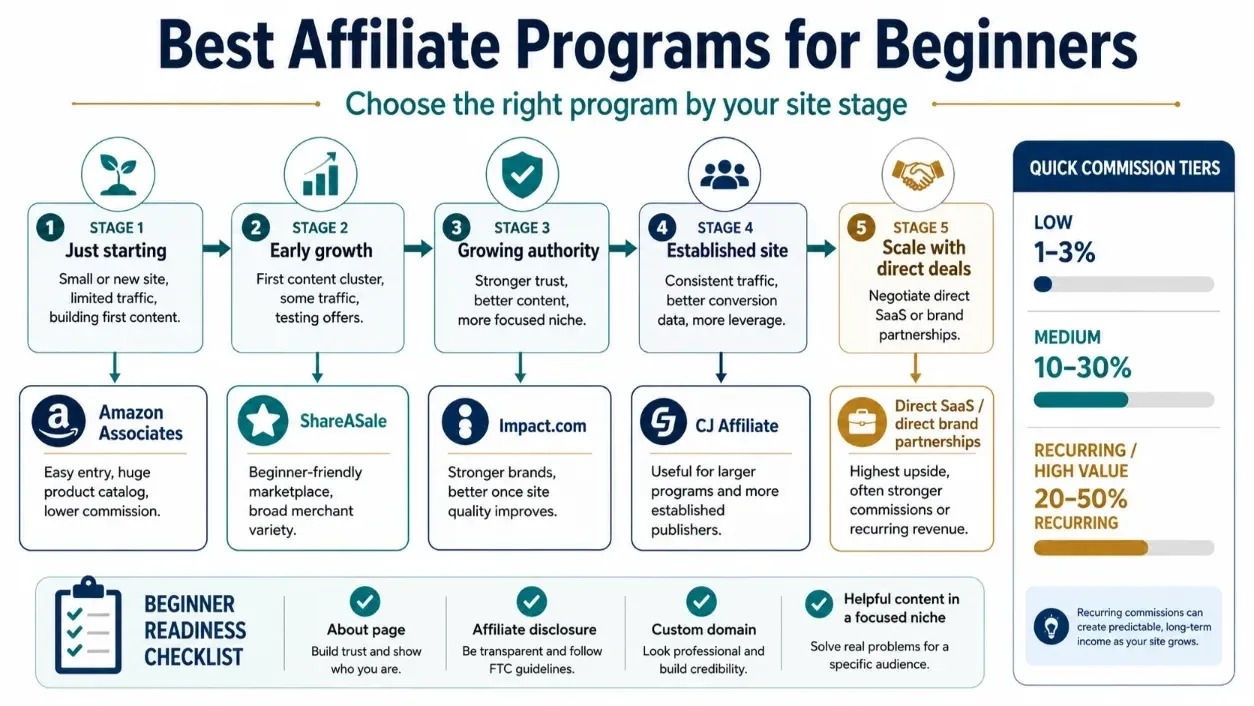
Best Affiliate Programs for Beginners: Practical Options by Business Model
Most affiliate programs require a website or online presence before approving you. Some programs accept social media profiles or email lists instead of a website, but a website with actual content is the safest path to approval for most programs. Even a simple blog with 5–10 quality posts is enough to get approved by Amazon Associates and most SaaS affiliate programs.
A direct affiliate program is run by the company itself — SEMrush runs its own affiliate program, ConvertKit runs its own. An affiliate network (ShareASale, Awin, CJ Affiliate, FlexOffers) acts as an intermediary, hosting programs for many different companies in one platform. Networks make it easier to join multiple programs with one application and one payment relationship. Direct programs sometimes offer better commissions because there is no network taking a cut, but require separate applications.
Most affiliate programs require a website or online presence before approving you. Some programs accept social media profiles or email lists instead of a website, but a website with actual content is the safest path to approval for most programs. Even a simple blog with 5–10 quality posts is enough to get approved by Amazon Associates and most SaaS affiliate programs.
Commission rate is less important than conversion rate and audience fit. A 5% commission on a product that 5% of your visitors buy is better than a 30% commission on a product that 0.1% buy. That said, a reasonable target for beginners is 10–30% recurring for SaaS products or 5–15% for physical products or services. Avoid programs below 3% on physical products unless the product has an exceptionally high average order value.
Related reading: How to Start Affiliate Marketing: Complete Beginner’s Guide · Affiliate Disclosure Examples for Blog Posts · Affiliate SEO: Complete 2026 Guide · AI Content Strategy 2026: The Affiliate Content Moat
Last reviewed: February 2026. Commission rates and program terms change frequently — verify current terms on each program’s official affiliate page before promoting.
Start with one or two programs maximum. Joining too many programs spreads your attention across too many products, makes tracking and disclosure management complex, and can feel overwhelming when you are still learning content creation and SEO. Start with Amazon Associates (for physical products and general niches) or one niche-specific SaaS program. Add programs as your content strategy solidifies and traffic patterns reveal what your audience actually buys.
A direct affiliate program is run by the company itself — SEMrush runs its own affiliate program, ConvertKit runs its own. An affiliate network (ShareASale, Awin, CJ Affiliate, FlexOffers) acts as an intermediary, hosting programs for many different companies in one platform. Networks make it easier to join multiple programs with one application and one payment relationship. Direct programs sometimes offer better commissions because there is no network taking a cut, but require separate applications.
Most affiliate programs require a website or online presence before approving you. Some programs accept social media profiles or email lists instead of a website, but a website with actual content is the safest path to approval for most programs. Even a simple blog with 5–10 quality posts is enough to get approved by Amazon Associates and most SaaS affiliate programs.
Commission rate is less important than conversion rate and audience fit. A 5% commission on a product that 5% of your visitors buy is better than a 30% commission on a product that 0.1% buy. That said, a reasonable target for beginners is 10–30% recurring for SaaS products or 5–15% for physical products or services. Avoid programs below 3% on physical products unless the product has an exceptionally high average order value.
Related reading: How to Start Affiliate Marketing: Complete Beginner’s Guide · Affiliate Disclosure Examples for Blog Posts · Affiliate SEO: Complete 2026 Guide · AI Content Strategy 2026: The Affiliate Content Moat
Last reviewed: February 2026. Commission rates and program terms change frequently — verify current terms on each program’s official affiliate page before promoting.
Yes, for most beginners. Amazon Associates has low commission rates compared to many other programs, but it has three significant advantages: (1) It is the easiest affiliate program to join with an new site. (2) Amazon is a trusted brand that converts well — visitors are familiar with the buying process. (3) The product catalog is enormous, so you can write about almost any category. Many successful affiliate sites started with Amazon Associates and added higher-commission programs as they grew. Treat it as a training ground, not a long-term strategy.
Start with one or two programs maximum. Joining too many programs spreads your attention across too many products, makes tracking and disclosure management complex, and can feel overwhelming when you are still learning content creation and SEO. Start with Amazon Associates (for physical products and general niches) or one niche-specific SaaS program. Add programs as your content strategy solidifies and traffic patterns reveal what your audience actually buys.
A direct affiliate program is run by the company itself — SEMrush runs its own affiliate program, ConvertKit runs its own. An affiliate network (ShareASale, Awin, CJ Affiliate, FlexOffers) acts as an intermediary, hosting programs for many different companies in one platform. Networks make it easier to join multiple programs with one application and one payment relationship. Direct programs sometimes offer better commissions because there is no network taking a cut, but require separate applications.
Most affiliate programs require a website or online presence before approving you. Some programs accept social media profiles or email lists instead of a website, but a website with actual content is the safest path to approval for most programs. Even a simple blog with 5–10 quality posts is enough to get approved by Amazon Associates and most SaaS affiliate programs.
Commission rate is less important than conversion rate and audience fit. A 5% commission on a product that 5% of your visitors buy is better than a 30% commission on a product that 0.1% buy. That said, a reasonable target for beginners is 10–30% recurring for SaaS products or 5–15% for physical products or services. Avoid programs below 3% on physical products unless the product has an exceptionally high average order value.
Related reading: How to Start Affiliate Marketing: Complete Beginner’s Guide · Affiliate Disclosure Examples for Blog Posts · Affiliate SEO: Complete 2026 Guide · AI Content Strategy 2026: The Affiliate Content Moat
Last reviewed: February 2026. Commission rates and program terms change frequently — verify current terms on each program’s official affiliate page before promoting.
Amazon Associates has the easiest approval process — you need one published blog post that follows Amazon’s content guidelines. It is the standard starting point for most new affiliate sites. ClickBank also has an open application process, though the quality and trustworthiness of products on ClickBank varies widely; vet individual products carefully before promoting them.
Yes, for most beginners. Amazon Associates has low commission rates compared to many other programs, but it has three significant advantages: (1) It is the easiest affiliate program to join with an new site. (2) Amazon is a trusted brand that converts well — visitors are familiar with the buying process. (3) The product catalog is enormous, so you can write about almost any category. Many successful affiliate sites started with Amazon Associates and added higher-commission programs as they grew. Treat it as a training ground, not a long-term strategy.
Start with one or two programs maximum. Joining too many programs spreads your attention across too many products, makes tracking and disclosure management complex, and can feel overwhelming when you are still learning content creation and SEO. Start with Amazon Associates (for physical products and general niches) or one niche-specific SaaS program. Add programs as your content strategy solidifies and traffic patterns reveal what your audience actually buys.
A direct affiliate program is run by the company itself — SEMrush runs its own affiliate program, ConvertKit runs its own. An affiliate network (ShareASale, Awin, CJ Affiliate, FlexOffers) acts as an intermediary, hosting programs for many different companies in one platform. Networks make it easier to join multiple programs with one application and one payment relationship. Direct programs sometimes offer better commissions because there is no network taking a cut, but require separate applications.
Most affiliate programs require a website or online presence before approving you. Some programs accept social media profiles or email lists instead of a website, but a website with actual content is the safest path to approval for most programs. Even a simple blog with 5–10 quality posts is enough to get approved by Amazon Associates and most SaaS affiliate programs.
Commission rate is less important than conversion rate and audience fit. A 5% commission on a product that 5% of your visitors buy is better than a 30% commission on a product that 0.1% buy. That said, a reasonable target for beginners is 10–30% recurring for SaaS products or 5–15% for physical products or services. Avoid programs below 3% on physical products unless the product has an exceptionally high average order value.
Related reading: How to Start Affiliate Marketing: Complete Beginner’s Guide · Affiliate Disclosure Examples for Blog Posts · Affiliate SEO: Complete 2026 Guide · AI Content Strategy 2026: The Affiliate Content Moat
Last reviewed: February 2026. Commission rates and program terms change frequently — verify current terms on each program’s official affiliate page before promoting.
Quick Answer: Beginners usually do best with affiliate programs they can explain honestly, get approved for realistically, and support with helpful content. High commission is useful only when the product fits the audience, converts reliably, pays on time, and does not create refund or trust risk. Start with one core program, then add complementary networks after traffic signals appear.

The Biggest Beginner Mistake in Choosing Affiliate Programs
Most beginner affiliate marketing guides rank programs by commission rate. That is the wrong way to choose. A 50% commission on a product that nobody buys, that you cannot explain honestly, or that your audience does not trust is worth $0. A 5% commission on a product your audience genuinely needs, that converts reliably, and that pays consistently is worth building a content strategy around.
Before looking at specific programs, answer these three questions:
- Can I explain this product honestly and in my own words? If you cannot describe who it is for and why it works without reading the sales page, you cannot write a useful affiliate article about it.
- Would my audience actually buy this? If your traffic is DIY home improvers and you are promoting premium photography equipment, the commission is irrelevant — the conversions will not happen.
- Can I realistically get approved? Many high-commission programs require established traffic, a business website, or prior affiliate experience. Beginners should prioritize programs with realistic approval requirements.
Best Affiliate Programs for Beginners by Business Model
Different content types suit different affiliate programs. Here are the best options for beginners in each major business model.
Blogging and Informational Content
| Program / Network | Commission Range | Approval Difficulty | Cookie Duration | Why It Works for Beginners |
|---|---|---|---|---|
| Amazon Associates | 1–10% (varies by category) | Easy — requires one published post | 24 hours (attribution), 90 days (site navigator) | Trustworthy brand, massive product range, easy approval, 24-hour cookie |
| ShareASale | Varies by merchant (5–30% common) | Medium — requires business website | Varies (typically 30–90 days) | Large network of vetted merchants across many niches |
| Awin | Varies by advertiser (5–25% common) | Medium — some advertisers require traffic proof | Varies (typically 30–60 days) | Well-established global network with strong compliance standards |
| Impact | Varies by partner | Medium-High — many enterprise advertisers | Varies | Growing network with modern interface and strong tracking |
Software and SaaS Reviews
| Program | Commission Range | Approval Difficulty | Cookie / Recurring | Why It Works for Beginners |
|---|---|---|---|---|
| SEMrush Affiliate | Up to $199.99 per sale + 40% recurring for 10 years | Medium — apply with site and content plan | 120 days + recurring commission | High recurring commissions, strong brand authority, active affiliate community |
| SEMrush has an affiliate program for its own tools, but the link shows up here. Consider alternatives like | Agency Analytics, Conductor, or SpyFu for similar affiliate opportunities in the SEO tools space | |||
| ConvertKit ( recurring affiliate program) | 30% recurring for life of customer | Easy — apply and get approved | Recurring (for duration of subscription) | One of the best recurring programs for email marketing beginners; 30% is high |
| Teachable | 30% recurring on all courses | Easy — free to join | Recurring (duration of subscription) | Great for beginners in the education/creator niche |
| Canva Affiliates | Up to $36 per paying user | Medium — requires approved content | 30–90 days | Popular design tool with strong brand trust and frequent feature updates to write about |
| Notion Partners | 50% of annual plan revenue for first year | Easy — open to all affiliates | First year annual subscription | High commission, popular product, strong content angles |
Physical Products and eCommerce
| Program / Network | Commission Range | Approval Difficulty | Cookie Duration | Why It Works for Beginners |
|---|---|---|---|---|
| Amazon Associates | 1–10% depending on category | Easy — one published post | 24 hours standard, 90 days with SiteStripe | Trusted brand, billions of products, trusted checkout process |
| Rakuten Advertising | Varies by retailer | Medium — requires website and traffic | Varies by merchant | Premium brands, strong tracking, international reach |
| AWIN (eCommerce segment) | Varies by advertiser | Medium | Varies | Access to large retail partners including Macy’s, Dell, and others |
| FlexOffers | Varies by advertiser | Medium | Varies | Large network with thousands of advertisers across categories |
Best Programs by Niche: What to Look For
Technology and Software
Tech affiliate programs typically offer recurring commissions — you earn every month a customer stays subscribed. A 20–30% recurring commission on a $50/month software tool earns you $15/month per customer. With 10 referring customers, that is $150/month in recurring revenue.
The best beginner-friendly tech programs are ConvertKit, Teachable, Canva, SEMrush, and Notion — all have open or easy approval processes and recurring commissions. The technology space is competitive, but the recurring revenue model makes it worthwhile.
Finance and Personal Finance
Finance affiliate programs offer some of the highest commissions in affiliate marketing — bank account bonuses, credit card referrals, and loan commissions can pay $50–$250 per lead. Approval for financial affiliate programs is typically harder, often requiring established sites with relevant financial content.
Beginners should start with affiliate programs for personal finance tools (budgeting apps, financial calculators) rather than direct financial product referrals. As your site gains authority and your content demonstrates financial expertise, you can apply to harder-to-join financial programs.
Health and Wellness
Health affiliate programs range from supplement retailers to fitness equipment to wellness apps. Supplement affiliate programs often have high commissions but also carry regulatory risk — health claims in affiliate content must be carefully worded to avoid FDA or FTC issues.
Beginners should prioritize health affiliate programs that do not require health claims: fitness equipment reviews, wellness app comparisons, and supplement product roundups where you describe ingredients and customer reviews rather than making health benefit claims.
Travel
Travel affiliate programs (booking platforms, hotel aggregators, travel gear) typically pay 2–5% per booking. The volume potential is high — travel purchases are common and often impulse-driven. Commission rates are lower than software or finance, but conversion rates can be strong when content matches strong travel intent.
Booking.com and GetYourGuide have accessible affiliate programs for beginners. The travel niche requires fresh content or the ability to update listings as prices and availability change.
How to Choose: A Decision Framework for Beginners
| Your Situation | Recommended Starting Point | Why |
|---|---|---|
| New site, no traffic yet | Amazon Associates | Easiest approval, trusted brand, millions of products to write about |
| Established blog, tech niche | ConvertKit, Teachable, or Notion | Recurring commissions, easy approval for bloggers, popular products |
| Established blog, broad niche | ShareASale or Awin | Access to many merchants across categories |
| High-traffic informational site | SEMrush or similar SaaS programs | High per-sale commissions, recurring revenue potential |
| eCommerce content site | Amazon Associates + Rakuten | Physical products + premium brands |
| Not sure what niche yet | Amazon Associates | Try many product categories before committing to a niche |
What to Avoid as a Beginner
- Programs requiring upfront fees: Legitimate affiliate programs do not charge you to join. If a program asks for a membership fee, setup fee, or “training fee” before you can earn commissions, it is not a real affiliate program.
- Programs that guarantee income: No affiliate program guarantees income. Any program making income promises is selling something other than the affiliate relationship — usually a business opportunity or training program.
- Programs with unclear tracking: If you cannot see how sales are tracked, what the cookie duration is, or when commissions are paid, ask before joining. Ambiguity usually favors the program, not the affiliate.
- Programs in regulated industries without compliance knowledge: Health, finance, and legal affiliate marketing require knowledge of FTC guidelines, FDA regulations, and specific disclosure requirements. Without this knowledge, you risk regulatory issues.
- Programs with very low commissions (under 1%) on low-price items: If a $10 product pays 0.5%, you earn $0.05 per sale. The traffic required to generate meaningful income from sub-1% commissions on cheap products is usually not viable for beginners.
FTC Disclosure Requirements for Affiliate Links
Every page on your site that contains an affiliate link must include a clear, conspicuous disclosure. This is not optional — it is a legal requirement under FTC guidelines. The disclosure must be in plain language and positioned near the affiliate links, not buried in a footer.
A simple, effective disclosure for beginners: “This page contains affiliate links. If you click a link and make a purchase, I may earn a commission at no additional cost to you. I only recommend products and services I use and trust.”
Place this disclosure in your site header or footer (appears on every page), and repeat it near the top of any page that contains affiliate links. For more details, see the FTC affiliate guidelines.
Payout Thresholds and Payment Methods
| Network / Program | Minimum Payout | Payment Methods | Payout Frequency |
|---|---|---|---|
| Amazon Associates | $10 (gift card) / $100 (direct deposit) | Gift card, direct deposit, check | Monthly |
| ShareASale | $50 | Direct deposit, Payoneer | Monthly |
| Awin | $20 | Direct deposit, Payoneer, wire transfer | Monthly |
| SEMrush Affiliate | $50 (PayPal) / $500 (wire) | PayPal, wire transfer | Monthly |
| ConvertKit | $50 | PayPal, Stripe | Monthly |
| Teachable | $50 | PayPal, direct deposit | Monthly |
| Canva | $50 | PayPal | Monthly |
Frequently Asked Questions
Amazon Associates has the easiest approval process — you need one published blog post that follows Amazon’s content guidelines. It is the standard starting point for most new affiliate sites. ClickBank also has an open application process, though the quality and trustworthiness of products on ClickBank varies widely; vet individual products carefully before promoting them.
Yes, for most beginners. Amazon Associates has low commission rates compared to many other programs, but it has three significant advantages: (1) It is the easiest affiliate program to join with an new site. (2) Amazon is a trusted brand that converts well — visitors are familiar with the buying process. (3) The product catalog is enormous, so you can write about almost any category. Many successful affiliate sites started with Amazon Associates and added higher-commission programs as they grew. Treat it as a training ground, not a long-term strategy.
Start with one or two programs maximum. Joining too many programs spreads your attention across too many products, makes tracking and disclosure management complex, and can feel overwhelming when you are still learning content creation and SEO. Start with Amazon Associates (for physical products and general niches) or one niche-specific SaaS program. Add programs as your content strategy solidifies and traffic patterns reveal what your audience actually buys.
A direct affiliate program is run by the company itself — SEMrush runs its own affiliate program, ConvertKit runs its own. An affiliate network (ShareASale, Awin, CJ Affiliate, FlexOffers) acts as an intermediary, hosting programs for many different companies in one platform. Networks make it easier to join multiple programs with one application and one payment relationship. Direct programs sometimes offer better commissions because there is no network taking a cut, but require separate applications.
Most affiliate programs require a website or online presence before approving you. Some programs accept social media profiles or email lists instead of a website, but a website with actual content is the safest path to approval for most programs. Even a simple blog with 5–10 quality posts is enough to get approved by Amazon Associates and most SaaS affiliate programs.
Commission rate is less important than conversion rate and audience fit. A 5% commission on a product that 5% of your visitors buy is better than a 30% commission on a product that 0.1% buy. That said, a reasonable target for beginners is 10–30% recurring for SaaS products or 5–15% for physical products or services. Avoid programs below 3% on physical products unless the product has an exceptionally high average order value.
Related reading: How to Start Affiliate Marketing: Complete Beginner’s Guide · Affiliate Disclosure Examples for Blog Posts · Affiliate SEO: Complete 2026 Guide · AI Content Strategy 2026: The Affiliate Content Moat
Last reviewed: February 2026. Commission rates and program terms change frequently — verify current terms on each program’s official affiliate page before promoting.
A direct affiliate program is run by the company itself — SEMrush runs its own affiliate program, ConvertKit runs its own. An affiliate network (ShareASale, Awin, CJ Affiliate, FlexOffers) acts as an intermediary, hosting programs for many different companies in one platform. Networks make it easier to join multiple programs with one application and one payment relationship. Direct programs sometimes offer better commissions because there is no network taking a cut, but require separate applications.
Most affiliate programs require a website or online presence before approving you. Some programs accept social media profiles or email lists instead of a website, but a website with actual content is the safest path to approval for most programs. Even a simple blog with 5–10 quality posts is enough to get approved by Amazon Associates and most SaaS affiliate programs.
Commission rate is less important than conversion rate and audience fit. A 5% commission on a product that 5% of your visitors buy is better than a 30% commission on a product that 0.1% buy. That said, a reasonable target for beginners is 10–30% recurring for SaaS products or 5–15% for physical products or services. Avoid programs below 3% on physical products unless the product has an exceptionally high average order value.
Related reading: How to Start Affiliate Marketing: Complete Beginner’s Guide · Affiliate Disclosure Examples for Blog Posts · Affiliate SEO: Complete 2026 Guide · AI Content Strategy 2026: The Affiliate Content Moat
Last reviewed: February 2026. Commission rates and program terms change frequently — verify current terms on each program’s official affiliate page before promoting.
Quick Answer: Beginners usually do best with affiliate programs they can explain honestly, get approved for realistically, and support with helpful content. High commission is useful only when the product fits the audience, converts reliably, pays on time, and does not create refund or trust risk. Start with one core program, then add complementary networks after traffic signals appear.
The Biggest Beginner Mistake in Choosing Affiliate Programs
Most beginner affiliate marketing guides rank programs by commission rate. That is the wrong way to choose. A 50% commission on a product that nobody buys, that you cannot explain honestly, or that your audience does not trust is worth $0. A 5% commission on a product your audience genuinely needs, that converts reliably, and that pays consistently is worth building a content strategy around.
Before looking at specific programs, answer these three questions:
- Can I explain this product honestly and in my own words? If you cannot describe who it is for and why it works without reading the sales page, you cannot write a useful affiliate article about it.
- Would my audience actually buy this? If your traffic is DIY home improvers and you are promoting premium photography equipment, the commission is irrelevant — the conversions will not happen.
- Can I realistically get approved? Many high-commission programs require established traffic, a business website, or prior affiliate experience. Beginners should prioritize programs with realistic approval requirements.
Best Affiliate Programs for Beginners by Business Model
Different content types suit different affiliate programs. Here are the best options for beginners in each major business model.
Blogging and Informational Content
| Program / Network | Commission Range | Approval Difficulty | Cookie Duration | Why It Works for Beginners |
|---|---|---|---|---|
| Amazon Associates | 1–10% (varies by category) | Easy — requires one published post | 24 hours (attribution), 90 days (site navigator) | Trustworthy brand, massive product range, easy approval, 24-hour cookie |
| ShareASale | Varies by merchant (5–30% common) | Medium — requires business website | Varies (typically 30–90 days) | Large network of vetted merchants across many niches |
| Awin | Varies by advertiser (5–25% common) | Medium — some advertisers require traffic proof | Varies (typically 30–60 days) | Well-established global network with strong compliance standards |
| Impact | Varies by partner | Medium-High — many enterprise advertisers | Varies | Growing network with modern interface and strong tracking |
Software and SaaS Reviews
| Program | Commission Range | Approval Difficulty | Cookie / Recurring | Why It Works for Beginners |
|---|---|---|---|---|
| SEMrush Affiliate | Up to $199.99 per sale + 40% recurring for 10 years | Medium — apply with site and content plan | 120 days + recurring commission | High recurring commissions, strong brand authority, active affiliate community |
| SEMrush has an affiliate program for its own tools, but the link shows up here. Consider alternatives like | Agency Analytics, Conductor, or SpyFu for similar affiliate opportunities in the SEO tools space | |||
| ConvertKit ( recurring affiliate program) | 30% recurring for life of customer | Easy — apply and get approved | Recurring (for duration of subscription) | One of the best recurring programs for email marketing beginners; 30% is high |
| Teachable | 30% recurring on all courses | Easy — free to join | Recurring (duration of subscription) | Great for beginners in the education/creator niche |
| Canva Affiliates | Up to $36 per paying user | Medium — requires approved content | 30–90 days | Popular design tool with strong brand trust and frequent feature updates to write about |
| Notion Partners | 50% of annual plan revenue for first year | Easy — open to all affiliates | First year annual subscription | High commission, popular product, strong content angles |
Physical Products and eCommerce
| Program / Network | Commission Range | Approval Difficulty | Cookie Duration | Why It Works for Beginners |
|---|---|---|---|---|
| Amazon Associates | 1–10% depending on category | Easy — one published post | 24 hours standard, 90 days with SiteStripe | Trusted brand, billions of products, trusted checkout process |
| Rakuten Advertising | Varies by retailer | Medium — requires website and traffic | Varies by merchant | Premium brands, strong tracking, international reach |
| AWIN (eCommerce segment) | Varies by advertiser | Medium | Varies | Access to large retail partners including Macy’s, Dell, and others |
| FlexOffers | Varies by advertiser | Medium | Varies | Large network with thousands of advertisers across categories |
Best Programs by Niche: What to Look For
Technology and Software
Tech affiliate programs typically offer recurring commissions — you earn every month a customer stays subscribed. A 20–30% recurring commission on a $50/month software tool earns you $15/month per customer. With 10 referring customers, that is $150/month in recurring revenue.
The best beginner-friendly tech programs are ConvertKit, Teachable, Canva, SEMrush, and Notion — all have open or easy approval processes and recurring commissions. The technology space is competitive, but the recurring revenue model makes it worthwhile.
Finance and Personal Finance
Finance affiliate programs offer some of the highest commissions in affiliate marketing — bank account bonuses, credit card referrals, and loan commissions can pay $50–$250 per lead. Approval for financial affiliate programs is typically harder, often requiring established sites with relevant financial content.
Beginners should start with affiliate programs for personal finance tools (budgeting apps, financial calculators) rather than direct financial product referrals. As your site gains authority and your content demonstrates financial expertise, you can apply to harder-to-join financial programs.
Health and Wellness
Health affiliate programs range from supplement retailers to fitness equipment to wellness apps. Supplement affiliate programs often have high commissions but also carry regulatory risk — health claims in affiliate content must be carefully worded to avoid FDA or FTC issues.
Beginners should prioritize health affiliate programs that do not require health claims: fitness equipment reviews, wellness app comparisons, and supplement product roundups where you describe ingredients and customer reviews rather than making health benefit claims.
Travel
Travel affiliate programs (booking platforms, hotel aggregators, travel gear) typically pay 2–5% per booking. The volume potential is high — travel purchases are common and often impulse-driven. Commission rates are lower than software or finance, but conversion rates can be strong when content matches strong travel intent.
Booking.com and GetYourGuide have accessible affiliate programs for beginners. The travel niche requires fresh content or the ability to update listings as prices and availability change.
How to Choose: A Decision Framework for Beginners
| Your Situation | Recommended Starting Point | Why |
|---|---|---|
| New site, no traffic yet | Amazon Associates | Easiest approval, trusted brand, millions of products to write about |
| Established blog, tech niche | ConvertKit, Teachable, or Notion | Recurring commissions, easy approval for bloggers, popular products |
| Established blog, broad niche | ShareASale or Awin | Access to many merchants across categories |
| High-traffic informational site | SEMrush or similar SaaS programs | High per-sale commissions, recurring revenue potential |
| eCommerce content site | Amazon Associates + Rakuten | Physical products + premium brands |
| Not sure what niche yet | Amazon Associates | Try many product categories before committing to a niche |
What to Avoid as a Beginner
- Programs requiring upfront fees: Legitimate affiliate programs do not charge you to join. If a program asks for a membership fee, setup fee, or “training fee” before you can earn commissions, it is not a real affiliate program.
- Programs that guarantee income: No affiliate program guarantees income. Any program making income promises is selling something other than the affiliate relationship — usually a business opportunity or training program.
- Programs with unclear tracking: If you cannot see how sales are tracked, what the cookie duration is, or when commissions are paid, ask before joining. Ambiguity usually favors the program, not the affiliate.
- Programs in regulated industries without compliance knowledge: Health, finance, and legal affiliate marketing require knowledge of FTC guidelines, FDA regulations, and specific disclosure requirements. Without this knowledge, you risk regulatory issues.
- Programs with very low commissions (under 1%) on low-price items: If a $10 product pays 0.5%, you earn $0.05 per sale. The traffic required to generate meaningful income from sub-1% commissions on cheap products is usually not viable for beginners.
FTC Disclosure Requirements for Affiliate Links
Every page on your site that contains an affiliate link must include a clear, conspicuous disclosure. This is not optional — it is a legal requirement under FTC guidelines. The disclosure must be in plain language and positioned near the affiliate links, not buried in a footer.
A simple, effective disclosure for beginners: “This page contains affiliate links. If you click a link and make a purchase, I may earn a commission at no additional cost to you. I only recommend products and services I use and trust.”
Place this disclosure in your site header or footer (appears on every page), and repeat it near the top of any page that contains affiliate links. For more details, see the FTC affiliate guidelines.
Payout Thresholds and Payment Methods
| Network / Program | Minimum Payout | Payment Methods | Payout Frequency |
|---|---|---|---|
| Amazon Associates | $10 (gift card) / $100 (direct deposit) | Gift card, direct deposit, check | Monthly |
| ShareASale | $50 | Direct deposit, Payoneer | Monthly |
| Awin | $20 | Direct deposit, Payoneer, wire transfer | Monthly |
| SEMrush Affiliate | $50 (PayPal) / $500 (wire) | PayPal, wire transfer | Monthly |
| ConvertKit | $50 | PayPal, Stripe | Monthly |
| Teachable | $50 | PayPal, direct deposit | Monthly |
| Canva | $50 | PayPal | Monthly |
Frequently Asked Questions
Amazon Associates has the easiest approval process — you need one published blog post that follows Amazon’s content guidelines. It is the standard starting point for most new affiliate sites. ClickBank also has an open application process, though the quality and trustworthiness of products on ClickBank varies widely; vet individual products carefully before promoting them.
Yes, for most beginners. Amazon Associates has low commission rates compared to many other programs, but it has three significant advantages: (1) It is the easiest affiliate program to join with an new site. (2) Amazon is a trusted brand that converts well — visitors are familiar with the buying process. (3) The product catalog is enormous, so you can write about almost any category. Many successful affiliate sites started with Amazon Associates and added higher-commission programs as they grew. Treat it as a training ground, not a long-term strategy.
Start with one or two programs maximum. Joining too many programs spreads your attention across too many products, makes tracking and disclosure management complex, and can feel overwhelming when you are still learning content creation and SEO. Start with Amazon Associates (for physical products and general niches) or one niche-specific SaaS program. Add programs as your content strategy solidifies and traffic patterns reveal what your audience actually buys.
A direct affiliate program is run by the company itself — SEMrush runs its own affiliate program, ConvertKit runs its own. An affiliate network (ShareASale, Awin, CJ Affiliate, FlexOffers) acts as an intermediary, hosting programs for many different companies in one platform. Networks make it easier to join multiple programs with one application and one payment relationship. Direct programs sometimes offer better commissions because there is no network taking a cut, but require separate applications.
Most affiliate programs require a website or online presence before approving you. Some programs accept social media profiles or email lists instead of a website, but a website with actual content is the safest path to approval for most programs. Even a simple blog with 5–10 quality posts is enough to get approved by Amazon Associates and most SaaS affiliate programs.
Commission rate is less important than conversion rate and audience fit. A 5% commission on a product that 5% of your visitors buy is better than a 30% commission on a product that 0.1% buy. That said, a reasonable target for beginners is 10–30% recurring for SaaS products or 5–15% for physical products or services. Avoid programs below 3% on physical products unless the product has an exceptionally high average order value.
Related reading: How to Start Affiliate Marketing: Complete Beginner’s Guide · Affiliate Disclosure Examples for Blog Posts · Affiliate SEO: Complete 2026 Guide · AI Content Strategy 2026: The Affiliate Content Moat
Last reviewed: February 2026. Commission rates and program terms change frequently — verify current terms on each program’s official affiliate page before promoting.
Start with one or two programs maximum. Joining too many programs spreads your attention across too many products, makes tracking and disclosure management complex, and can feel overwhelming when you are still learning content creation and SEO. Start with Amazon Associates (for physical products and general niches) or one niche-specific SaaS program. Add programs as your content strategy solidifies and traffic patterns reveal what your audience actually buys.
A direct affiliate program is run by the company itself — SEMrush runs its own affiliate program, ConvertKit runs its own. An affiliate network (ShareASale, Awin, CJ Affiliate, FlexOffers) acts as an intermediary, hosting programs for many different companies in one platform. Networks make it easier to join multiple programs with one application and one payment relationship. Direct programs sometimes offer better commissions because there is no network taking a cut, but require separate applications.
Most affiliate programs require a website or online presence before approving you. Some programs accept social media profiles or email lists instead of a website, but a website with actual content is the safest path to approval for most programs. Even a simple blog with 5–10 quality posts is enough to get approved by Amazon Associates and most SaaS affiliate programs.
Commission rate is less important than conversion rate and audience fit. A 5% commission on a product that 5% of your visitors buy is better than a 30% commission on a product that 0.1% buy. That said, a reasonable target for beginners is 10–30% recurring for SaaS products or 5–15% for physical products or services. Avoid programs below 3% on physical products unless the product has an exceptionally high average order value.
Related reading: How to Start Affiliate Marketing: Complete Beginner’s Guide · Affiliate Disclosure Examples for Blog Posts · Affiliate SEO: Complete 2026 Guide · AI Content Strategy 2026: The Affiliate Content Moat
Last reviewed: February 2026. Commission rates and program terms change frequently — verify current terms on each program’s official affiliate page before promoting.
Quick Answer: Beginners usually do best with affiliate programs they can explain honestly, get approved for realistically, and support with helpful content. High commission is useful only when the product fits the audience, converts reliably, pays on time, and does not create refund or trust risk. Start with one core program, then add complementary networks after traffic signals appear.
The Biggest Beginner Mistake in Choosing Affiliate Programs
Most beginner affiliate marketing guides rank programs by commission rate. That is the wrong way to choose. A 50% commission on a product that nobody buys, that you cannot explain honestly, or that your audience does not trust is worth $0. A 5% commission on a product your audience genuinely needs, that converts reliably, and that pays consistently is worth building a content strategy around.
Before looking at specific programs, answer these three questions:
- Can I explain this product honestly and in my own words? If you cannot describe who it is for and why it works without reading the sales page, you cannot write a useful affiliate article about it.
- Would my audience actually buy this? If your traffic is DIY home improvers and you are promoting premium photography equipment, the commission is irrelevant — the conversions will not happen.
- Can I realistically get approved? Many high-commission programs require established traffic, a business website, or prior affiliate experience. Beginners should prioritize programs with realistic approval requirements.
Best Affiliate Programs for Beginners by Business Model
Different content types suit different affiliate programs. Here are the best options for beginners in each major business model.
Blogging and Informational Content
| Program / Network | Commission Range | Approval Difficulty | Cookie Duration | Why It Works for Beginners |
|---|---|---|---|---|
| Amazon Associates | 1–10% (varies by category) | Easy — requires one published post | 24 hours (attribution), 90 days (site navigator) | Trustworthy brand, massive product range, easy approval, 24-hour cookie |
| ShareASale | Varies by merchant (5–30% common) | Medium — requires business website | Varies (typically 30–90 days) | Large network of vetted merchants across many niches |
| Awin | Varies by advertiser (5–25% common) | Medium — some advertisers require traffic proof | Varies (typically 30–60 days) | Well-established global network with strong compliance standards |
| Impact | Varies by partner | Medium-High — many enterprise advertisers | Varies | Growing network with modern interface and strong tracking |
Software and SaaS Reviews
| Program | Commission Range | Approval Difficulty | Cookie / Recurring | Why It Works for Beginners |
|---|---|---|---|---|
| SEMrush Affiliate | Up to $199.99 per sale + 40% recurring for 10 years | Medium — apply with site and content plan | 120 days + recurring commission | High recurring commissions, strong brand authority, active affiliate community |
| SEMrush has an affiliate program for its own tools, but the link shows up here. Consider alternatives like | Agency Analytics, Conductor, or SpyFu for similar affiliate opportunities in the SEO tools space | |||
| ConvertKit ( recurring affiliate program) | 30% recurring for life of customer | Easy — apply and get approved | Recurring (for duration of subscription) | One of the best recurring programs for email marketing beginners; 30% is high |
| Teachable | 30% recurring on all courses | Easy — free to join | Recurring (duration of subscription) | Great for beginners in the education/creator niche |
| Canva Affiliates | Up to $36 per paying user | Medium — requires approved content | 30–90 days | Popular design tool with strong brand trust and frequent feature updates to write about |
| Notion Partners | 50% of annual plan revenue for first year | Easy — open to all affiliates | First year annual subscription | High commission, popular product, strong content angles |
Physical Products and eCommerce
| Program / Network | Commission Range | Approval Difficulty | Cookie Duration | Why It Works for Beginners |
|---|---|---|---|---|
| Amazon Associates | 1–10% depending on category | Easy — one published post | 24 hours standard, 90 days with SiteStripe | Trusted brand, billions of products, trusted checkout process |
| Rakuten Advertising | Varies by retailer | Medium — requires website and traffic | Varies by merchant | Premium brands, strong tracking, international reach |
| AWIN (eCommerce segment) | Varies by advertiser | Medium | Varies | Access to large retail partners including Macy’s, Dell, and others |
| FlexOffers | Varies by advertiser | Medium | Varies | Large network with thousands of advertisers across categories |
Best Programs by Niche: What to Look For
Technology and Software
Tech affiliate programs typically offer recurring commissions — you earn every month a customer stays subscribed. A 20–30% recurring commission on a $50/month software tool earns you $15/month per customer. With 10 referring customers, that is $150/month in recurring revenue.
The best beginner-friendly tech programs are ConvertKit, Teachable, Canva, SEMrush, and Notion — all have open or easy approval processes and recurring commissions. The technology space is competitive, but the recurring revenue model makes it worthwhile.
Finance and Personal Finance
Finance affiliate programs offer some of the highest commissions in affiliate marketing — bank account bonuses, credit card referrals, and loan commissions can pay $50–$250 per lead. Approval for financial affiliate programs is typically harder, often requiring established sites with relevant financial content.
Beginners should start with affiliate programs for personal finance tools (budgeting apps, financial calculators) rather than direct financial product referrals. As your site gains authority and your content demonstrates financial expertise, you can apply to harder-to-join financial programs.
Health and Wellness
Health affiliate programs range from supplement retailers to fitness equipment to wellness apps. Supplement affiliate programs often have high commissions but also carry regulatory risk — health claims in affiliate content must be carefully worded to avoid FDA or FTC issues.
Beginners should prioritize health affiliate programs that do not require health claims: fitness equipment reviews, wellness app comparisons, and supplement product roundups where you describe ingredients and customer reviews rather than making health benefit claims.
Travel
Travel affiliate programs (booking platforms, hotel aggregators, travel gear) typically pay 2–5% per booking. The volume potential is high — travel purchases are common and often impulse-driven. Commission rates are lower than software or finance, but conversion rates can be strong when content matches strong travel intent.
Booking.com and GetYourGuide have accessible affiliate programs for beginners. The travel niche requires fresh content or the ability to update listings as prices and availability change.
How to Choose: A Decision Framework for Beginners
| Your Situation | Recommended Starting Point | Why |
|---|---|---|
| New site, no traffic yet | Amazon Associates | Easiest approval, trusted brand, millions of products to write about |
| Established blog, tech niche | ConvertKit, Teachable, or Notion | Recurring commissions, easy approval for bloggers, popular products |
| Established blog, broad niche | ShareASale or Awin | Access to many merchants across categories |
| High-traffic informational site | SEMrush or similar SaaS programs | High per-sale commissions, recurring revenue potential |
| eCommerce content site | Amazon Associates + Rakuten | Physical products + premium brands |
| Not sure what niche yet | Amazon Associates | Try many product categories before committing to a niche |
What to Avoid as a Beginner
- Programs requiring upfront fees: Legitimate affiliate programs do not charge you to join. If a program asks for a membership fee, setup fee, or “training fee” before you can earn commissions, it is not a real affiliate program.
- Programs that guarantee income: No affiliate program guarantees income. Any program making income promises is selling something other than the affiliate relationship — usually a business opportunity or training program.
- Programs with unclear tracking: If you cannot see how sales are tracked, what the cookie duration is, or when commissions are paid, ask before joining. Ambiguity usually favors the program, not the affiliate.
- Programs in regulated industries without compliance knowledge: Health, finance, and legal affiliate marketing require knowledge of FTC guidelines, FDA regulations, and specific disclosure requirements. Without this knowledge, you risk regulatory issues.
- Programs with very low commissions (under 1%) on low-price items: If a $10 product pays 0.5%, you earn $0.05 per sale. The traffic required to generate meaningful income from sub-1% commissions on cheap products is usually not viable for beginners.
FTC Disclosure Requirements for Affiliate Links
Every page on your site that contains an affiliate link must include a clear, conspicuous disclosure. This is not optional — it is a legal requirement under FTC guidelines. The disclosure must be in plain language and positioned near the affiliate links, not buried in a footer.
A simple, effective disclosure for beginners: “This page contains affiliate links. If you click a link and make a purchase, I may earn a commission at no additional cost to you. I only recommend products and services I use and trust.”
Place this disclosure in your site header or footer (appears on every page), and repeat it near the top of any page that contains affiliate links. For more details, see the FTC affiliate guidelines.
Payout Thresholds and Payment Methods
| Network / Program | Minimum Payout | Payment Methods | Payout Frequency |
|---|---|---|---|
| Amazon Associates | $10 (gift card) / $100 (direct deposit) | Gift card, direct deposit, check | Monthly |
| ShareASale | $50 | Direct deposit, Payoneer | Monthly |
| Awin | $20 | Direct deposit, Payoneer, wire transfer | Monthly |
| SEMrush Affiliate | $50 (PayPal) / $500 (wire) | PayPal, wire transfer | Monthly |
| ConvertKit | $50 | PayPal, Stripe | Monthly |
| Teachable | $50 | PayPal, direct deposit | Monthly |
| Canva | $50 | PayPal | Monthly |
Frequently Asked Questions
Amazon Associates has the easiest approval process — you need one published blog post that follows Amazon’s content guidelines. It is the standard starting point for most new affiliate sites. ClickBank also has an open application process, though the quality and trustworthiness of products on ClickBank varies widely; vet individual products carefully before promoting them.
Yes, for most beginners. Amazon Associates has low commission rates compared to many other programs, but it has three significant advantages: (1) It is the easiest affiliate program to join with an new site. (2) Amazon is a trusted brand that converts well — visitors are familiar with the buying process. (3) The product catalog is enormous, so you can write about almost any category. Many successful affiliate sites started with Amazon Associates and added higher-commission programs as they grew. Treat it as a training ground, not a long-term strategy.
Start with one or two programs maximum. Joining too many programs spreads your attention across too many products, makes tracking and disclosure management complex, and can feel overwhelming when you are still learning content creation and SEO. Start with Amazon Associates (for physical products and general niches) or one niche-specific SaaS program. Add programs as your content strategy solidifies and traffic patterns reveal what your audience actually buys.
A direct affiliate program is run by the company itself — SEMrush runs its own affiliate program, ConvertKit runs its own. An affiliate network (ShareASale, Awin, CJ Affiliate, FlexOffers) acts as an intermediary, hosting programs for many different companies in one platform. Networks make it easier to join multiple programs with one application and one payment relationship. Direct programs sometimes offer better commissions because there is no network taking a cut, but require separate applications.
Most affiliate programs require a website or online presence before approving you. Some programs accept social media profiles or email lists instead of a website, but a website with actual content is the safest path to approval for most programs. Even a simple blog with 5–10 quality posts is enough to get approved by Amazon Associates and most SaaS affiliate programs.
Commission rate is less important than conversion rate and audience fit. A 5% commission on a product that 5% of your visitors buy is better than a 30% commission on a product that 0.1% buy. That said, a reasonable target for beginners is 10–30% recurring for SaaS products or 5–15% for physical products or services. Avoid programs below 3% on physical products unless the product has an exceptionally high average order value.
Related reading: How to Start Affiliate Marketing: Complete Beginner’s Guide · Affiliate Disclosure Examples for Blog Posts · Affiliate SEO: Complete 2026 Guide · AI Content Strategy 2026: The Affiliate Content Moat
Last reviewed: February 2026. Commission rates and program terms change frequently — verify current terms on each program’s official affiliate page before promoting.
Yes, for most beginners. Amazon Associates has low commission rates compared to many other programs, but it has three significant advantages: (1) It is the easiest affiliate program to join with an new site. (2) Amazon is a trusted brand that converts well — visitors are familiar with the buying process. (3) The product catalog is enormous, so you can write about almost any category. Many successful affiliate sites started with Amazon Associates and added higher-commission programs as they grew. Treat it as a training ground, not a long-term strategy.
Start with one or two programs maximum. Joining too many programs spreads your attention across too many products, makes tracking and disclosure management complex, and can feel overwhelming when you are still learning content creation and SEO. Start with Amazon Associates (for physical products and general niches) or one niche-specific SaaS program. Add programs as your content strategy solidifies and traffic patterns reveal what your audience actually buys.
A direct affiliate program is run by the company itself — SEMrush runs its own affiliate program, ConvertKit runs its own. An affiliate network (ShareASale, Awin, CJ Affiliate, FlexOffers) acts as an intermediary, hosting programs for many different companies in one platform. Networks make it easier to join multiple programs with one application and one payment relationship. Direct programs sometimes offer better commissions because there is no network taking a cut, but require separate applications.
Most affiliate programs require a website or online presence before approving you. Some programs accept social media profiles or email lists instead of a website, but a website with actual content is the safest path to approval for most programs. Even a simple blog with 5–10 quality posts is enough to get approved by Amazon Associates and most SaaS affiliate programs.
Commission rate is less important than conversion rate and audience fit. A 5% commission on a product that 5% of your visitors buy is better than a 30% commission on a product that 0.1% buy. That said, a reasonable target for beginners is 10–30% recurring for SaaS products or 5–15% for physical products or services. Avoid programs below 3% on physical products unless the product has an exceptionally high average order value.
Related reading: How to Start Affiliate Marketing: Complete Beginner’s Guide · Affiliate Disclosure Examples for Blog Posts · Affiliate SEO: Complete 2026 Guide · AI Content Strategy 2026: The Affiliate Content Moat
Last reviewed: February 2026. Commission rates and program terms change frequently — verify current terms on each program’s official affiliate page before promoting.
Quick Answer: Beginners usually do best with affiliate programs they can explain honestly, get approved for realistically, and support with helpful content. High commission is useful only when the product fits the audience, converts reliably, pays on time, and does not create refund or trust risk. Start with one core program, then add complementary networks after traffic signals appear.
The Biggest Beginner Mistake in Choosing Affiliate Programs
Most beginner affiliate marketing guides rank programs by commission rate. That is the wrong way to choose. A 50% commission on a product that nobody buys, that you cannot explain honestly, or that your audience does not trust is worth $0. A 5% commission on a product your audience genuinely needs, that converts reliably, and that pays consistently is worth building a content strategy around.
Before looking at specific programs, answer these three questions:
- Can I explain this product honestly and in my own words? If you cannot describe who it is for and why it works without reading the sales page, you cannot write a useful affiliate article about it.
- Would my audience actually buy this? If your traffic is DIY home improvers and you are promoting premium photography equipment, the commission is irrelevant — the conversions will not happen.
- Can I realistically get approved? Many high-commission programs require established traffic, a business website, or prior affiliate experience. Beginners should prioritize programs with realistic approval requirements.
Best Affiliate Programs for Beginners by Business Model
Different content types suit different affiliate programs. Here are the best options for beginners in each major business model.
Blogging and Informational Content
| Program / Network | Commission Range | Approval Difficulty | Cookie Duration | Why It Works for Beginners |
|---|---|---|---|---|
| Amazon Associates | 1–10% (varies by category) | Easy — requires one published post | 24 hours (attribution), 90 days (site navigator) | Trustworthy brand, massive product range, easy approval, 24-hour cookie |
| ShareASale | Varies by merchant (5–30% common) | Medium — requires business website | Varies (typically 30–90 days) | Large network of vetted merchants across many niches |
| Awin | Varies by advertiser (5–25% common) | Medium — some advertisers require traffic proof | Varies (typically 30–60 days) | Well-established global network with strong compliance standards |
| Impact | Varies by partner | Medium-High — many enterprise advertisers | Varies | Growing network with modern interface and strong tracking |
Software and SaaS Reviews
| Program | Commission Range | Approval Difficulty | Cookie / Recurring | Why It Works for Beginners |
|---|---|---|---|---|
| SEMrush Affiliate | Up to $199.99 per sale + 40% recurring for 10 years | Medium — apply with site and content plan | 120 days + recurring commission | High recurring commissions, strong brand authority, active affiliate community |
| SEMrush has an affiliate program for its own tools, but the link shows up here. Consider alternatives like | Agency Analytics, Conductor, or SpyFu for similar affiliate opportunities in the SEO tools space | |||
| ConvertKit ( recurring affiliate program) | 30% recurring for life of customer | Easy — apply and get approved | Recurring (for duration of subscription) | One of the best recurring programs for email marketing beginners; 30% is high |
| Teachable | 30% recurring on all courses | Easy — free to join | Recurring (duration of subscription) | Great for beginners in the education/creator niche |
| Canva Affiliates | Up to $36 per paying user | Medium — requires approved content | 30–90 days | Popular design tool with strong brand trust and frequent feature updates to write about |
| Notion Partners | 50% of annual plan revenue for first year | Easy — open to all affiliates | First year annual subscription | High commission, popular product, strong content angles |
Physical Products and eCommerce
| Program / Network | Commission Range | Approval Difficulty | Cookie Duration | Why It Works for Beginners |
|---|---|---|---|---|
| Amazon Associates | 1–10% depending on category | Easy — one published post | 24 hours standard, 90 days with SiteStripe | Trusted brand, billions of products, trusted checkout process |
| Rakuten Advertising | Varies by retailer | Medium — requires website and traffic | Varies by merchant | Premium brands, strong tracking, international reach |
| AWIN (eCommerce segment) | Varies by advertiser | Medium | Varies | Access to large retail partners including Macy’s, Dell, and others |
| FlexOffers | Varies by advertiser | Medium | Varies | Large network with thousands of advertisers across categories |
Best Programs by Niche: What to Look For
Technology and Software
Tech affiliate programs typically offer recurring commissions — you earn every month a customer stays subscribed. A 20–30% recurring commission on a $50/month software tool earns you $15/month per customer. With 10 referring customers, that is $150/month in recurring revenue.
The best beginner-friendly tech programs are ConvertKit, Teachable, Canva, SEMrush, and Notion — all have open or easy approval processes and recurring commissions. The technology space is competitive, but the recurring revenue model makes it worthwhile.
Finance and Personal Finance
Finance affiliate programs offer some of the highest commissions in affiliate marketing — bank account bonuses, credit card referrals, and loan commissions can pay $50–$250 per lead. Approval for financial affiliate programs is typically harder, often requiring established sites with relevant financial content.
Beginners should start with affiliate programs for personal finance tools (budgeting apps, financial calculators) rather than direct financial product referrals. As your site gains authority and your content demonstrates financial expertise, you can apply to harder-to-join financial programs.
Health and Wellness
Health affiliate programs range from supplement retailers to fitness equipment to wellness apps. Supplement affiliate programs often have high commissions but also carry regulatory risk — health claims in affiliate content must be carefully worded to avoid FDA or FTC issues.
Beginners should prioritize health affiliate programs that do not require health claims: fitness equipment reviews, wellness app comparisons, and supplement product roundups where you describe ingredients and customer reviews rather than making health benefit claims.
Travel
Travel affiliate programs (booking platforms, hotel aggregators, travel gear) typically pay 2–5% per booking. The volume potential is high — travel purchases are common and often impulse-driven. Commission rates are lower than software or finance, but conversion rates can be strong when content matches strong travel intent.
Booking.com and GetYourGuide have accessible affiliate programs for beginners. The travel niche requires fresh content or the ability to update listings as prices and availability change.
How to Choose: A Decision Framework for Beginners
| Your Situation | Recommended Starting Point | Why |
|---|---|---|
| New site, no traffic yet | Amazon Associates | Easiest approval, trusted brand, millions of products to write about |
| Established blog, tech niche | ConvertKit, Teachable, or Notion | Recurring commissions, easy approval for bloggers, popular products |
| Established blog, broad niche | ShareASale or Awin | Access to many merchants across categories |
| High-traffic informational site | SEMrush or similar SaaS programs | High per-sale commissions, recurring revenue potential |
| eCommerce content site | Amazon Associates + Rakuten | Physical products + premium brands |
| Not sure what niche yet | Amazon Associates | Try many product categories before committing to a niche |
What to Avoid as a Beginner
- Programs requiring upfront fees: Legitimate affiliate programs do not charge you to join. If a program asks for a membership fee, setup fee, or “training fee” before you can earn commissions, it is not a real affiliate program.
- Programs that guarantee income: No affiliate program guarantees income. Any program making income promises is selling something other than the affiliate relationship — usually a business opportunity or training program.
- Programs with unclear tracking: If you cannot see how sales are tracked, what the cookie duration is, or when commissions are paid, ask before joining. Ambiguity usually favors the program, not the affiliate.
- Programs in regulated industries without compliance knowledge: Health, finance, and legal affiliate marketing require knowledge of FTC guidelines, FDA regulations, and specific disclosure requirements. Without this knowledge, you risk regulatory issues.
- Programs with very low commissions (under 1%) on low-price items: If a $10 product pays 0.5%, you earn $0.05 per sale. The traffic required to generate meaningful income from sub-1% commissions on cheap products is usually not viable for beginners.
FTC Disclosure Requirements for Affiliate Links
Every page on your site that contains an affiliate link must include a clear, conspicuous disclosure. This is not optional — it is a legal requirement under FTC guidelines. The disclosure must be in plain language and positioned near the affiliate links, not buried in a footer.
A simple, effective disclosure for beginners: “This page contains affiliate links. If you click a link and make a purchase, I may earn a commission at no additional cost to you. I only recommend products and services I use and trust.”
Place this disclosure in your site header or footer (appears on every page), and repeat it near the top of any page that contains affiliate links. For more details, see the FTC affiliate guidelines.
Payout Thresholds and Payment Methods
| Network / Program | Minimum Payout | Payment Methods | Payout Frequency |
|---|---|---|---|
| Amazon Associates | $10 (gift card) / $100 (direct deposit) | Gift card, direct deposit, check | Monthly |
| ShareASale | $50 | Direct deposit, Payoneer | Monthly |
| Awin | $20 | Direct deposit, Payoneer, wire transfer | Monthly |
| SEMrush Affiliate | $50 (PayPal) / $500 (wire) | PayPal, wire transfer | Monthly |
| ConvertKit | $50 | PayPal, Stripe | Monthly |
| Teachable | $50 | PayPal, direct deposit | Monthly |
| Canva | $50 | PayPal | Monthly |
Frequently Asked Questions
Amazon Associates has the easiest approval process — you need one published blog post that follows Amazon’s content guidelines. It is the standard starting point for most new affiliate sites. ClickBank also has an open application process, though the quality and trustworthiness of products on ClickBank varies widely; vet individual products carefully before promoting them.
Yes, for most beginners. Amazon Associates has low commission rates compared to many other programs, but it has three significant advantages: (1) It is the easiest affiliate program to join with an new site. (2) Amazon is a trusted brand that converts well — visitors are familiar with the buying process. (3) The product catalog is enormous, so you can write about almost any category. Many successful affiliate sites started with Amazon Associates and added higher-commission programs as they grew. Treat it as a training ground, not a long-term strategy.
Start with one or two programs maximum. Joining too many programs spreads your attention across too many products, makes tracking and disclosure management complex, and can feel overwhelming when you are still learning content creation and SEO. Start with Amazon Associates (for physical products and general niches) or one niche-specific SaaS program. Add programs as your content strategy solidifies and traffic patterns reveal what your audience actually buys.
A direct affiliate program is run by the company itself — SEMrush runs its own affiliate program, ConvertKit runs its own. An affiliate network (ShareASale, Awin, CJ Affiliate, FlexOffers) acts as an intermediary, hosting programs for many different companies in one platform. Networks make it easier to join multiple programs with one application and one payment relationship. Direct programs sometimes offer better commissions because there is no network taking a cut, but require separate applications.
Most affiliate programs require a website or online presence before approving you. Some programs accept social media profiles or email lists instead of a website, but a website with actual content is the safest path to approval for most programs. Even a simple blog with 5–10 quality posts is enough to get approved by Amazon Associates and most SaaS affiliate programs.
Commission rate is less important than conversion rate and audience fit. A 5% commission on a product that 5% of your visitors buy is better than a 30% commission on a product that 0.1% buy. That said, a reasonable target for beginners is 10–30% recurring for SaaS products or 5–15% for physical products or services. Avoid programs below 3% on physical products unless the product has an exceptionally high average order value.
Related reading: How to Start Affiliate Marketing: Complete Beginner’s Guide · Affiliate Disclosure Examples for Blog Posts · Affiliate SEO: Complete 2026 Guide · AI Content Strategy 2026: The Affiliate Content Moat
Last reviewed: February 2026. Commission rates and program terms change frequently — verify current terms on each program’s official affiliate page before promoting.
Amazon Associates has the easiest approval process — you need one published blog post that follows Amazon’s content guidelines. It is the standard starting point for most new affiliate sites. ClickBank also has an open application process, though the quality and trustworthiness of products on ClickBank varies widely; vet individual products carefully before promoting them.
Yes, for most beginners. Amazon Associates has low commission rates compared to many other programs, but it has three significant advantages: (1) It is the easiest affiliate program to join with an new site. (2) Amazon is a trusted brand that converts well — visitors are familiar with the buying process. (3) The product catalog is enormous, so you can write about almost any category. Many successful affiliate sites started with Amazon Associates and added higher-commission programs as they grew. Treat it as a training ground, not a long-term strategy.
Start with one or two programs maximum. Joining too many programs spreads your attention across too many products, makes tracking and disclosure management complex, and can feel overwhelming when you are still learning content creation and SEO. Start with Amazon Associates (for physical products and general niches) or one niche-specific SaaS program. Add programs as your content strategy solidifies and traffic patterns reveal what your audience actually buys.
A direct affiliate program is run by the company itself — SEMrush runs its own affiliate program, ConvertKit runs its own. An affiliate network (ShareASale, Awin, CJ Affiliate, FlexOffers) acts as an intermediary, hosting programs for many different companies in one platform. Networks make it easier to join multiple programs with one application and one payment relationship. Direct programs sometimes offer better commissions because there is no network taking a cut, but require separate applications.
Most affiliate programs require a website or online presence before approving you. Some programs accept social media profiles or email lists instead of a website, but a website with actual content is the safest path to approval for most programs. Even a simple blog with 5–10 quality posts is enough to get approved by Amazon Associates and most SaaS affiliate programs.
Commission rate is less important than conversion rate and audience fit. A 5% commission on a product that 5% of your visitors buy is better than a 30% commission on a product that 0.1% buy. That said, a reasonable target for beginners is 10–30% recurring for SaaS products or 5–15% for physical products or services. Avoid programs below 3% on physical products unless the product has an exceptionally high average order value.
Related reading: How to Start Affiliate Marketing: Complete Beginner’s Guide · Affiliate Disclosure Examples for Blog Posts · Affiliate SEO: Complete 2026 Guide · AI Content Strategy 2026: The Affiliate Content Moat
Last reviewed: February 2026. Commission rates and program terms change frequently — verify current terms on each program’s official affiliate page before promoting.
Quick Answer: Beginners usually do best with affiliate programs they can explain honestly, get approved for realistically, and support with helpful content. High commission is useful only when the product fits the audience, converts reliably, pays on time, and does not create refund or trust risk. Start with one core program, then add complementary networks after traffic signals appear.
The Biggest Beginner Mistake in Choosing Affiliate Programs
Most beginner affiliate marketing guides rank programs by commission rate. That is the wrong way to choose. A 50% commission on a product that nobody buys, that you cannot explain honestly, or that your audience does not trust is worth $0. A 5% commission on a product your audience genuinely needs, that converts reliably, and that pays consistently is worth building a content strategy around.
Before looking at specific programs, answer these three questions:
- Can I explain this product honestly and in my own words? If you cannot describe who it is for and why it works without reading the sales page, you cannot write a useful affiliate article about it.
- Would my audience actually buy this? If your traffic is DIY home improvers and you are promoting premium photography equipment, the commission is irrelevant — the conversions will not happen.
- Can I realistically get approved? Many high-commission programs require established traffic, a business website, or prior affiliate experience. Beginners should prioritize programs with realistic approval requirements.
Best Affiliate Programs for Beginners by Business Model
Different content types suit different affiliate programs. Here are the best options for beginners in each major business model.
Blogging and Informational Content
| Program / Network | Commission Range | Approval Difficulty | Cookie Duration | Why It Works for Beginners |
|---|---|---|---|---|
| Amazon Associates | 1–10% (varies by category) | Easy — requires one published post | 24 hours (attribution), 90 days (site navigator) | Trustworthy brand, massive product range, easy approval, 24-hour cookie |
| ShareASale | Varies by merchant (5–30% common) | Medium — requires business website | Varies (typically 30–90 days) | Large network of vetted merchants across many niches |
| Awin | Varies by advertiser (5–25% common) | Medium — some advertisers require traffic proof | Varies (typically 30–60 days) | Well-established global network with strong compliance standards |
| Impact | Varies by partner | Medium-High — many enterprise advertisers | Varies | Growing network with modern interface and strong tracking |
Software and SaaS Reviews
| Program | Commission Range | Approval Difficulty | Cookie / Recurring | Why It Works for Beginners |
|---|---|---|---|---|
| SEMrush Affiliate | Up to $199.99 per sale + 40% recurring for 10 years | Medium — apply with site and content plan | 120 days + recurring commission | High recurring commissions, strong brand authority, active affiliate community |
| SEMrush has an affiliate program for its own tools, but the link shows up here. Consider alternatives like | Agency Analytics, Conductor, or SpyFu for similar affiliate opportunities in the SEO tools space | |||
| ConvertKit ( recurring affiliate program) | 30% recurring for life of customer | Easy — apply and get approved | Recurring (for duration of subscription) | One of the best recurring programs for email marketing beginners; 30% is high |
| Teachable | 30% recurring on all courses | Easy — free to join | Recurring (duration of subscription) | Great for beginners in the education/creator niche |
| Canva Affiliates | Up to $36 per paying user | Medium — requires approved content | 30–90 days | Popular design tool with strong brand trust and frequent feature updates to write about |
| Notion Partners | 50% of annual plan revenue for first year | Easy — open to all affiliates | First year annual subscription | High commission, popular product, strong content angles |
Physical Products and eCommerce
| Program / Network | Commission Range | Approval Difficulty | Cookie Duration | Why It Works for Beginners |
|---|---|---|---|---|
| Amazon Associates | 1–10% depending on category | Easy — one published post | 24 hours standard, 90 days with SiteStripe | Trusted brand, billions of products, trusted checkout process |
| Rakuten Advertising | Varies by retailer | Medium — requires website and traffic | Varies by merchant | Premium brands, strong tracking, international reach |
| AWIN (eCommerce segment) | Varies by advertiser | Medium | Varies | Access to large retail partners including Macy’s, Dell, and others |
| FlexOffers | Varies by advertiser | Medium | Varies | Large network with thousands of advertisers across categories |
Best Programs by Niche: What to Look For
Technology and Software
Tech affiliate programs typically offer recurring commissions — you earn every month a customer stays subscribed. A 20–30% recurring commission on a $50/month software tool earns you $15/month per customer. With 10 referring customers, that is $150/month in recurring revenue.
The best beginner-friendly tech programs are ConvertKit, Teachable, Canva, SEMrush, and Notion — all have open or easy approval processes and recurring commissions. The technology space is competitive, but the recurring revenue model makes it worthwhile.
Finance and Personal Finance
Finance affiliate programs offer some of the highest commissions in affiliate marketing — bank account bonuses, credit card referrals, and loan commissions can pay $50–$250 per lead. Approval for financial affiliate programs is typically harder, often requiring established sites with relevant financial content.
Beginners should start with affiliate programs for personal finance tools (budgeting apps, financial calculators) rather than direct financial product referrals. As your site gains authority and your content demonstrates financial expertise, you can apply to harder-to-join financial programs.
Health and Wellness
Health affiliate programs range from supplement retailers to fitness equipment to wellness apps. Supplement affiliate programs often have high commissions but also carry regulatory risk — health claims in affiliate content must be carefully worded to avoid FDA or FTC issues.
Beginners should prioritize health affiliate programs that do not require health claims: fitness equipment reviews, wellness app comparisons, and supplement product roundups where you describe ingredients and customer reviews rather than making health benefit claims.
Travel
Travel affiliate programs (booking platforms, hotel aggregators, travel gear) typically pay 2–5% per booking. The volume potential is high — travel purchases are common and often impulse-driven. Commission rates are lower than software or finance, but conversion rates can be strong when content matches strong travel intent.
Booking.com and GetYourGuide have accessible affiliate programs for beginners. The travel niche requires fresh content or the ability to update listings as prices and availability change.
How to Choose: A Decision Framework for Beginners
| Your Situation | Recommended Starting Point | Why |
|---|---|---|
| New site, no traffic yet | Amazon Associates | Easiest approval, trusted brand, millions of products to write about |
| Established blog, tech niche | ConvertKit, Teachable, or Notion | Recurring commissions, easy approval for bloggers, popular products |
| Established blog, broad niche | ShareASale or Awin | Access to many merchants across categories |
| High-traffic informational site | SEMrush or similar SaaS programs | High per-sale commissions, recurring revenue potential |
| eCommerce content site | Amazon Associates + Rakuten | Physical products + premium brands |
| Not sure what niche yet | Amazon Associates | Try many product categories before committing to a niche |
What to Avoid as a Beginner
- Programs requiring upfront fees: Legitimate affiliate programs do not charge you to join. If a program asks for a membership fee, setup fee, or “training fee” before you can earn commissions, it is not a real affiliate program.
- Programs that guarantee income: No affiliate program guarantees income. Any program making income promises is selling something other than the affiliate relationship — usually a business opportunity or training program.
- Programs with unclear tracking: If you cannot see how sales are tracked, what the cookie duration is, or when commissions are paid, ask before joining. Ambiguity usually favors the program, not the affiliate.
- Programs in regulated industries without compliance knowledge: Health, finance, and legal affiliate marketing require knowledge of FTC guidelines, FDA regulations, and specific disclosure requirements. Without this knowledge, you risk regulatory issues.
- Programs with very low commissions (under 1%) on low-price items: If a $10 product pays 0.5%, you earn $0.05 per sale. The traffic required to generate meaningful income from sub-1% commissions on cheap products is usually not viable for beginners.
FTC Disclosure Requirements for Affiliate Links
Every page on your site that contains an affiliate link must include a clear, conspicuous disclosure. This is not optional — it is a legal requirement under FTC guidelines. The disclosure must be in plain language and positioned near the affiliate links, not buried in a footer.
A simple, effective disclosure for beginners: “This page contains affiliate links. If you click a link and make a purchase, I may earn a commission at no additional cost to you. I only recommend products and services I use and trust.”
Place this disclosure in your site header or footer (appears on every page), and repeat it near the top of any page that contains affiliate links. For more details, see the FTC affiliate guidelines.
Payout Thresholds and Payment Methods
| Network / Program | Minimum Payout | Payment Methods | Payout Frequency |
|---|---|---|---|
| Amazon Associates | $10 (gift card) / $100 (direct deposit) | Gift card, direct deposit, check | Monthly |
| ShareASale | $50 | Direct deposit, Payoneer | Monthly |
| Awin | $20 | Direct deposit, Payoneer, wire transfer | Monthly |
| SEMrush Affiliate | $50 (PayPal) / $500 (wire) | PayPal, wire transfer | Monthly |
| ConvertKit | $50 | PayPal, Stripe | Monthly |
| Teachable | $50 | PayPal, direct deposit | Monthly |
| Canva | $50 | PayPal | Monthly |
Frequently Asked Questions
Amazon Associates has the easiest approval process — you need one published blog post that follows Amazon’s content guidelines. It is the standard starting point for most new affiliate sites. ClickBank also has an open application process, though the quality and trustworthiness of products on ClickBank varies widely; vet individual products carefully before promoting them.
Yes, for most beginners. Amazon Associates has low commission rates compared to many other programs, but it has three significant advantages: (1) It is the easiest affiliate program to join with an new site. (2) Amazon is a trusted brand that converts well — visitors are familiar with the buying process. (3) The product catalog is enormous, so you can write about almost any category. Many successful affiliate sites started with Amazon Associates and added higher-commission programs as they grew. Treat it as a training ground, not a long-term strategy.
Start with one or two programs maximum. Joining too many programs spreads your attention across too many products, makes tracking and disclosure management complex, and can feel overwhelming when you are still learning content creation and SEO. Start with Amazon Associates (for physical products and general niches) or one niche-specific SaaS program. Add programs as your content strategy solidifies and traffic patterns reveal what your audience actually buys.
A direct affiliate program is run by the company itself — SEMrush runs its own affiliate program, ConvertKit runs its own. An affiliate network (ShareASale, Awin, CJ Affiliate, FlexOffers) acts as an intermediary, hosting programs for many different companies in one platform. Networks make it easier to join multiple programs with one application and one payment relationship. Direct programs sometimes offer better commissions because there is no network taking a cut, but require separate applications.
Most affiliate programs require a website or online presence before approving you. Some programs accept social media profiles or email lists instead of a website, but a website with actual content is the safest path to approval for most programs. Even a simple blog with 5–10 quality posts is enough to get approved by Amazon Associates and most SaaS affiliate programs.
Commission rate is less important than conversion rate and audience fit. A 5% commission on a product that 5% of your visitors buy is better than a 30% commission on a product that 0.1% buy. That said, a reasonable target for beginners is 10–30% recurring for SaaS products or 5–15% for physical products or services. Avoid programs below 3% on physical products unless the product has an exceptionally high average order value.
Related reading: How to Start Affiliate Marketing: Complete Beginner’s Guide · Affiliate Disclosure Examples for Blog Posts · Affiliate SEO: Complete 2026 Guide · AI Content Strategy 2026: The Affiliate Content Moat
Last reviewed: February 2026. Commission rates and program terms change frequently — verify current terms on each program’s official affiliate page before promoting.
A direct affiliate program is run by the company itself — SEMrush runs its own affiliate program, ConvertKit runs its own. An affiliate network (ShareASale, Awin, CJ Affiliate, FlexOffers) acts as an intermediary, hosting programs for many different companies in one platform. Networks make it easier to join multiple programs with one application and one payment relationship. Direct programs sometimes offer better commissions because there is no network taking a cut, but require separate applications.
Most affiliate programs require a website or online presence before approving you. Some programs accept social media profiles or email lists instead of a website, but a website with actual content is the safest path to approval for most programs. Even a simple blog with 5–10 quality posts is enough to get approved by Amazon Associates and most SaaS affiliate programs.
Commission rate is less important than conversion rate and audience fit. A 5% commission on a product that 5% of your visitors buy is better than a 30% commission on a product that 0.1% buy. That said, a reasonable target for beginners is 10–30% recurring for SaaS products or 5–15% for physical products or services. Avoid programs below 3% on physical products unless the product has an exceptionally high average order value.
Related reading: How to Start Affiliate Marketing: Complete Beginner’s Guide · Affiliate Disclosure Examples for Blog Posts · Affiliate SEO: Complete 2026 Guide · AI Content Strategy 2026: The Affiliate Content Moat
Last reviewed: February 2026. Commission rates and program terms change frequently — verify current terms on each program’s official affiliate page before promoting.
Amazon Associates has the easiest approval process — you need one published blog post that follows Amazon’s content guidelines. It is the standard starting point for most new affiliate sites. ClickBank also has an open application process, though the quality and trustworthiness of products on ClickBank varies widely; vet individual products carefully before promoting them.
Yes, for most beginners. Amazon Associates has low commission rates compared to many other programs, but it has three significant advantages: (1) It is the easiest affiliate program to join with an new site. (2) Amazon is a trusted brand that converts well — visitors are familiar with the buying process. (3) The product catalog is enormous, so you can write about almost any category. Many successful affiliate sites started with Amazon Associates and added higher-commission programs as they grew. Treat it as a training ground, not a long-term strategy.
Start with one or two programs maximum. Joining too many programs spreads your attention across too many products, makes tracking and disclosure management complex, and can feel overwhelming when you are still learning content creation and SEO. Start with Amazon Associates (for physical products and general niches) or one niche-specific SaaS program. Add programs as your content strategy solidifies and traffic patterns reveal what your audience actually buys.
A direct affiliate program is run by the company itself — SEMrush runs its own affiliate program, ConvertKit runs its own. An affiliate network (ShareASale, Awin, CJ Affiliate, FlexOffers) acts as an intermediary, hosting programs for many different companies in one platform. Networks make it easier to join multiple programs with one application and one payment relationship. Direct programs sometimes offer better commissions because there is no network taking a cut, but require separate applications.
Most affiliate programs require a website or online presence before approving you. Some programs accept social media profiles or email lists instead of a website, but a website with actual content is the safest path to approval for most programs. Even a simple blog with 5–10 quality posts is enough to get approved by Amazon Associates and most SaaS affiliate programs.
Commission rate is less important than conversion rate and audience fit. A 5% commission on a product that 5% of your visitors buy is better than a 30% commission on a product that 0.1% buy. That said, a reasonable target for beginners is 10–30% recurring for SaaS products or 5–15% for physical products or services. Avoid programs below 3% on physical products unless the product has an exceptionally high average order value.
Related reading: How to Start Affiliate Marketing: Complete Beginner’s Guide · Affiliate Disclosure Examples for Blog Posts · Affiliate SEO: Complete 2026 Guide · AI Content Strategy 2026: The Affiliate Content Moat
Last reviewed: February 2026. Commission rates and program terms change frequently — verify current terms on each program’s official affiliate page before promoting.
Quick Answer: Beginners usually do best with affiliate programs they can explain honestly, get approved for realistically, and support with helpful content. High commission is useful only when the product fits the audience, converts reliably, pays on time, and does not create refund or trust risk. Start with one core program, then add complementary networks after traffic signals appear.
The Biggest Beginner Mistake in Choosing Affiliate Programs
Most beginner affiliate marketing guides rank programs by commission rate. That is the wrong way to choose. A 50% commission on a product that nobody buys, that you cannot explain honestly, or that your audience does not trust is worth $0. A 5% commission on a product your audience genuinely needs, that converts reliably, and that pays consistently is worth building a content strategy around.
Before looking at specific programs, answer these three questions:
- Can I explain this product honestly and in my own words? If you cannot describe who it is for and why it works without reading the sales page, you cannot write a useful affiliate article about it.
- Would my audience actually buy this? If your traffic is DIY home improvers and you are promoting premium photography equipment, the commission is irrelevant — the conversions will not happen.
- Can I realistically get approved? Many high-commission programs require established traffic, a business website, or prior affiliate experience. Beginners should prioritize programs with realistic approval requirements.
Best Affiliate Programs for Beginners by Business Model
Different content types suit different affiliate programs. Here are the best options for beginners in each major business model.
Blogging and Informational Content
| Program / Network | Commission Range | Approval Difficulty | Cookie Duration | Why It Works for Beginners |
|---|---|---|---|---|
| Amazon Associates | 1–10% (varies by category) | Easy — requires one published post | 24 hours (attribution), 90 days (site navigator) | Trustworthy brand, massive product range, easy approval, 24-hour cookie |
| ShareASale | Varies by merchant (5–30% common) | Medium — requires business website | Varies (typically 30–90 days) | Large network of vetted merchants across many niches |
| Awin | Varies by advertiser (5–25% common) | Medium — some advertisers require traffic proof | Varies (typically 30–60 days) | Well-established global network with strong compliance standards |
| Impact | Varies by partner | Medium-High — many enterprise advertisers | Varies | Growing network with modern interface and strong tracking |
Software and SaaS Reviews
| Program | Commission Range | Approval Difficulty | Cookie / Recurring | Why It Works for Beginners |
|---|---|---|---|---|
| SEMrush Affiliate | Up to $199.99 per sale + 40% recurring for 10 years | Medium — apply with site and content plan | 120 days + recurring commission | High recurring commissions, strong brand authority, active affiliate community |
| SEMrush has an affiliate program for its own tools, but the link shows up here. Consider alternatives like | Agency Analytics, Conductor, or SpyFu for similar affiliate opportunities in the SEO tools space | |||
| ConvertKit ( recurring affiliate program) | 30% recurring for life of customer | Easy — apply and get approved | Recurring (for duration of subscription) | One of the best recurring programs for email marketing beginners; 30% is high |
| Teachable | 30% recurring on all courses | Easy — free to join | Recurring (duration of subscription) | Great for beginners in the education/creator niche |
| Canva Affiliates | Up to $36 per paying user | Medium — requires approved content | 30–90 days | Popular design tool with strong brand trust and frequent feature updates to write about |
| Notion Partners | 50% of annual plan revenue for first year | Easy — open to all affiliates | First year annual subscription | High commission, popular product, strong content angles |
Physical Products and eCommerce
| Program / Network | Commission Range | Approval Difficulty | Cookie Duration | Why It Works for Beginners |
|---|---|---|---|---|
| Amazon Associates | 1–10% depending on category | Easy — one published post | 24 hours standard, 90 days with SiteStripe | Trusted brand, billions of products, trusted checkout process |
| Rakuten Advertising | Varies by retailer | Medium — requires website and traffic | Varies by merchant | Premium brands, strong tracking, international reach |
| AWIN (eCommerce segment) | Varies by advertiser | Medium | Varies | Access to large retail partners including Macy’s, Dell, and others |
| FlexOffers | Varies by advertiser | Medium | Varies | Large network with thousands of advertisers across categories |
Best Programs by Niche: What to Look For
Technology and Software
Tech affiliate programs typically offer recurring commissions — you earn every month a customer stays subscribed. A 20–30% recurring commission on a $50/month software tool earns you $15/month per customer. With 10 referring customers, that is $150/month in recurring revenue.
The best beginner-friendly tech programs are ConvertKit, Teachable, Canva, SEMrush, and Notion — all have open or easy approval processes and recurring commissions. The technology space is competitive, but the recurring revenue model makes it worthwhile.
Finance and Personal Finance
Finance affiliate programs offer some of the highest commissions in affiliate marketing — bank account bonuses, credit card referrals, and loan commissions can pay $50–$250 per lead. Approval for financial affiliate programs is typically harder, often requiring established sites with relevant financial content.
Beginners should start with affiliate programs for personal finance tools (budgeting apps, financial calculators) rather than direct financial product referrals. As your site gains authority and your content demonstrates financial expertise, you can apply to harder-to-join financial programs.
Health and Wellness
Health affiliate programs range from supplement retailers to fitness equipment to wellness apps. Supplement affiliate programs often have high commissions but also carry regulatory risk — health claims in affiliate content must be carefully worded to avoid FDA or FTC issues.
Beginners should prioritize health affiliate programs that do not require health claims: fitness equipment reviews, wellness app comparisons, and supplement product roundups where you describe ingredients and customer reviews rather than making health benefit claims.
Travel
Travel affiliate programs (booking platforms, hotel aggregators, travel gear) typically pay 2–5% per booking. The volume potential is high — travel purchases are common and often impulse-driven. Commission rates are lower than software or finance, but conversion rates can be strong when content matches strong travel intent.
Booking.com and GetYourGuide have accessible affiliate programs for beginners. The travel niche requires fresh content or the ability to update listings as prices and availability change.
How to Choose: A Decision Framework for Beginners
| Your Situation | Recommended Starting Point | Why |
|---|---|---|
| New site, no traffic yet | Amazon Associates | Easiest approval, trusted brand, millions of products to write about |
| Established blog, tech niche | ConvertKit, Teachable, or Notion | Recurring commissions, easy approval for bloggers, popular products |
| Established blog, broad niche | ShareASale or Awin | Access to many merchants across categories |
| High-traffic informational site | SEMrush or similar SaaS programs | High per-sale commissions, recurring revenue potential |
| eCommerce content site | Amazon Associates + Rakuten | Physical products + premium brands |
| Not sure what niche yet | Amazon Associates | Try many product categories before committing to a niche |
What to Avoid as a Beginner
- Programs requiring upfront fees: Legitimate affiliate programs do not charge you to join. If a program asks for a membership fee, setup fee, or “training fee” before you can earn commissions, it is not a real affiliate program.
- Programs that guarantee income: No affiliate program guarantees income. Any program making income promises is selling something other than the affiliate relationship — usually a business opportunity or training program.
- Programs with unclear tracking: If you cannot see how sales are tracked, what the cookie duration is, or when commissions are paid, ask before joining. Ambiguity usually favors the program, not the affiliate.
- Programs in regulated industries without compliance knowledge: Health, finance, and legal affiliate marketing require knowledge of FTC guidelines, FDA regulations, and specific disclosure requirements. Without this knowledge, you risk regulatory issues.
- Programs with very low commissions (under 1%) on low-price items: If a $10 product pays 0.5%, you earn $0.05 per sale. The traffic required to generate meaningful income from sub-1% commissions on cheap products is usually not viable for beginners.
FTC Disclosure Requirements for Affiliate Links
Every page on your site that contains an affiliate link must include a clear, conspicuous disclosure. This is not optional — it is a legal requirement under FTC guidelines. The disclosure must be in plain language and positioned near the affiliate links, not buried in a footer.
A simple, effective disclosure for beginners: “This page contains affiliate links. If you click a link and make a purchase, I may earn a commission at no additional cost to you. I only recommend products and services I use and trust.”
Place this disclosure in your site header or footer (appears on every page), and repeat it near the top of any page that contains affiliate links. For more details, see the FTC affiliate guidelines.
Payout Thresholds and Payment Methods
| Network / Program | Minimum Payout | Payment Methods | Payout Frequency |
|---|---|---|---|
| Amazon Associates | $10 (gift card) / $100 (direct deposit) | Gift card, direct deposit, check | Monthly |
| ShareASale | $50 | Direct deposit, Payoneer | Monthly |
| Awin | $20 | Direct deposit, Payoneer, wire transfer | Monthly |
| SEMrush Affiliate | $50 (PayPal) / $500 (wire) | PayPal, wire transfer | Monthly |
| ConvertKit | $50 | PayPal, Stripe | Monthly |
| Teachable | $50 | PayPal, direct deposit | Monthly |
| Canva | $50 | PayPal | Monthly |
Frequently Asked Questions
Amazon Associates has the easiest approval process — you need one published blog post that follows Amazon’s content guidelines. It is the standard starting point for most new affiliate sites. ClickBank also has an open application process, though the quality and trustworthiness of products on ClickBank varies widely; vet individual products carefully before promoting them.
Yes, for most beginners. Amazon Associates has low commission rates compared to many other programs, but it has three significant advantages: (1) It is the easiest affiliate program to join with an new site. (2) Amazon is a trusted brand that converts well — visitors are familiar with the buying process. (3) The product catalog is enormous, so you can write about almost any category. Many successful affiliate sites started with Amazon Associates and added higher-commission programs as they grew. Treat it as a training ground, not a long-term strategy.
Start with one or two programs maximum. Joining too many programs spreads your attention across too many products, makes tracking and disclosure management complex, and can feel overwhelming when you are still learning content creation and SEO. Start with Amazon Associates (for physical products and general niches) or one niche-specific SaaS program. Add programs as your content strategy solidifies and traffic patterns reveal what your audience actually buys.
A direct affiliate program is run by the company itself — SEMrush runs its own affiliate program, ConvertKit runs its own. An affiliate network (ShareASale, Awin, CJ Affiliate, FlexOffers) acts as an intermediary, hosting programs for many different companies in one platform. Networks make it easier to join multiple programs with one application and one payment relationship. Direct programs sometimes offer better commissions because there is no network taking a cut, but require separate applications.
Most affiliate programs require a website or online presence before approving you. Some programs accept social media profiles or email lists instead of a website, but a website with actual content is the safest path to approval for most programs. Even a simple blog with 5–10 quality posts is enough to get approved by Amazon Associates and most SaaS affiliate programs.
Commission rate is less important than conversion rate and audience fit. A 5% commission on a product that 5% of your visitors buy is better than a 30% commission on a product that 0.1% buy. That said, a reasonable target for beginners is 10–30% recurring for SaaS products or 5–15% for physical products or services. Avoid programs below 3% on physical products unless the product has an exceptionally high average order value.
Related reading: How to Start Affiliate Marketing: Complete Beginner’s Guide · Affiliate Disclosure Examples for Blog Posts · Affiliate SEO: Complete 2026 Guide · AI Content Strategy 2026: The Affiliate Content Moat
Last reviewed: February 2026. Commission rates and program terms change frequently — verify current terms on each program’s official affiliate page before promoting.
Start with one or two programs maximum. Joining too many programs spreads your attention across too many products, makes tracking and disclosure management complex, and can feel overwhelming when you are still learning content creation and SEO. Start with Amazon Associates (for physical products and general niches) or one niche-specific SaaS program. Add programs as your content strategy solidifies and traffic patterns reveal what your audience actually buys.
A direct affiliate program is run by the company itself — SEMrush runs its own affiliate program, ConvertKit runs its own. An affiliate network (ShareASale, Awin, CJ Affiliate, FlexOffers) acts as an intermediary, hosting programs for many different companies in one platform. Networks make it easier to join multiple programs with one application and one payment relationship. Direct programs sometimes offer better commissions because there is no network taking a cut, but require separate applications.
Most affiliate programs require a website or online presence before approving you. Some programs accept social media profiles or email lists instead of a website, but a website with actual content is the safest path to approval for most programs. Even a simple blog with 5–10 quality posts is enough to get approved by Amazon Associates and most SaaS affiliate programs.
Commission rate is less important than conversion rate and audience fit. A 5% commission on a product that 5% of your visitors buy is better than a 30% commission on a product that 0.1% buy. That said, a reasonable target for beginners is 10–30% recurring for SaaS products or 5–15% for physical products or services. Avoid programs below 3% on physical products unless the product has an exceptionally high average order value.
Related reading: How to Start Affiliate Marketing: Complete Beginner’s Guide · Affiliate Disclosure Examples for Blog Posts · Affiliate SEO: Complete 2026 Guide · AI Content Strategy 2026: The Affiliate Content Moat
Last reviewed: February 2026. Commission rates and program terms change frequently — verify current terms on each program’s official affiliate page before promoting.
Amazon Associates has the easiest approval process — you need one published blog post that follows Amazon’s content guidelines. It is the standard starting point for most new affiliate sites. ClickBank also has an open application process, though the quality and trustworthiness of products on ClickBank varies widely; vet individual products carefully before promoting them.
Yes, for most beginners. Amazon Associates has low commission rates compared to many other programs, but it has three significant advantages: (1) It is the easiest affiliate program to join with an new site. (2) Amazon is a trusted brand that converts well — visitors are familiar with the buying process. (3) The product catalog is enormous, so you can write about almost any category. Many successful affiliate sites started with Amazon Associates and added higher-commission programs as they grew. Treat it as a training ground, not a long-term strategy.
Start with one or two programs maximum. Joining too many programs spreads your attention across too many products, makes tracking and disclosure management complex, and can feel overwhelming when you are still learning content creation and SEO. Start with Amazon Associates (for physical products and general niches) or one niche-specific SaaS program. Add programs as your content strategy solidifies and traffic patterns reveal what your audience actually buys.
A direct affiliate program is run by the company itself — SEMrush runs its own affiliate program, ConvertKit runs its own. An affiliate network (ShareASale, Awin, CJ Affiliate, FlexOffers) acts as an intermediary, hosting programs for many different companies in one platform. Networks make it easier to join multiple programs with one application and one payment relationship. Direct programs sometimes offer better commissions because there is no network taking a cut, but require separate applications.
Most affiliate programs require a website or online presence before approving you. Some programs accept social media profiles or email lists instead of a website, but a website with actual content is the safest path to approval for most programs. Even a simple blog with 5–10 quality posts is enough to get approved by Amazon Associates and most SaaS affiliate programs.
Commission rate is less important than conversion rate and audience fit. A 5% commission on a product that 5% of your visitors buy is better than a 30% commission on a product that 0.1% buy. That said, a reasonable target for beginners is 10–30% recurring for SaaS products or 5–15% for physical products or services. Avoid programs below 3% on physical products unless the product has an exceptionally high average order value.
Related reading: How to Start Affiliate Marketing: Complete Beginner’s Guide · Affiliate Disclosure Examples for Blog Posts · Affiliate SEO: Complete 2026 Guide · AI Content Strategy 2026: The Affiliate Content Moat
Last reviewed: February 2026. Commission rates and program terms change frequently — verify current terms on each program’s official affiliate page before promoting.
Quick Answer: Beginners usually do best with affiliate programs they can explain honestly, get approved for realistically, and support with helpful content. High commission is useful only when the product fits the audience, converts reliably, pays on time, and does not create refund or trust risk. Start with one core program, then add complementary networks after traffic signals appear.
The Biggest Beginner Mistake in Choosing Affiliate Programs
Most beginner affiliate marketing guides rank programs by commission rate. That is the wrong way to choose. A 50% commission on a product that nobody buys, that you cannot explain honestly, or that your audience does not trust is worth $0. A 5% commission on a product your audience genuinely needs, that converts reliably, and that pays consistently is worth building a content strategy around.
Before looking at specific programs, answer these three questions:
- Can I explain this product honestly and in my own words? If you cannot describe who it is for and why it works without reading the sales page, you cannot write a useful affiliate article about it.
- Would my audience actually buy this? If your traffic is DIY home improvers and you are promoting premium photography equipment, the commission is irrelevant — the conversions will not happen.
- Can I realistically get approved? Many high-commission programs require established traffic, a business website, or prior affiliate experience. Beginners should prioritize programs with realistic approval requirements.
Best Affiliate Programs for Beginners by Business Model
Different content types suit different affiliate programs. Here are the best options for beginners in each major business model.
Blogging and Informational Content
| Program / Network | Commission Range | Approval Difficulty | Cookie Duration | Why It Works for Beginners |
|---|---|---|---|---|
| Amazon Associates | 1–10% (varies by category) | Easy — requires one published post | 24 hours (attribution), 90 days (site navigator) | Trustworthy brand, massive product range, easy approval, 24-hour cookie |
| ShareASale | Varies by merchant (5–30% common) | Medium — requires business website | Varies (typically 30–90 days) | Large network of vetted merchants across many niches |
| Awin | Varies by advertiser (5–25% common) | Medium — some advertisers require traffic proof | Varies (typically 30–60 days) | Well-established global network with strong compliance standards |
| Impact | Varies by partner | Medium-High — many enterprise advertisers | Varies | Growing network with modern interface and strong tracking |
Software and SaaS Reviews
| Program | Commission Range | Approval Difficulty | Cookie / Recurring | Why It Works for Beginners |
|---|---|---|---|---|
| SEMrush Affiliate | Up to $199.99 per sale + 40% recurring for 10 years | Medium — apply with site and content plan | 120 days + recurring commission | High recurring commissions, strong brand authority, active affiliate community |
| SEMrush has an affiliate program for its own tools, but the link shows up here. Consider alternatives like | Agency Analytics, Conductor, or SpyFu for similar affiliate opportunities in the SEO tools space | |||
| ConvertKit ( recurring affiliate program) | 30% recurring for life of customer | Easy — apply and get approved | Recurring (for duration of subscription) | One of the best recurring programs for email marketing beginners; 30% is high |
| Teachable | 30% recurring on all courses | Easy — free to join | Recurring (duration of subscription) | Great for beginners in the education/creator niche |
| Canva Affiliates | Up to $36 per paying user | Medium — requires approved content | 30–90 days | Popular design tool with strong brand trust and frequent feature updates to write about |
| Notion Partners | 50% of annual plan revenue for first year | Easy — open to all affiliates | First year annual subscription | High commission, popular product, strong content angles |
Physical Products and eCommerce
| Program / Network | Commission Range | Approval Difficulty | Cookie Duration | Why It Works for Beginners |
|---|---|---|---|---|
| Amazon Associates | 1–10% depending on category | Easy — one published post | 24 hours standard, 90 days with SiteStripe | Trusted brand, billions of products, trusted checkout process |
| Rakuten Advertising | Varies by retailer | Medium — requires website and traffic | Varies by merchant | Premium brands, strong tracking, international reach |
| AWIN (eCommerce segment) | Varies by advertiser | Medium | Varies | Access to large retail partners including Macy’s, Dell, and others |
| FlexOffers | Varies by advertiser | Medium | Varies | Large network with thousands of advertisers across categories |
Best Programs by Niche: What to Look For
Technology and Software
Tech affiliate programs typically offer recurring commissions — you earn every month a customer stays subscribed. A 20–30% recurring commission on a $50/month software tool earns you $15/month per customer. With 10 referring customers, that is $150/month in recurring revenue.
The best beginner-friendly tech programs are ConvertKit, Teachable, Canva, SEMrush, and Notion — all have open or easy approval processes and recurring commissions. The technology space is competitive, but the recurring revenue model makes it worthwhile.
Finance and Personal Finance
Finance affiliate programs offer some of the highest commissions in affiliate marketing — bank account bonuses, credit card referrals, and loan commissions can pay $50–$250 per lead. Approval for financial affiliate programs is typically harder, often requiring established sites with relevant financial content.
Beginners should start with affiliate programs for personal finance tools (budgeting apps, financial calculators) rather than direct financial product referrals. As your site gains authority and your content demonstrates financial expertise, you can apply to harder-to-join financial programs.
Health and Wellness
Health affiliate programs range from supplement retailers to fitness equipment to wellness apps. Supplement affiliate programs often have high commissions but also carry regulatory risk — health claims in affiliate content must be carefully worded to avoid FDA or FTC issues.
Beginners should prioritize health affiliate programs that do not require health claims: fitness equipment reviews, wellness app comparisons, and supplement product roundups where you describe ingredients and customer reviews rather than making health benefit claims.
Travel
Travel affiliate programs (booking platforms, hotel aggregators, travel gear) typically pay 2–5% per booking. The volume potential is high — travel purchases are common and often impulse-driven. Commission rates are lower than software or finance, but conversion rates can be strong when content matches strong travel intent.
Booking.com and GetYourGuide have accessible affiliate programs for beginners. The travel niche requires fresh content or the ability to update listings as prices and availability change.
How to Choose: A Decision Framework for Beginners
| Your Situation | Recommended Starting Point | Why |
|---|---|---|
| New site, no traffic yet | Amazon Associates | Easiest approval, trusted brand, millions of products to write about |
| Established blog, tech niche | ConvertKit, Teachable, or Notion | Recurring commissions, easy approval for bloggers, popular products |
| Established blog, broad niche | ShareASale or Awin | Access to many merchants across categories |
| High-traffic informational site | SEMrush or similar SaaS programs | High per-sale commissions, recurring revenue potential |
| eCommerce content site | Amazon Associates + Rakuten | Physical products + premium brands |
| Not sure what niche yet | Amazon Associates | Try many product categories before committing to a niche |
What to Avoid as a Beginner
- Programs requiring upfront fees: Legitimate affiliate programs do not charge you to join. If a program asks for a membership fee, setup fee, or “training fee” before you can earn commissions, it is not a real affiliate program.
- Programs that guarantee income: No affiliate program guarantees income. Any program making income promises is selling something other than the affiliate relationship — usually a business opportunity or training program.
- Programs with unclear tracking: If you cannot see how sales are tracked, what the cookie duration is, or when commissions are paid, ask before joining. Ambiguity usually favors the program, not the affiliate.
- Programs in regulated industries without compliance knowledge: Health, finance, and legal affiliate marketing require knowledge of FTC guidelines, FDA regulations, and specific disclosure requirements. Without this knowledge, you risk regulatory issues.
- Programs with very low commissions (under 1%) on low-price items: If a $10 product pays 0.5%, you earn $0.05 per sale. The traffic required to generate meaningful income from sub-1% commissions on cheap products is usually not viable for beginners.
FTC Disclosure Requirements for Affiliate Links
Every page on your site that contains an affiliate link must include a clear, conspicuous disclosure. This is not optional — it is a legal requirement under FTC guidelines. The disclosure must be in plain language and positioned near the affiliate links, not buried in a footer.
A simple, effective disclosure for beginners: “This page contains affiliate links. If you click a link and make a purchase, I may earn a commission at no additional cost to you. I only recommend products and services I use and trust.”
Place this disclosure in your site header or footer (appears on every page), and repeat it near the top of any page that contains affiliate links. For more details, see the FTC affiliate guidelines.
Payout Thresholds and Payment Methods
| Network / Program | Minimum Payout | Payment Methods | Payout Frequency |
|---|---|---|---|
| Amazon Associates | $10 (gift card) / $100 (direct deposit) | Gift card, direct deposit, check | Monthly |
| ShareASale | $50 | Direct deposit, Payoneer | Monthly |
| Awin | $20 | Direct deposit, Payoneer, wire transfer | Monthly |
| SEMrush Affiliate | $50 (PayPal) / $500 (wire) | PayPal, wire transfer | Monthly |
| ConvertKit | $50 | PayPal, Stripe | Monthly |
| Teachable | $50 | PayPal, direct deposit | Monthly |
| Canva | $50 | PayPal | Monthly |
Frequently Asked Questions
Amazon Associates has the easiest approval process — you need one published blog post that follows Amazon’s content guidelines. It is the standard starting point for most new affiliate sites. ClickBank also has an open application process, though the quality and trustworthiness of products on ClickBank varies widely; vet individual products carefully before promoting them.
Yes, for most beginners. Amazon Associates has low commission rates compared to many other programs, but it has three significant advantages: (1) It is the easiest affiliate program to join with an new site. (2) Amazon is a trusted brand that converts well — visitors are familiar with the buying process. (3) The product catalog is enormous, so you can write about almost any category. Many successful affiliate sites started with Amazon Associates and added higher-commission programs as they grew. Treat it as a training ground, not a long-term strategy.
Start with one or two programs maximum. Joining too many programs spreads your attention across too many products, makes tracking and disclosure management complex, and can feel overwhelming when you are still learning content creation and SEO. Start with Amazon Associates (for physical products and general niches) or one niche-specific SaaS program. Add programs as your content strategy solidifies and traffic patterns reveal what your audience actually buys.
A direct affiliate program is run by the company itself — SEMrush runs its own affiliate program, ConvertKit runs its own. An affiliate network (ShareASale, Awin, CJ Affiliate, FlexOffers) acts as an intermediary, hosting programs for many different companies in one platform. Networks make it easier to join multiple programs with one application and one payment relationship. Direct programs sometimes offer better commissions because there is no network taking a cut, but require separate applications.
Most affiliate programs require a website or online presence before approving you. Some programs accept social media profiles or email lists instead of a website, but a website with actual content is the safest path to approval for most programs. Even a simple blog with 5–10 quality posts is enough to get approved by Amazon Associates and most SaaS affiliate programs.
Commission rate is less important than conversion rate and audience fit. A 5% commission on a product that 5% of your visitors buy is better than a 30% commission on a product that 0.1% buy. That said, a reasonable target for beginners is 10–30% recurring for SaaS products or 5–15% for physical products or services. Avoid programs below 3% on physical products unless the product has an exceptionally high average order value.
Related reading: How to Start Affiliate Marketing: Complete Beginner’s Guide · Affiliate Disclosure Examples for Blog Posts · Affiliate SEO: Complete 2026 Guide · AI Content Strategy 2026: The Affiliate Content Moat
Last reviewed: February 2026. Commission rates and program terms change frequently — verify current terms on each program’s official affiliate page before promoting.
Yes, for most beginners. Amazon Associates has low commission rates compared to many other programs, but it has three significant advantages: (1) It is the easiest affiliate program to join with an new site. (2) Amazon is a trusted brand that converts well — visitors are familiar with the buying process. (3) The product catalog is enormous, so you can write about almost any category. Many successful affiliate sites started with Amazon Associates and added higher-commission programs as they grew. Treat it as a training ground, not a long-term strategy.
Start with one or two programs maximum. Joining too many programs spreads your attention across too many products, makes tracking and disclosure management complex, and can feel overwhelming when you are still learning content creation and SEO. Start with Amazon Associates (for physical products and general niches) or one niche-specific SaaS program. Add programs as your content strategy solidifies and traffic patterns reveal what your audience actually buys.
A direct affiliate program is run by the company itself — SEMrush runs its own affiliate program, ConvertKit runs its own. An affiliate network (ShareASale, Awin, CJ Affiliate, FlexOffers) acts as an intermediary, hosting programs for many different companies in one platform. Networks make it easier to join multiple programs with one application and one payment relationship. Direct programs sometimes offer better commissions because there is no network taking a cut, but require separate applications.
Most affiliate programs require a website or online presence before approving you. Some programs accept social media profiles or email lists instead of a website, but a website with actual content is the safest path to approval for most programs. Even a simple blog with 5–10 quality posts is enough to get approved by Amazon Associates and most SaaS affiliate programs.
Commission rate is less important than conversion rate and audience fit. A 5% commission on a product that 5% of your visitors buy is better than a 30% commission on a product that 0.1% buy. That said, a reasonable target for beginners is 10–30% recurring for SaaS products or 5–15% for physical products or services. Avoid programs below 3% on physical products unless the product has an exceptionally high average order value.
Related reading: How to Start Affiliate Marketing: Complete Beginner’s Guide · Affiliate Disclosure Examples for Blog Posts · Affiliate SEO: Complete 2026 Guide · AI Content Strategy 2026: The Affiliate Content Moat
Last reviewed: February 2026. Commission rates and program terms change frequently — verify current terms on each program’s official affiliate page before promoting.
Amazon Associates has the easiest approval process — you need one published blog post that follows Amazon’s content guidelines. It is the standard starting point for most new affiliate sites. ClickBank also has an open application process, though the quality and trustworthiness of products on ClickBank varies widely; vet individual products carefully before promoting them.
Yes, for most beginners. Amazon Associates has low commission rates compared to many other programs, but it has three significant advantages: (1) It is the easiest affiliate program to join with an new site. (2) Amazon is a trusted brand that converts well — visitors are familiar with the buying process. (3) The product catalog is enormous, so you can write about almost any category. Many successful affiliate sites started with Amazon Associates and added higher-commission programs as they grew. Treat it as a training ground, not a long-term strategy.
Start with one or two programs maximum. Joining too many programs spreads your attention across too many products, makes tracking and disclosure management complex, and can feel overwhelming when you are still learning content creation and SEO. Start with Amazon Associates (for physical products and general niches) or one niche-specific SaaS program. Add programs as your content strategy solidifies and traffic patterns reveal what your audience actually buys.
A direct affiliate program is run by the company itself — SEMrush runs its own affiliate program, ConvertKit runs its own. An affiliate network (ShareASale, Awin, CJ Affiliate, FlexOffers) acts as an intermediary, hosting programs for many different companies in one platform. Networks make it easier to join multiple programs with one application and one payment relationship. Direct programs sometimes offer better commissions because there is no network taking a cut, but require separate applications.
Most affiliate programs require a website or online presence before approving you. Some programs accept social media profiles or email lists instead of a website, but a website with actual content is the safest path to approval for most programs. Even a simple blog with 5–10 quality posts is enough to get approved by Amazon Associates and most SaaS affiliate programs.
Commission rate is less important than conversion rate and audience fit. A 5% commission on a product that 5% of your visitors buy is better than a 30% commission on a product that 0.1% buy. That said, a reasonable target for beginners is 10–30% recurring for SaaS products or 5–15% for physical products or services. Avoid programs below 3% on physical products unless the product has an exceptionally high average order value.
Related reading: How to Start Affiliate Marketing: Complete Beginner’s Guide · Affiliate Disclosure Examples for Blog Posts · Affiliate SEO: Complete 2026 Guide · AI Content Strategy 2026: The Affiliate Content Moat
Last reviewed: February 2026. Commission rates and program terms change frequently — verify current terms on each program’s official affiliate page before promoting.
Quick Answer: Beginners usually do best with affiliate programs they can explain honestly, get approved for realistically, and support with helpful content. High commission is useful only when the product fits the audience, converts reliably, pays on time, and does not create refund or trust risk. Start with one core program, then add complementary networks after traffic signals appear.
The Biggest Beginner Mistake in Choosing Affiliate Programs
Most beginner affiliate marketing guides rank programs by commission rate. That is the wrong way to choose. A 50% commission on a product that nobody buys, that you cannot explain honestly, or that your audience does not trust is worth $0. A 5% commission on a product your audience genuinely needs, that converts reliably, and that pays consistently is worth building a content strategy around.
Before looking at specific programs, answer these three questions:
- Can I explain this product honestly and in my own words? If you cannot describe who it is for and why it works without reading the sales page, you cannot write a useful affiliate article about it.
- Would my audience actually buy this? If your traffic is DIY home improvers and you are promoting premium photography equipment, the commission is irrelevant — the conversions will not happen.
- Can I realistically get approved? Many high-commission programs require established traffic, a business website, or prior affiliate experience. Beginners should prioritize programs with realistic approval requirements.
Best Affiliate Programs for Beginners by Business Model
Different content types suit different affiliate programs. Here are the best options for beginners in each major business model.
Blogging and Informational Content
| Program / Network | Commission Range | Approval Difficulty | Cookie Duration | Why It Works for Beginners |
|---|---|---|---|---|
| Amazon Associates | 1–10% (varies by category) | Easy — requires one published post | 24 hours (attribution), 90 days (site navigator) | Trustworthy brand, massive product range, easy approval, 24-hour cookie |
| ShareASale | Varies by merchant (5–30% common) | Medium — requires business website | Varies (typically 30–90 days) | Large network of vetted merchants across many niches |
| Awin | Varies by advertiser (5–25% common) | Medium — some advertisers require traffic proof | Varies (typically 30–60 days) | Well-established global network with strong compliance standards |
| Impact | Varies by partner | Medium-High — many enterprise advertisers | Varies | Growing network with modern interface and strong tracking |
Software and SaaS Reviews
| Program | Commission Range | Approval Difficulty | Cookie / Recurring | Why It Works for Beginners |
|---|---|---|---|---|
| SEMrush Affiliate | Up to $199.99 per sale + 40% recurring for 10 years | Medium — apply with site and content plan | 120 days + recurring commission | High recurring commissions, strong brand authority, active affiliate community |
| SEMrush has an affiliate program for its own tools, but the link shows up here. Consider alternatives like | Agency Analytics, Conductor, or SpyFu for similar affiliate opportunities in the SEO tools space | |||
| ConvertKit ( recurring affiliate program) | 30% recurring for life of customer | Easy — apply and get approved | Recurring (for duration of subscription) | One of the best recurring programs for email marketing beginners; 30% is high |
| Teachable | 30% recurring on all courses | Easy — free to join | Recurring (duration of subscription) | Great for beginners in the education/creator niche |
| Canva Affiliates | Up to $36 per paying user | Medium — requires approved content | 30–90 days | Popular design tool with strong brand trust and frequent feature updates to write about |
| Notion Partners | 50% of annual plan revenue for first year | Easy — open to all affiliates | First year annual subscription | High commission, popular product, strong content angles |
Physical Products and eCommerce
| Program / Network | Commission Range | Approval Difficulty | Cookie Duration | Why It Works for Beginners |
|---|---|---|---|---|
| Amazon Associates | 1–10% depending on category | Easy — one published post | 24 hours standard, 90 days with SiteStripe | Trusted brand, billions of products, trusted checkout process |
| Rakuten Advertising | Varies by retailer | Medium — requires website and traffic | Varies by merchant | Premium brands, strong tracking, international reach |
| AWIN (eCommerce segment) | Varies by advertiser | Medium | Varies | Access to large retail partners including Macy’s, Dell, and others |
| FlexOffers | Varies by advertiser | Medium | Varies | Large network with thousands of advertisers across categories |
Best Programs by Niche: What to Look For
Technology and Software
Tech affiliate programs typically offer recurring commissions — you earn every month a customer stays subscribed. A 20–30% recurring commission on a $50/month software tool earns you $15/month per customer. With 10 referring customers, that is $150/month in recurring revenue.
The best beginner-friendly tech programs are ConvertKit, Teachable, Canva, SEMrush, and Notion — all have open or easy approval processes and recurring commissions. The technology space is competitive, but the recurring revenue model makes it worthwhile.
Finance and Personal Finance
Finance affiliate programs offer some of the highest commissions in affiliate marketing — bank account bonuses, credit card referrals, and loan commissions can pay $50–$250 per lead. Approval for financial affiliate programs is typically harder, often requiring established sites with relevant financial content.
Beginners should start with affiliate programs for personal finance tools (budgeting apps, financial calculators) rather than direct financial product referrals. As your site gains authority and your content demonstrates financial expertise, you can apply to harder-to-join financial programs.
Health and Wellness
Health affiliate programs range from supplement retailers to fitness equipment to wellness apps. Supplement affiliate programs often have high commissions but also carry regulatory risk — health claims in affiliate content must be carefully worded to avoid FDA or FTC issues.
Beginners should prioritize health affiliate programs that do not require health claims: fitness equipment reviews, wellness app comparisons, and supplement product roundups where you describe ingredients and customer reviews rather than making health benefit claims.
Travel
Travel affiliate programs (booking platforms, hotel aggregators, travel gear) typically pay 2–5% per booking. The volume potential is high — travel purchases are common and often impulse-driven. Commission rates are lower than software or finance, but conversion rates can be strong when content matches strong travel intent.
Booking.com and GetYourGuide have accessible affiliate programs for beginners. The travel niche requires fresh content or the ability to update listings as prices and availability change.
How to Choose: A Decision Framework for Beginners
| Your Situation | Recommended Starting Point | Why |
|---|---|---|
| New site, no traffic yet | Amazon Associates | Easiest approval, trusted brand, millions of products to write about |
| Established blog, tech niche | ConvertKit, Teachable, or Notion | Recurring commissions, easy approval for bloggers, popular products |
| Established blog, broad niche | ShareASale or Awin | Access to many merchants across categories |
| High-traffic informational site | SEMrush or similar SaaS programs | High per-sale commissions, recurring revenue potential |
| eCommerce content site | Amazon Associates + Rakuten | Physical products + premium brands |
| Not sure what niche yet | Amazon Associates | Try many product categories before committing to a niche |
What to Avoid as a Beginner
- Programs requiring upfront fees: Legitimate affiliate programs do not charge you to join. If a program asks for a membership fee, setup fee, or “training fee” before you can earn commissions, it is not a real affiliate program.
- Programs that guarantee income: No affiliate program guarantees income. Any program making income promises is selling something other than the affiliate relationship — usually a business opportunity or training program.
- Programs with unclear tracking: If you cannot see how sales are tracked, what the cookie duration is, or when commissions are paid, ask before joining. Ambiguity usually favors the program, not the affiliate.
- Programs in regulated industries without compliance knowledge: Health, finance, and legal affiliate marketing require knowledge of FTC guidelines, FDA regulations, and specific disclosure requirements. Without this knowledge, you risk regulatory issues.
- Programs with very low commissions (under 1%) on low-price items: If a $10 product pays 0.5%, you earn $0.05 per sale. The traffic required to generate meaningful income from sub-1% commissions on cheap products is usually not viable for beginners.
FTC Disclosure Requirements for Affiliate Links
Every page on your site that contains an affiliate link must include a clear, conspicuous disclosure. This is not optional — it is a legal requirement under FTC guidelines. The disclosure must be in plain language and positioned near the affiliate links, not buried in a footer.
A simple, effective disclosure for beginners: “This page contains affiliate links. If you click a link and make a purchase, I may earn a commission at no additional cost to you. I only recommend products and services I use and trust.”
Place this disclosure in your site header or footer (appears on every page), and repeat it near the top of any page that contains affiliate links. For more details, see the FTC affiliate guidelines.
Payout Thresholds and Payment Methods
| Network / Program | Minimum Payout | Payment Methods | Payout Frequency |
|---|---|---|---|
| Amazon Associates | $10 (gift card) / $100 (direct deposit) | Gift card, direct deposit, check | Monthly |
| ShareASale | $50 | Direct deposit, Payoneer | Monthly |
| Awin | $20 | Direct deposit, Payoneer, wire transfer | Monthly |
| SEMrush Affiliate | $50 (PayPal) / $500 (wire) | PayPal, wire transfer | Monthly |
| ConvertKit | $50 | PayPal, Stripe | Monthly |
| Teachable | $50 | PayPal, direct deposit | Monthly |
| Canva | $50 | PayPal | Monthly |
Frequently Asked Questions
Amazon Associates has the easiest approval process — you need one published blog post that follows Amazon’s content guidelines. It is the standard starting point for most new affiliate sites. ClickBank also has an open application process, though the quality and trustworthiness of products on ClickBank varies widely; vet individual products carefully before promoting them.
Yes, for most beginners. Amazon Associates has low commission rates compared to many other programs, but it has three significant advantages: (1) It is the easiest affiliate program to join with an new site. (2) Amazon is a trusted brand that converts well — visitors are familiar with the buying process. (3) The product catalog is enormous, so you can write about almost any category. Many successful affiliate sites started with Amazon Associates and added higher-commission programs as they grew. Treat it as a training ground, not a long-term strategy.
Start with one or two programs maximum. Joining too many programs spreads your attention across too many products, makes tracking and disclosure management complex, and can feel overwhelming when you are still learning content creation and SEO. Start with Amazon Associates (for physical products and general niches) or one niche-specific SaaS program. Add programs as your content strategy solidifies and traffic patterns reveal what your audience actually buys.
A direct affiliate program is run by the company itself — SEMrush runs its own affiliate program, ConvertKit runs its own. An affiliate network (ShareASale, Awin, CJ Affiliate, FlexOffers) acts as an intermediary, hosting programs for many different companies in one platform. Networks make it easier to join multiple programs with one application and one payment relationship. Direct programs sometimes offer better commissions because there is no network taking a cut, but require separate applications.
Most affiliate programs require a website or online presence before approving you. Some programs accept social media profiles or email lists instead of a website, but a website with actual content is the safest path to approval for most programs. Even a simple blog with 5–10 quality posts is enough to get approved by Amazon Associates and most SaaS affiliate programs.
Commission rate is less important than conversion rate and audience fit. A 5% commission on a product that 5% of your visitors buy is better than a 30% commission on a product that 0.1% buy. That said, a reasonable target for beginners is 10–30% recurring for SaaS products or 5–15% for physical products or services. Avoid programs below 3% on physical products unless the product has an exceptionally high average order value.
Related reading: How to Start Affiliate Marketing: Complete Beginner’s Guide · Affiliate Disclosure Examples for Blog Posts · Affiliate SEO: Complete 2026 Guide · AI Content Strategy 2026: The Affiliate Content Moat
Last reviewed: February 2026. Commission rates and program terms change frequently — verify current terms on each program’s official affiliate page before promoting.
A direct affiliate program is run by the company itself — SEMrush runs its own affiliate program, ConvertKit runs its own. An affiliate network (ShareASale, Awin, CJ Affiliate, FlexOffers) acts as an intermediary, hosting programs for many different companies in one platform. Networks make it easier to join multiple programs with one application and one payment relationship. Direct programs sometimes offer better commissions because there is no network taking a cut, but require separate applications.
Most affiliate programs require a website or online presence before approving you. Some programs accept social media profiles or email lists instead of a website, but a website with actual content is the safest path to approval for most programs. Even a simple blog with 5–10 quality posts is enough to get approved by Amazon Associates and most SaaS affiliate programs.
Commission rate is less important than conversion rate and audience fit. A 5% commission on a product that 5% of your visitors buy is better than a 30% commission on a product that 0.1% buy. That said, a reasonable target for beginners is 10–30% recurring for SaaS products or 5–15% for physical products or services. Avoid programs below 3% on physical products unless the product has an exceptionally high average order value.
Related reading: How to Start Affiliate Marketing: Complete Beginner’s Guide · Affiliate Disclosure Examples for Blog Posts · Affiliate SEO: Complete 2026 Guide · AI Content Strategy 2026: The Affiliate Content Moat
Last reviewed: February 2026. Commission rates and program terms change frequently — verify current terms on each program’s official affiliate page before promoting.
Yes, for most beginners. Amazon Associates has low commission rates compared to many other programs, but it has three significant advantages: (1) It is the easiest affiliate program to join with an new site. (2) Amazon is a trusted brand that converts well — visitors are familiar with the buying process. (3) The product catalog is enormous, so you can write about almost any category. Many successful affiliate sites started with Amazon Associates and added higher-commission programs as they grew. Treat it as a training ground, not a long-term strategy.
Start with one or two programs maximum. Joining too many programs spreads your attention across too many products, makes tracking and disclosure management complex, and can feel overwhelming when you are still learning content creation and SEO. Start with Amazon Associates (for physical products and general niches) or one niche-specific SaaS program. Add programs as your content strategy solidifies and traffic patterns reveal what your audience actually buys.
A direct affiliate program is run by the company itself — SEMrush runs its own affiliate program, ConvertKit runs its own. An affiliate network (ShareASale, Awin, CJ Affiliate, FlexOffers) acts as an intermediary, hosting programs for many different companies in one platform. Networks make it easier to join multiple programs with one application and one payment relationship. Direct programs sometimes offer better commissions because there is no network taking a cut, but require separate applications.
Most affiliate programs require a website or online presence before approving you. Some programs accept social media profiles or email lists instead of a website, but a website with actual content is the safest path to approval for most programs. Even a simple blog with 5–10 quality posts is enough to get approved by Amazon Associates and most SaaS affiliate programs.
Commission rate is less important than conversion rate and audience fit. A 5% commission on a product that 5% of your visitors buy is better than a 30% commission on a product that 0.1% buy. That said, a reasonable target for beginners is 10–30% recurring for SaaS products or 5–15% for physical products or services. Avoid programs below 3% on physical products unless the product has an exceptionally high average order value.
Related reading: How to Start Affiliate Marketing: Complete Beginner’s Guide · Affiliate Disclosure Examples for Blog Posts · Affiliate SEO: Complete 2026 Guide · AI Content Strategy 2026: The Affiliate Content Moat
Last reviewed: February 2026. Commission rates and program terms change frequently — verify current terms on each program’s official affiliate page before promoting.
Amazon Associates has the easiest approval process — you need one published blog post that follows Amazon’s content guidelines. It is the standard starting point for most new affiliate sites. ClickBank also has an open application process, though the quality and trustworthiness of products on ClickBank varies widely; vet individual products carefully before promoting them.
Yes, for most beginners. Amazon Associates has low commission rates compared to many other programs, but it has three significant advantages: (1) It is the easiest affiliate program to join with an new site. (2) Amazon is a trusted brand that converts well — visitors are familiar with the buying process. (3) The product catalog is enormous, so you can write about almost any category. Many successful affiliate sites started with Amazon Associates and added higher-commission programs as they grew. Treat it as a training ground, not a long-term strategy.
Start with one or two programs maximum. Joining too many programs spreads your attention across too many products, makes tracking and disclosure management complex, and can feel overwhelming when you are still learning content creation and SEO. Start with Amazon Associates (for physical products and general niches) or one niche-specific SaaS program. Add programs as your content strategy solidifies and traffic patterns reveal what your audience actually buys.
A direct affiliate program is run by the company itself — SEMrush runs its own affiliate program, ConvertKit runs its own. An affiliate network (ShareASale, Awin, CJ Affiliate, FlexOffers) acts as an intermediary, hosting programs for many different companies in one platform. Networks make it easier to join multiple programs with one application and one payment relationship. Direct programs sometimes offer better commissions because there is no network taking a cut, but require separate applications.
Most affiliate programs require a website or online presence before approving you. Some programs accept social media profiles or email lists instead of a website, but a website with actual content is the safest path to approval for most programs. Even a simple blog with 5–10 quality posts is enough to get approved by Amazon Associates and most SaaS affiliate programs.
Commission rate is less important than conversion rate and audience fit. A 5% commission on a product that 5% of your visitors buy is better than a 30% commission on a product that 0.1% buy. That said, a reasonable target for beginners is 10–30% recurring for SaaS products or 5–15% for physical products or services. Avoid programs below 3% on physical products unless the product has an exceptionally high average order value.
Related reading: How to Start Affiliate Marketing: Complete Beginner’s Guide · Affiliate Disclosure Examples for Blog Posts · Affiliate SEO: Complete 2026 Guide · AI Content Strategy 2026: The Affiliate Content Moat
Last reviewed: February 2026. Commission rates and program terms change frequently — verify current terms on each program’s official affiliate page before promoting.
Quick Answer: Beginners usually do best with affiliate programs they can explain honestly, get approved for realistically, and support with helpful content. High commission is useful only when the product fits the audience, converts reliably, pays on time, and does not create refund or trust risk. Start with one core program, then add complementary networks after traffic signals appear.
The Biggest Beginner Mistake in Choosing Affiliate Programs
Most beginner affiliate marketing guides rank programs by commission rate. That is the wrong way to choose. A 50% commission on a product that nobody buys, that you cannot explain honestly, or that your audience does not trust is worth $0. A 5% commission on a product your audience genuinely needs, that converts reliably, and that pays consistently is worth building a content strategy around.
Before looking at specific programs, answer these three questions:
- Can I explain this product honestly and in my own words? If you cannot describe who it is for and why it works without reading the sales page, you cannot write a useful affiliate article about it.
- Would my audience actually buy this? If your traffic is DIY home improvers and you are promoting premium photography equipment, the commission is irrelevant — the conversions will not happen.
- Can I realistically get approved? Many high-commission programs require established traffic, a business website, or prior affiliate experience. Beginners should prioritize programs with realistic approval requirements.
Best Affiliate Programs for Beginners by Business Model
Different content types suit different affiliate programs. Here are the best options for beginners in each major business model.
Blogging and Informational Content
| Program / Network | Commission Range | Approval Difficulty | Cookie Duration | Why It Works for Beginners |
|---|---|---|---|---|
| Amazon Associates | 1–10% (varies by category) | Easy — requires one published post | 24 hours (attribution), 90 days (site navigator) | Trustworthy brand, massive product range, easy approval, 24-hour cookie |
| ShareASale | Varies by merchant (5–30% common) | Medium — requires business website | Varies (typically 30–90 days) | Large network of vetted merchants across many niches |
| Awin | Varies by advertiser (5–25% common) | Medium — some advertisers require traffic proof | Varies (typically 30–60 days) | Well-established global network with strong compliance standards |
| Impact | Varies by partner | Medium-High — many enterprise advertisers | Varies | Growing network with modern interface and strong tracking |
Software and SaaS Reviews
| Program | Commission Range | Approval Difficulty | Cookie / Recurring | Why It Works for Beginners |
|---|---|---|---|---|
| SEMrush Affiliate | Up to $199.99 per sale + 40% recurring for 10 years | Medium — apply with site and content plan | 120 days + recurring commission | High recurring commissions, strong brand authority, active affiliate community |
| SEMrush has an affiliate program for its own tools, but the link shows up here. Consider alternatives like | Agency Analytics, Conductor, or SpyFu for similar affiliate opportunities in the SEO tools space | |||
| ConvertKit ( recurring affiliate program) | 30% recurring for life of customer | Easy — apply and get approved | Recurring (for duration of subscription) | One of the best recurring programs for email marketing beginners; 30% is high |
| Teachable | 30% recurring on all courses | Easy — free to join | Recurring (duration of subscription) | Great for beginners in the education/creator niche |
| Canva Affiliates | Up to $36 per paying user | Medium — requires approved content | 30–90 days | Popular design tool with strong brand trust and frequent feature updates to write about |
| Notion Partners | 50% of annual plan revenue for first year | Easy — open to all affiliates | First year annual subscription | High commission, popular product, strong content angles |
Physical Products and eCommerce
| Program / Network | Commission Range | Approval Difficulty | Cookie Duration | Why It Works for Beginners |
|---|---|---|---|---|
| Amazon Associates | 1–10% depending on category | Easy — one published post | 24 hours standard, 90 days with SiteStripe | Trusted brand, billions of products, trusted checkout process |
| Rakuten Advertising | Varies by retailer | Medium — requires website and traffic | Varies by merchant | Premium brands, strong tracking, international reach |
| AWIN (eCommerce segment) | Varies by advertiser | Medium | Varies | Access to large retail partners including Macy’s, Dell, and others |
| FlexOffers | Varies by advertiser | Medium | Varies | Large network with thousands of advertisers across categories |
Best Programs by Niche: What to Look For
Technology and Software
Tech affiliate programs typically offer recurring commissions — you earn every month a customer stays subscribed. A 20–30% recurring commission on a $50/month software tool earns you $15/month per customer. With 10 referring customers, that is $150/month in recurring revenue.
The best beginner-friendly tech programs are ConvertKit, Teachable, Canva, SEMrush, and Notion — all have open or easy approval processes and recurring commissions. The technology space is competitive, but the recurring revenue model makes it worthwhile.
Finance and Personal Finance
Finance affiliate programs offer some of the highest commissions in affiliate marketing — bank account bonuses, credit card referrals, and loan commissions can pay $50–$250 per lead. Approval for financial affiliate programs is typically harder, often requiring established sites with relevant financial content.
Beginners should start with affiliate programs for personal finance tools (budgeting apps, financial calculators) rather than direct financial product referrals. As your site gains authority and your content demonstrates financial expertise, you can apply to harder-to-join financial programs.
Health and Wellness
Health affiliate programs range from supplement retailers to fitness equipment to wellness apps. Supplement affiliate programs often have high commissions but also carry regulatory risk — health claims in affiliate content must be carefully worded to avoid FDA or FTC issues.
Beginners should prioritize health affiliate programs that do not require health claims: fitness equipment reviews, wellness app comparisons, and supplement product roundups where you describe ingredients and customer reviews rather than making health benefit claims.
Travel
Travel affiliate programs (booking platforms, hotel aggregators, travel gear) typically pay 2–5% per booking. The volume potential is high — travel purchases are common and often impulse-driven. Commission rates are lower than software or finance, but conversion rates can be strong when content matches strong travel intent.
Booking.com and GetYourGuide have accessible affiliate programs for beginners. The travel niche requires fresh content or the ability to update listings as prices and availability change.
How to Choose: A Decision Framework for Beginners
| Your Situation | Recommended Starting Point | Why |
|---|---|---|
| New site, no traffic yet | Amazon Associates | Easiest approval, trusted brand, millions of products to write about |
| Established blog, tech niche | ConvertKit, Teachable, or Notion | Recurring commissions, easy approval for bloggers, popular products |
| Established blog, broad niche | ShareASale or Awin | Access to many merchants across categories |
| High-traffic informational site | SEMrush or similar SaaS programs | High per-sale commissions, recurring revenue potential |
| eCommerce content site | Amazon Associates + Rakuten | Physical products + premium brands |
| Not sure what niche yet | Amazon Associates | Try many product categories before committing to a niche |
What to Avoid as a Beginner
- Programs requiring upfront fees: Legitimate affiliate programs do not charge you to join. If a program asks for a membership fee, setup fee, or “training fee” before you can earn commissions, it is not a real affiliate program.
- Programs that guarantee income: No affiliate program guarantees income. Any program making income promises is selling something other than the affiliate relationship — usually a business opportunity or training program.
- Programs with unclear tracking: If you cannot see how sales are tracked, what the cookie duration is, or when commissions are paid, ask before joining. Ambiguity usually favors the program, not the affiliate.
- Programs in regulated industries without compliance knowledge: Health, finance, and legal affiliate marketing require knowledge of FTC guidelines, FDA regulations, and specific disclosure requirements. Without this knowledge, you risk regulatory issues.
- Programs with very low commissions (under 1%) on low-price items: If a $10 product pays 0.5%, you earn $0.05 per sale. The traffic required to generate meaningful income from sub-1% commissions on cheap products is usually not viable for beginners.
FTC Disclosure Requirements for Affiliate Links
Every page on your site that contains an affiliate link must include a clear, conspicuous disclosure. This is not optional — it is a legal requirement under FTC guidelines. The disclosure must be in plain language and positioned near the affiliate links, not buried in a footer.
A simple, effective disclosure for beginners: “This page contains affiliate links. If you click a link and make a purchase, I may earn a commission at no additional cost to you. I only recommend products and services I use and trust.”
Place this disclosure in your site header or footer (appears on every page), and repeat it near the top of any page that contains affiliate links. For more details, see the FTC affiliate guidelines.
Payout Thresholds and Payment Methods
| Network / Program | Minimum Payout | Payment Methods | Payout Frequency |
|---|---|---|---|
| Amazon Associates | $10 (gift card) / $100 (direct deposit) | Gift card, direct deposit, check | Monthly |
| ShareASale | $50 | Direct deposit, Payoneer | Monthly |
| Awin | $20 | Direct deposit, Payoneer, wire transfer | Monthly |
| SEMrush Affiliate | $50 (PayPal) / $500 (wire) | PayPal, wire transfer | Monthly |
| ConvertKit | $50 | PayPal, Stripe | Monthly |
| Teachable | $50 | PayPal, direct deposit | Monthly |
| Canva | $50 | PayPal | Monthly |
Frequently Asked Questions
Amazon Associates has the easiest approval process — you need one published blog post that follows Amazon’s content guidelines. It is the standard starting point for most new affiliate sites. ClickBank also has an open application process, though the quality and trustworthiness of products on ClickBank varies widely; vet individual products carefully before promoting them.
Yes, for most beginners. Amazon Associates has low commission rates compared to many other programs, but it has three significant advantages: (1) It is the easiest affiliate program to join with an new site. (2) Amazon is a trusted brand that converts well — visitors are familiar with the buying process. (3) The product catalog is enormous, so you can write about almost any category. Many successful affiliate sites started with Amazon Associates and added higher-commission programs as they grew. Treat it as a training ground, not a long-term strategy.
Start with one or two programs maximum. Joining too many programs spreads your attention across too many products, makes tracking and disclosure management complex, and can feel overwhelming when you are still learning content creation and SEO. Start with Amazon Associates (for physical products and general niches) or one niche-specific SaaS program. Add programs as your content strategy solidifies and traffic patterns reveal what your audience actually buys.
A direct affiliate program is run by the company itself — SEMrush runs its own affiliate program, ConvertKit runs its own. An affiliate network (ShareASale, Awin, CJ Affiliate, FlexOffers) acts as an intermediary, hosting programs for many different companies in one platform. Networks make it easier to join multiple programs with one application and one payment relationship. Direct programs sometimes offer better commissions because there is no network taking a cut, but require separate applications.
Most affiliate programs require a website or online presence before approving you. Some programs accept social media profiles or email lists instead of a website, but a website with actual content is the safest path to approval for most programs. Even a simple blog with 5–10 quality posts is enough to get approved by Amazon Associates and most SaaS affiliate programs.
Commission rate is less important than conversion rate and audience fit. A 5% commission on a product that 5% of your visitors buy is better than a 30% commission on a product that 0.1% buy. That said, a reasonable target for beginners is 10–30% recurring for SaaS products or 5–15% for physical products or services. Avoid programs below 3% on physical products unless the product has an exceptionally high average order value.
Related reading: How to Start Affiliate Marketing: Complete Beginner’s Guide · Affiliate Disclosure Examples for Blog Posts · Affiliate SEO: Complete 2026 Guide · AI Content Strategy 2026: The Affiliate Content Moat
Last reviewed: February 2026. Commission rates and program terms change frequently — verify current terms on each program’s official affiliate page before promoting.
Start with one or two programs maximum. Joining too many programs spreads your attention across too many products, makes tracking and disclosure management complex, and can feel overwhelming when you are still learning content creation and SEO. Start with Amazon Associates (for physical products and general niches) or one niche-specific SaaS program. Add programs as your content strategy solidifies and traffic patterns reveal what your audience actually buys.
A direct affiliate program is run by the company itself — SEMrush runs its own affiliate program, ConvertKit runs its own. An affiliate network (ShareASale, Awin, CJ Affiliate, FlexOffers) acts as an intermediary, hosting programs for many different companies in one platform. Networks make it easier to join multiple programs with one application and one payment relationship. Direct programs sometimes offer better commissions because there is no network taking a cut, but require separate applications.
Most affiliate programs require a website or online presence before approving you. Some programs accept social media profiles or email lists instead of a website, but a website with actual content is the safest path to approval for most programs. Even a simple blog with 5–10 quality posts is enough to get approved by Amazon Associates and most SaaS affiliate programs.
Commission rate is less important than conversion rate and audience fit. A 5% commission on a product that 5% of your visitors buy is better than a 30% commission on a product that 0.1% buy. That said, a reasonable target for beginners is 10–30% recurring for SaaS products or 5–15% for physical products or services. Avoid programs below 3% on physical products unless the product has an exceptionally high average order value.
Related reading: How to Start Affiliate Marketing: Complete Beginner’s Guide · Affiliate Disclosure Examples for Blog Posts · Affiliate SEO: Complete 2026 Guide · AI Content Strategy 2026: The Affiliate Content Moat
Last reviewed: February 2026. Commission rates and program terms change frequently — verify current terms on each program’s official affiliate page before promoting.
Yes, for most beginners. Amazon Associates has low commission rates compared to many other programs, but it has three significant advantages: (1) It is the easiest affiliate program to join with an new site. (2) Amazon is a trusted brand that converts well — visitors are familiar with the buying process. (3) The product catalog is enormous, so you can write about almost any category. Many successful affiliate sites started with Amazon Associates and added higher-commission programs as they grew. Treat it as a training ground, not a long-term strategy.
Start with one or two programs maximum. Joining too many programs spreads your attention across too many products, makes tracking and disclosure management complex, and can feel overwhelming when you are still learning content creation and SEO. Start with Amazon Associates (for physical products and general niches) or one niche-specific SaaS program. Add programs as your content strategy solidifies and traffic patterns reveal what your audience actually buys.
A direct affiliate program is run by the company itself — SEMrush runs its own affiliate program, ConvertKit runs its own. An affiliate network (ShareASale, Awin, CJ Affiliate, FlexOffers) acts as an intermediary, hosting programs for many different companies in one platform. Networks make it easier to join multiple programs with one application and one payment relationship. Direct programs sometimes offer better commissions because there is no network taking a cut, but require separate applications.
Most affiliate programs require a website or online presence before approving you. Some programs accept social media profiles or email lists instead of a website, but a website with actual content is the safest path to approval for most programs. Even a simple blog with 5–10 quality posts is enough to get approved by Amazon Associates and most SaaS affiliate programs.
Commission rate is less important than conversion rate and audience fit. A 5% commission on a product that 5% of your visitors buy is better than a 30% commission on a product that 0.1% buy. That said, a reasonable target for beginners is 10–30% recurring for SaaS products or 5–15% for physical products or services. Avoid programs below 3% on physical products unless the product has an exceptionally high average order value.
Related reading: How to Start Affiliate Marketing: Complete Beginner’s Guide · Affiliate Disclosure Examples for Blog Posts · Affiliate SEO: Complete 2026 Guide · AI Content Strategy 2026: The Affiliate Content Moat
Last reviewed: February 2026. Commission rates and program terms change frequently — verify current terms on each program’s official affiliate page before promoting.
Amazon Associates has the easiest approval process — you need one published blog post that follows Amazon’s content guidelines. It is the standard starting point for most new affiliate sites. ClickBank also has an open application process, though the quality and trustworthiness of products on ClickBank varies widely; vet individual products carefully before promoting them.
Yes, for most beginners. Amazon Associates has low commission rates compared to many other programs, but it has three significant advantages: (1) It is the easiest affiliate program to join with an new site. (2) Amazon is a trusted brand that converts well — visitors are familiar with the buying process. (3) The product catalog is enormous, so you can write about almost any category. Many successful affiliate sites started with Amazon Associates and added higher-commission programs as they grew. Treat it as a training ground, not a long-term strategy.
Start with one or two programs maximum. Joining too many programs spreads your attention across too many products, makes tracking and disclosure management complex, and can feel overwhelming when you are still learning content creation and SEO. Start with Amazon Associates (for physical products and general niches) or one niche-specific SaaS program. Add programs as your content strategy solidifies and traffic patterns reveal what your audience actually buys.
A direct affiliate program is run by the company itself — SEMrush runs its own affiliate program, ConvertKit runs its own. An affiliate network (ShareASale, Awin, CJ Affiliate, FlexOffers) acts as an intermediary, hosting programs for many different companies in one platform. Networks make it easier to join multiple programs with one application and one payment relationship. Direct programs sometimes offer better commissions because there is no network taking a cut, but require separate applications.
Most affiliate programs require a website or online presence before approving you. Some programs accept social media profiles or email lists instead of a website, but a website with actual content is the safest path to approval for most programs. Even a simple blog with 5–10 quality posts is enough to get approved by Amazon Associates and most SaaS affiliate programs.
Commission rate is less important than conversion rate and audience fit. A 5% commission on a product that 5% of your visitors buy is better than a 30% commission on a product that 0.1% buy. That said, a reasonable target for beginners is 10–30% recurring for SaaS products or 5–15% for physical products or services. Avoid programs below 3% on physical products unless the product has an exceptionally high average order value.
Related reading: How to Start Affiliate Marketing: Complete Beginner’s Guide · Affiliate Disclosure Examples for Blog Posts · Affiliate SEO: Complete 2026 Guide · AI Content Strategy 2026: The Affiliate Content Moat
Last reviewed: February 2026. Commission rates and program terms change frequently — verify current terms on each program’s official affiliate page before promoting.
Quick Answer: Beginners usually do best with affiliate programs they can explain honestly, get approved for realistically, and support with helpful content. High commission is useful only when the product fits the audience, converts reliably, pays on time, and does not create refund or trust risk. Start with one core program, then add complementary networks after traffic signals appear.
The Biggest Beginner Mistake in Choosing Affiliate Programs
Most beginner affiliate marketing guides rank programs by commission rate. That is the wrong way to choose. A 50% commission on a product that nobody buys, that you cannot explain honestly, or that your audience does not trust is worth $0. A 5% commission on a product your audience genuinely needs, that converts reliably, and that pays consistently is worth building a content strategy around.
Before looking at specific programs, answer these three questions:
- Can I explain this product honestly and in my own words? If you cannot describe who it is for and why it works without reading the sales page, you cannot write a useful affiliate article about it.
- Would my audience actually buy this? If your traffic is DIY home improvers and you are promoting premium photography equipment, the commission is irrelevant — the conversions will not happen.
- Can I realistically get approved? Many high-commission programs require established traffic, a business website, or prior affiliate experience. Beginners should prioritize programs with realistic approval requirements.
Best Affiliate Programs for Beginners by Business Model
Different content types suit different affiliate programs. Here are the best options for beginners in each major business model.
Blogging and Informational Content
| Program / Network | Commission Range | Approval Difficulty | Cookie Duration | Why It Works for Beginners |
|---|---|---|---|---|
| Amazon Associates | 1–10% (varies by category) | Easy — requires one published post | 24 hours (attribution), 90 days (site navigator) | Trustworthy brand, massive product range, easy approval, 24-hour cookie |
| ShareASale | Varies by merchant (5–30% common) | Medium — requires business website | Varies (typically 30–90 days) | Large network of vetted merchants across many niches |
| Awin | Varies by advertiser (5–25% common) | Medium — some advertisers require traffic proof | Varies (typically 30–60 days) | Well-established global network with strong compliance standards |
| Impact | Varies by partner | Medium-High — many enterprise advertisers | Varies | Growing network with modern interface and strong tracking |
Software and SaaS Reviews
| Program | Commission Range | Approval Difficulty | Cookie / Recurring | Why It Works for Beginners |
|---|---|---|---|---|
| SEMrush Affiliate | Up to $199.99 per sale + 40% recurring for 10 years | Medium — apply with site and content plan | 120 days + recurring commission | High recurring commissions, strong brand authority, active affiliate community |
| SEMrush has an affiliate program for its own tools, but the link shows up here. Consider alternatives like | Agency Analytics, Conductor, or SpyFu for similar affiliate opportunities in the SEO tools space | |||
| ConvertKit ( recurring affiliate program) | 30% recurring for life of customer | Easy — apply and get approved | Recurring (for duration of subscription) | One of the best recurring programs for email marketing beginners; 30% is high |
| Teachable | 30% recurring on all courses | Easy — free to join | Recurring (duration of subscription) | Great for beginners in the education/creator niche |
| Canva Affiliates | Up to $36 per paying user | Medium — requires approved content | 30–90 days | Popular design tool with strong brand trust and frequent feature updates to write about |
| Notion Partners | 50% of annual plan revenue for first year | Easy — open to all affiliates | First year annual subscription | High commission, popular product, strong content angles |
Physical Products and eCommerce
| Program / Network | Commission Range | Approval Difficulty | Cookie Duration | Why It Works for Beginners |
|---|---|---|---|---|
| Amazon Associates | 1–10% depending on category | Easy — one published post | 24 hours standard, 90 days with SiteStripe | Trusted brand, billions of products, trusted checkout process |
| Rakuten Advertising | Varies by retailer | Medium — requires website and traffic | Varies by merchant | Premium brands, strong tracking, international reach |
| AWIN (eCommerce segment) | Varies by advertiser | Medium | Varies | Access to large retail partners including Macy’s, Dell, and others |
| FlexOffers | Varies by advertiser | Medium | Varies | Large network with thousands of advertisers across categories |
Best Programs by Niche: What to Look For
Technology and Software
Tech affiliate programs typically offer recurring commissions — you earn every month a customer stays subscribed. A 20–30% recurring commission on a $50/month software tool earns you $15/month per customer. With 10 referring customers, that is $150/month in recurring revenue.
The best beginner-friendly tech programs are ConvertKit, Teachable, Canva, SEMrush, and Notion — all have open or easy approval processes and recurring commissions. The technology space is competitive, but the recurring revenue model makes it worthwhile.
Finance and Personal Finance
Finance affiliate programs offer some of the highest commissions in affiliate marketing — bank account bonuses, credit card referrals, and loan commissions can pay $50–$250 per lead. Approval for financial affiliate programs is typically harder, often requiring established sites with relevant financial content.
Beginners should start with affiliate programs for personal finance tools (budgeting apps, financial calculators) rather than direct financial product referrals. As your site gains authority and your content demonstrates financial expertise, you can apply to harder-to-join financial programs.
Health and Wellness
Health affiliate programs range from supplement retailers to fitness equipment to wellness apps. Supplement affiliate programs often have high commissions but also carry regulatory risk — health claims in affiliate content must be carefully worded to avoid FDA or FTC issues.
Beginners should prioritize health affiliate programs that do not require health claims: fitness equipment reviews, wellness app comparisons, and supplement product roundups where you describe ingredients and customer reviews rather than making health benefit claims.
Travel
Travel affiliate programs (booking platforms, hotel aggregators, travel gear) typically pay 2–5% per booking. The volume potential is high — travel purchases are common and often impulse-driven. Commission rates are lower than software or finance, but conversion rates can be strong when content matches strong travel intent.
Booking.com and GetYourGuide have accessible affiliate programs for beginners. The travel niche requires fresh content or the ability to update listings as prices and availability change.
How to Choose: A Decision Framework for Beginners
| Your Situation | Recommended Starting Point | Why |
|---|---|---|
| New site, no traffic yet | Amazon Associates | Easiest approval, trusted brand, millions of products to write about |
| Established blog, tech niche | ConvertKit, Teachable, or Notion | Recurring commissions, easy approval for bloggers, popular products |
| Established blog, broad niche | ShareASale or Awin | Access to many merchants across categories |
| High-traffic informational site | SEMrush or similar SaaS programs | High per-sale commissions, recurring revenue potential |
| eCommerce content site | Amazon Associates + Rakuten | Physical products + premium brands |
| Not sure what niche yet | Amazon Associates | Try many product categories before committing to a niche |
What to Avoid as a Beginner
- Programs requiring upfront fees: Legitimate affiliate programs do not charge you to join. If a program asks for a membership fee, setup fee, or “training fee” before you can earn commissions, it is not a real affiliate program.
- Programs that guarantee income: No affiliate program guarantees income. Any program making income promises is selling something other than the affiliate relationship — usually a business opportunity or training program.
- Programs with unclear tracking: If you cannot see how sales are tracked, what the cookie duration is, or when commissions are paid, ask before joining. Ambiguity usually favors the program, not the affiliate.
- Programs in regulated industries without compliance knowledge: Health, finance, and legal affiliate marketing require knowledge of FTC guidelines, FDA regulations, and specific disclosure requirements. Without this knowledge, you risk regulatory issues.
- Programs with very low commissions (under 1%) on low-price items: If a $10 product pays 0.5%, you earn $0.05 per sale. The traffic required to generate meaningful income from sub-1% commissions on cheap products is usually not viable for beginners.
FTC Disclosure Requirements for Affiliate Links
Every page on your site that contains an affiliate link must include a clear, conspicuous disclosure. This is not optional — it is a legal requirement under FTC guidelines. The disclosure must be in plain language and positioned near the affiliate links, not buried in a footer.
A simple, effective disclosure for beginners: “This page contains affiliate links. If you click a link and make a purchase, I may earn a commission at no additional cost to you. I only recommend products and services I use and trust.”
Place this disclosure in your site header or footer (appears on every page), and repeat it near the top of any page that contains affiliate links. For more details, see the FTC affiliate guidelines.
Payout Thresholds and Payment Methods
| Network / Program | Minimum Payout | Payment Methods | Payout Frequency |
|---|---|---|---|
| Amazon Associates | $10 (gift card) / $100 (direct deposit) | Gift card, direct deposit, check | Monthly |
| ShareASale | $50 | Direct deposit, Payoneer | Monthly |
| Awin | $20 | Direct deposit, Payoneer, wire transfer | Monthly |
| SEMrush Affiliate | $50 (PayPal) / $500 (wire) | PayPal, wire transfer | Monthly |
| ConvertKit | $50 | PayPal, Stripe | Monthly |
| Teachable | $50 | PayPal, direct deposit | Monthly |
| Canva | $50 | PayPal | Monthly |
Frequently Asked Questions
Amazon Associates has the easiest approval process — you need one published blog post that follows Amazon’s content guidelines. It is the standard starting point for most new affiliate sites. ClickBank also has an open application process, though the quality and trustworthiness of products on ClickBank varies widely; vet individual products carefully before promoting them.
Yes, for most beginners. Amazon Associates has low commission rates compared to many other programs, but it has three significant advantages: (1) It is the easiest affiliate program to join with an new site. (2) Amazon is a trusted brand that converts well — visitors are familiar with the buying process. (3) The product catalog is enormous, so you can write about almost any category. Many successful affiliate sites started with Amazon Associates and added higher-commission programs as they grew. Treat it as a training ground, not a long-term strategy.
Start with one or two programs maximum. Joining too many programs spreads your attention across too many products, makes tracking and disclosure management complex, and can feel overwhelming when you are still learning content creation and SEO. Start with Amazon Associates (for physical products and general niches) or one niche-specific SaaS program. Add programs as your content strategy solidifies and traffic patterns reveal what your audience actually buys.
A direct affiliate program is run by the company itself — SEMrush runs its own affiliate program, ConvertKit runs its own. An affiliate network (ShareASale, Awin, CJ Affiliate, FlexOffers) acts as an intermediary, hosting programs for many different companies in one platform. Networks make it easier to join multiple programs with one application and one payment relationship. Direct programs sometimes offer better commissions because there is no network taking a cut, but require separate applications.
Most affiliate programs require a website or online presence before approving you. Some programs accept social media profiles or email lists instead of a website, but a website with actual content is the safest path to approval for most programs. Even a simple blog with 5–10 quality posts is enough to get approved by Amazon Associates and most SaaS affiliate programs.
Commission rate is less important than conversion rate and audience fit. A 5% commission on a product that 5% of your visitors buy is better than a 30% commission on a product that 0.1% buy. That said, a reasonable target for beginners is 10–30% recurring for SaaS products or 5–15% for physical products or services. Avoid programs below 3% on physical products unless the product has an exceptionally high average order value.
Related reading: How to Start Affiliate Marketing: Complete Beginner’s Guide · Affiliate Disclosure Examples for Blog Posts · Affiliate SEO: Complete 2026 Guide · AI Content Strategy 2026: The Affiliate Content Moat
Last reviewed: February 2026. Commission rates and program terms change frequently — verify current terms on each program’s official affiliate page before promoting.
A direct affiliate program is run by the company itself — SEMrush runs its own affiliate program, ConvertKit runs its own. An affiliate network (ShareASale, Awin, CJ Affiliate, FlexOffers) acts as an intermediary, hosting programs for many different companies in one platform. Networks make it easier to join multiple programs with one application and one payment relationship. Direct programs sometimes offer better commissions because there is no network taking a cut, but require separate applications.
Most affiliate programs require a website or online presence before approving you. Some programs accept social media profiles or email lists instead of a website, but a website with actual content is the safest path to approval for most programs. Even a simple blog with 5–10 quality posts is enough to get approved by Amazon Associates and most SaaS affiliate programs.
Commission rate is less important than conversion rate and audience fit. A 5% commission on a product that 5% of your visitors buy is better than a 30% commission on a product that 0.1% buy. That said, a reasonable target for beginners is 10–30% recurring for SaaS products or 5–15% for physical products or services. Avoid programs below 3% on physical products unless the product has an exceptionally high average order value.
Related reading: How to Start Affiliate Marketing: Complete Beginner’s Guide · Affiliate Disclosure Examples for Blog Posts · Affiliate SEO: Complete 2026 Guide · AI Content Strategy 2026: The Affiliate Content Moat
Last reviewed: February 2026. Commission rates and program terms change frequently — verify current terms on each program’s official affiliate page before promoting.
Start with one or two programs maximum. Joining too many programs spreads your attention across too many products, makes tracking and disclosure management complex, and can feel overwhelming when you are still learning content creation and SEO. Start with Amazon Associates (for physical products and general niches) or one niche-specific SaaS program. Add programs as your content strategy solidifies and traffic patterns reveal what your audience actually buys.
A direct affiliate program is run by the company itself — SEMrush runs its own affiliate program, ConvertKit runs its own. An affiliate network (ShareASale, Awin, CJ Affiliate, FlexOffers) acts as an intermediary, hosting programs for many different companies in one platform. Networks make it easier to join multiple programs with one application and one payment relationship. Direct programs sometimes offer better commissions because there is no network taking a cut, but require separate applications.
Most affiliate programs require a website or online presence before approving you. Some programs accept social media profiles or email lists instead of a website, but a website with actual content is the safest path to approval for most programs. Even a simple blog with 5–10 quality posts is enough to get approved by Amazon Associates and most SaaS affiliate programs.
Commission rate is less important than conversion rate and audience fit. A 5% commission on a product that 5% of your visitors buy is better than a 30% commission on a product that 0.1% buy. That said, a reasonable target for beginners is 10–30% recurring for SaaS products or 5–15% for physical products or services. Avoid programs below 3% on physical products unless the product has an exceptionally high average order value.
Related reading: How to Start Affiliate Marketing: Complete Beginner’s Guide · Affiliate Disclosure Examples for Blog Posts · Affiliate SEO: Complete 2026 Guide · AI Content Strategy 2026: The Affiliate Content Moat
Last reviewed: February 2026. Commission rates and program terms change frequently — verify current terms on each program’s official affiliate page before promoting.
Yes, for most beginners. Amazon Associates has low commission rates compared to many other programs, but it has three significant advantages: (1) It is the easiest affiliate program to join with an new site. (2) Amazon is a trusted brand that converts well — visitors are familiar with the buying process. (3) The product catalog is enormous, so you can write about almost any category. Many successful affiliate sites started with Amazon Associates and added higher-commission programs as they grew. Treat it as a training ground, not a long-term strategy.
Start with one or two programs maximum. Joining too many programs spreads your attention across too many products, makes tracking and disclosure management complex, and can feel overwhelming when you are still learning content creation and SEO. Start with Amazon Associates (for physical products and general niches) or one niche-specific SaaS program. Add programs as your content strategy solidifies and traffic patterns reveal what your audience actually buys.
A direct affiliate program is run by the company itself — SEMrush runs its own affiliate program, ConvertKit runs its own. An affiliate network (ShareASale, Awin, CJ Affiliate, FlexOffers) acts as an intermediary, hosting programs for many different companies in one platform. Networks make it easier to join multiple programs with one application and one payment relationship. Direct programs sometimes offer better commissions because there is no network taking a cut, but require separate applications.
Most affiliate programs require a website or online presence before approving you. Some programs accept social media profiles or email lists instead of a website, but a website with actual content is the safest path to approval for most programs. Even a simple blog with 5–10 quality posts is enough to get approved by Amazon Associates and most SaaS affiliate programs.
Commission rate is less important than conversion rate and audience fit. A 5% commission on a product that 5% of your visitors buy is better than a 30% commission on a product that 0.1% buy. That said, a reasonable target for beginners is 10–30% recurring for SaaS products or 5–15% for physical products or services. Avoid programs below 3% on physical products unless the product has an exceptionally high average order value.
Related reading: How to Start Affiliate Marketing: Complete Beginner’s Guide · Affiliate Disclosure Examples for Blog Posts · Affiliate SEO: Complete 2026 Guide · AI Content Strategy 2026: The Affiliate Content Moat
Last reviewed: February 2026. Commission rates and program terms change frequently — verify current terms on each program’s official affiliate page before promoting.
Amazon Associates has the easiest approval process — you need one published blog post that follows Amazon’s content guidelines. It is the standard starting point for most new affiliate sites. ClickBank also has an open application process, though the quality and trustworthiness of products on ClickBank varies widely; vet individual products carefully before promoting them.
Yes, for most beginners. Amazon Associates has low commission rates compared to many other programs, but it has three significant advantages: (1) It is the easiest affiliate program to join with an new site. (2) Amazon is a trusted brand that converts well — visitors are familiar with the buying process. (3) The product catalog is enormous, so you can write about almost any category. Many successful affiliate sites started with Amazon Associates and added higher-commission programs as they grew. Treat it as a training ground, not a long-term strategy.
Start with one or two programs maximum. Joining too many programs spreads your attention across too many products, makes tracking and disclosure management complex, and can feel overwhelming when you are still learning content creation and SEO. Start with Amazon Associates (for physical products and general niches) or one niche-specific SaaS program. Add programs as your content strategy solidifies and traffic patterns reveal what your audience actually buys.
A direct affiliate program is run by the company itself — SEMrush runs its own affiliate program, ConvertKit runs its own. An affiliate network (ShareASale, Awin, CJ Affiliate, FlexOffers) acts as an intermediary, hosting programs for many different companies in one platform. Networks make it easier to join multiple programs with one application and one payment relationship. Direct programs sometimes offer better commissions because there is no network taking a cut, but require separate applications.
Most affiliate programs require a website or online presence before approving you. Some programs accept social media profiles or email lists instead of a website, but a website with actual content is the safest path to approval for most programs. Even a simple blog with 5–10 quality posts is enough to get approved by Amazon Associates and most SaaS affiliate programs.
Commission rate is less important than conversion rate and audience fit. A 5% commission on a product that 5% of your visitors buy is better than a 30% commission on a product that 0.1% buy. That said, a reasonable target for beginners is 10–30% recurring for SaaS products or 5–15% for physical products or services. Avoid programs below 3% on physical products unless the product has an exceptionally high average order value.
Related reading: How to Start Affiliate Marketing: Complete Beginner’s Guide · Affiliate Disclosure Examples for Blog Posts · Affiliate SEO: Complete 2026 Guide · AI Content Strategy 2026: The Affiliate Content Moat
Last reviewed: February 2026. Commission rates and program terms change frequently — verify current terms on each program’s official affiliate page before promoting.
Quick Answer: Beginners usually do best with affiliate programs they can explain honestly, get approved for realistically, and support with helpful content. High commission is useful only when the product fits the audience, converts reliably, pays on time, and does not create refund or trust risk. Start with one core program, then add complementary networks after traffic signals appear.
The Biggest Beginner Mistake in Choosing Affiliate Programs
Most beginner affiliate marketing guides rank programs by commission rate. That is the wrong way to choose. A 50% commission on a product that nobody buys, that you cannot explain honestly, or that your audience does not trust is worth $0. A 5% commission on a product your audience genuinely needs, that converts reliably, and that pays consistently is worth building a content strategy around.
Before looking at specific programs, answer these three questions:
- Can I explain this product honestly and in my own words? If you cannot describe who it is for and why it works without reading the sales page, you cannot write a useful affiliate article about it.
- Would my audience actually buy this? If your traffic is DIY home improvers and you are promoting premium photography equipment, the commission is irrelevant — the conversions will not happen.
- Can I realistically get approved? Many high-commission programs require established traffic, a business website, or prior affiliate experience. Beginners should prioritize programs with realistic approval requirements.
Best Affiliate Programs for Beginners by Business Model
Different content types suit different affiliate programs. Here are the best options for beginners in each major business model.
Blogging and Informational Content
| Program / Network | Commission Range | Approval Difficulty | Cookie Duration | Why It Works for Beginners |
|---|---|---|---|---|
| Amazon Associates | 1–10% (varies by category) | Easy — requires one published post | 24 hours (attribution), 90 days (site navigator) | Trustworthy brand, massive product range, easy approval, 24-hour cookie |
| ShareASale | Varies by merchant (5–30% common) | Medium — requires business website | Varies (typically 30–90 days) | Large network of vetted merchants across many niches |
| Awin | Varies by advertiser (5–25% common) | Medium — some advertisers require traffic proof | Varies (typically 30–60 days) | Well-established global network with strong compliance standards |
| Impact | Varies by partner | Medium-High — many enterprise advertisers | Varies | Growing network with modern interface and strong tracking |
Software and SaaS Reviews
| Program | Commission Range | Approval Difficulty | Cookie / Recurring | Why It Works for Beginners |
|---|---|---|---|---|
| SEMrush Affiliate | Up to $199.99 per sale + 40% recurring for 10 years | Medium — apply with site and content plan | 120 days + recurring commission | High recurring commissions, strong brand authority, active affiliate community |
| SEMrush has an affiliate program for its own tools, but the link shows up here. Consider alternatives like | Agency Analytics, Conductor, or SpyFu for similar affiliate opportunities in the SEO tools space | |||
| ConvertKit ( recurring affiliate program) | 30% recurring for life of customer | Easy — apply and get approved | Recurring (for duration of subscription) | One of the best recurring programs for email marketing beginners; 30% is high |
| Teachable | 30% recurring on all courses | Easy — free to join | Recurring (duration of subscription) | Great for beginners in the education/creator niche |
| Canva Affiliates | Up to $36 per paying user | Medium — requires approved content | 30–90 days | Popular design tool with strong brand trust and frequent feature updates to write about |
| Notion Partners | 50% of annual plan revenue for first year | Easy — open to all affiliates | First year annual subscription | High commission, popular product, strong content angles |
Physical Products and eCommerce
| Program / Network | Commission Range | Approval Difficulty | Cookie Duration | Why It Works for Beginners |
|---|---|---|---|---|
| Amazon Associates | 1–10% depending on category | Easy — one published post | 24 hours standard, 90 days with SiteStripe | Trusted brand, billions of products, trusted checkout process |
| Rakuten Advertising | Varies by retailer | Medium — requires website and traffic | Varies by merchant | Premium brands, strong tracking, international reach |
| AWIN (eCommerce segment) | Varies by advertiser | Medium | Varies | Access to large retail partners including Macy’s, Dell, and others |
| FlexOffers | Varies by advertiser | Medium | Varies | Large network with thousands of advertisers across categories |
Best Programs by Niche: What to Look For
Technology and Software
Tech affiliate programs typically offer recurring commissions — you earn every month a customer stays subscribed. A 20–30% recurring commission on a $50/month software tool earns you $15/month per customer. With 10 referring customers, that is $150/month in recurring revenue.
The best beginner-friendly tech programs are ConvertKit, Teachable, Canva, SEMrush, and Notion — all have open or easy approval processes and recurring commissions. The technology space is competitive, but the recurring revenue model makes it worthwhile.
Finance and Personal Finance
Finance affiliate programs offer some of the highest commissions in affiliate marketing — bank account bonuses, credit card referrals, and loan commissions can pay $50–$250 per lead. Approval for financial affiliate programs is typically harder, often requiring established sites with relevant financial content.
Beginners should start with affiliate programs for personal finance tools (budgeting apps, financial calculators) rather than direct financial product referrals. As your site gains authority and your content demonstrates financial expertise, you can apply to harder-to-join financial programs.
Health and Wellness
Health affiliate programs range from supplement retailers to fitness equipment to wellness apps. Supplement affiliate programs often have high commissions but also carry regulatory risk — health claims in affiliate content must be carefully worded to avoid FDA or FTC issues.
Beginners should prioritize health affiliate programs that do not require health claims: fitness equipment reviews, wellness app comparisons, and supplement product roundups where you describe ingredients and customer reviews rather than making health benefit claims.
Travel
Travel affiliate programs (booking platforms, hotel aggregators, travel gear) typically pay 2–5% per booking. The volume potential is high — travel purchases are common and often impulse-driven. Commission rates are lower than software or finance, but conversion rates can be strong when content matches strong travel intent.
Booking.com and GetYourGuide have accessible affiliate programs for beginners. The travel niche requires fresh content or the ability to update listings as prices and availability change.
How to Choose: A Decision Framework for Beginners
| Your Situation | Recommended Starting Point | Why |
|---|---|---|
| New site, no traffic yet | Amazon Associates | Easiest approval, trusted brand, millions of products to write about |
| Established blog, tech niche | ConvertKit, Teachable, or Notion | Recurring commissions, easy approval for bloggers, popular products |
| Established blog, broad niche | ShareASale or Awin | Access to many merchants across categories |
| High-traffic informational site | SEMrush or similar SaaS programs | High per-sale commissions, recurring revenue potential |
| eCommerce content site | Amazon Associates + Rakuten | Physical products + premium brands |
| Not sure what niche yet | Amazon Associates | Try many product categories before committing to a niche |
What to Avoid as a Beginner
- Programs requiring upfront fees: Legitimate affiliate programs do not charge you to join. If a program asks for a membership fee, setup fee, or “training fee” before you can earn commissions, it is not a real affiliate program.
- Programs that guarantee income: No affiliate program guarantees income. Any program making income promises is selling something other than the affiliate relationship — usually a business opportunity or training program.
- Programs with unclear tracking: If you cannot see how sales are tracked, what the cookie duration is, or when commissions are paid, ask before joining. Ambiguity usually favors the program, not the affiliate.
- Programs in regulated industries without compliance knowledge: Health, finance, and legal affiliate marketing require knowledge of FTC guidelines, FDA regulations, and specific disclosure requirements. Without this knowledge, you risk regulatory issues.
- Programs with very low commissions (under 1%) on low-price items: If a $10 product pays 0.5%, you earn $0.05 per sale. The traffic required to generate meaningful income from sub-1% commissions on cheap products is usually not viable for beginners.
FTC Disclosure Requirements for Affiliate Links
Every page on your site that contains an affiliate link must include a clear, conspicuous disclosure. This is not optional — it is a legal requirement under FTC guidelines. The disclosure must be in plain language and positioned near the affiliate links, not buried in a footer.
A simple, effective disclosure for beginners: “This page contains affiliate links. If you click a link and make a purchase, I may earn a commission at no additional cost to you. I only recommend products and services I use and trust.”
Place this disclosure in your site header or footer (appears on every page), and repeat it near the top of any page that contains affiliate links. For more details, see the FTC affiliate guidelines.
Payout Thresholds and Payment Methods
| Network / Program | Minimum Payout | Payment Methods | Payout Frequency |
|---|---|---|---|
| Amazon Associates | $10 (gift card) / $100 (direct deposit) | Gift card, direct deposit, check | Monthly |
| ShareASale | $50 | Direct deposit, Payoneer | Monthly |
| Awin | $20 | Direct deposit, Payoneer, wire transfer | Monthly |
| SEMrush Affiliate | $50 (PayPal) / $500 (wire) | PayPal, wire transfer | Monthly |
| ConvertKit | $50 | PayPal, Stripe | Monthly |
| Teachable | $50 | PayPal, direct deposit | Monthly |
| Canva | $50 | PayPal | Monthly |
Frequently Asked Questions
Amazon Associates has the easiest approval process — you need one published blog post that follows Amazon’s content guidelines. It is the standard starting point for most new affiliate sites. ClickBank also has an open application process, though the quality and trustworthiness of products on ClickBank varies widely; vet individual products carefully before promoting them.
Yes, for most beginners. Amazon Associates has low commission rates compared to many other programs, but it has three significant advantages: (1) It is the easiest affiliate program to join with an new site. (2) Amazon is a trusted brand that converts well — visitors are familiar with the buying process. (3) The product catalog is enormous, so you can write about almost any category. Many successful affiliate sites started with Amazon Associates and added higher-commission programs as they grew. Treat it as a training ground, not a long-term strategy.
Start with one or two programs maximum. Joining too many programs spreads your attention across too many products, makes tracking and disclosure management complex, and can feel overwhelming when you are still learning content creation and SEO. Start with Amazon Associates (for physical products and general niches) or one niche-specific SaaS program. Add programs as your content strategy solidifies and traffic patterns reveal what your audience actually buys.
A direct affiliate program is run by the company itself — SEMrush runs its own affiliate program, ConvertKit runs its own. An affiliate network (ShareASale, Awin, CJ Affiliate, FlexOffers) acts as an intermediary, hosting programs for many different companies in one platform. Networks make it easier to join multiple programs with one application and one payment relationship. Direct programs sometimes offer better commissions because there is no network taking a cut, but require separate applications.
Most affiliate programs require a website or online presence before approving you. Some programs accept social media profiles or email lists instead of a website, but a website with actual content is the safest path to approval for most programs. Even a simple blog with 5–10 quality posts is enough to get approved by Amazon Associates and most SaaS affiliate programs.
Commission rate is less important than conversion rate and audience fit. A 5% commission on a product that 5% of your visitors buy is better than a 30% commission on a product that 0.1% buy. That said, a reasonable target for beginners is 10–30% recurring for SaaS products or 5–15% for physical products or services. Avoid programs below 3% on physical products unless the product has an exceptionally high average order value.
Related reading: How to Start Affiliate Marketing: Complete Beginner’s Guide · Affiliate Disclosure Examples for Blog Posts · Affiliate SEO: Complete 2026 Guide · AI Content Strategy 2026: The Affiliate Content Moat
Last reviewed: February 2026. Commission rates and program terms change frequently — verify current terms on each program’s official affiliate page before promoting.

Alexios Papaioannou is the founder and lead editor of Affiliate Marketing for Success. He focuses on affiliate marketing systems, SEO, content strategy, monetization design, and the impact of AI-driven search on publishers. Editorial background, disclosure standards, and correction policy are documented on the site’s About Alexios and Editorial Policy pages.