
Best ChatGPT Alternatives for 2026: 10 AI Tools That Actually Deliver
Quick Answer
Use a baseline-first strategy, test one variable weekly, and scale only proven wins.
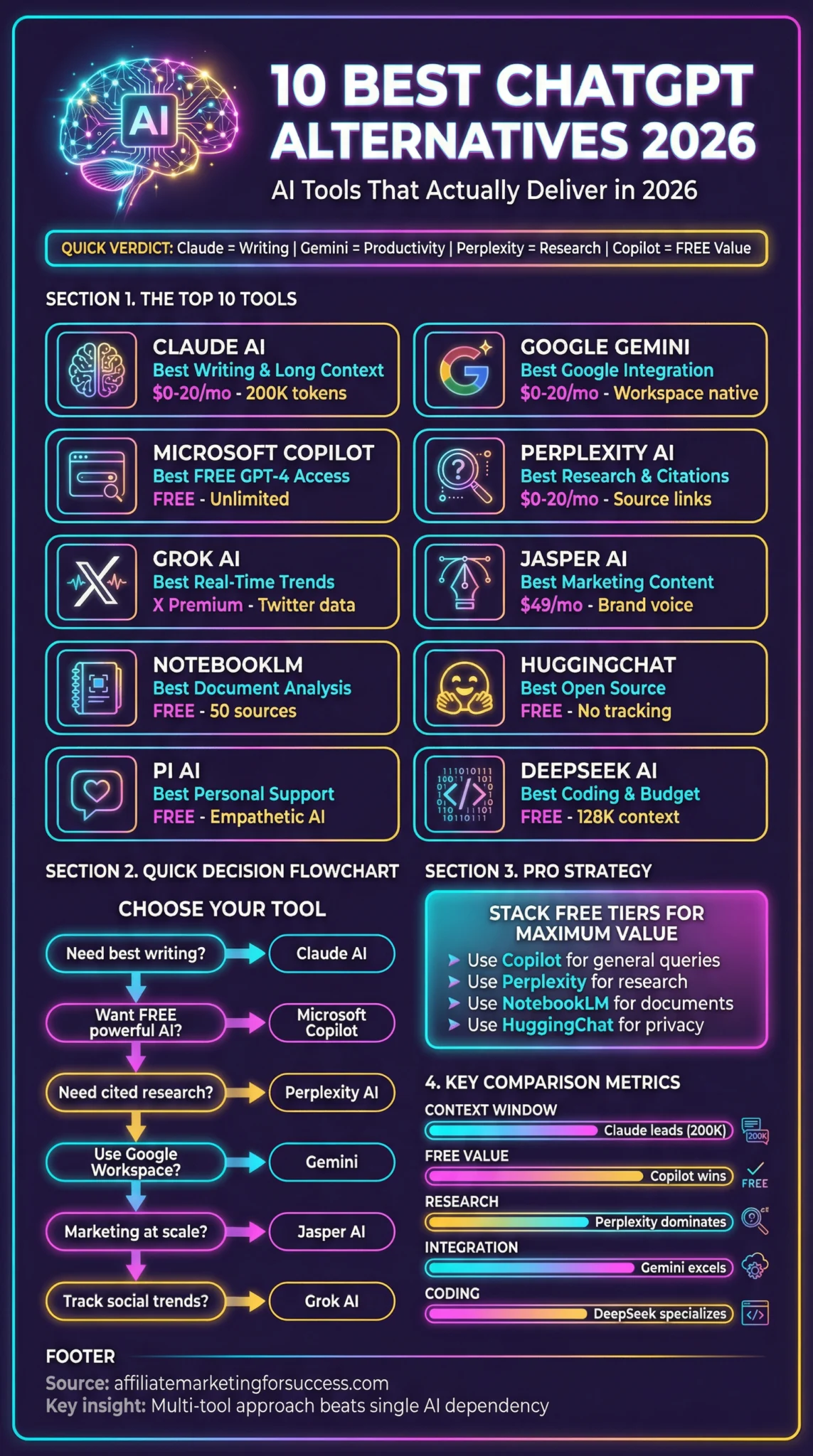
Quick Verdict
Bottom Line: Claude AI dominates for writing quality and context handling. Google Gemini wins for productivity integration. Perplexity AI is unmatched for research. Microsoft Copilot delivers the best value with free GPT-4 access. Pick based on your primary use case, not brand name.
✓ Choose Alternatives If:
- You need specialized features like research citations
- You’re integrated into Google or Microsoft ecosystems
- You want access to multiple AI models in one place
✗ Stick with ChatGPT If:
- You rely heavily on Custom GPTs and plugins
- You need consistent availability during peak hours
- You’re already comfortable with the interface
How We Selected These ChatGPT Alternatives
Every AI tool claims to be “revolutionary.” We filtered the noise by testing actual performance across criteria that matter for affiliate marketers and content creators.Our Evaluation Framework
- Response Quality: Accuracy, coherence, and depth of answers compared to ChatGPT
- Speed: Time to first token and overall response generation
- Features: Unique capabilities not available in ChatGPT (citations, integrations, specialized modes)
- Context Handling: Ability to maintain conversation coherence over extended exchanges
- Pricing: Cost-effectiveness relative to capabilities delivered
- Reliability: Uptime, rate limits, and consistency during high-demand periods
- Specialization: Performance in specific use cases (coding, research, writing, analysis)

Top 10 ChatGPT Alternatives (Detailed Reviews)
1. Claude AI: Best for Human-Like Writing and Long Context
Claude AI (Sonnet 4.5 / Opus 4.5)
Best For: Writers, researchers, and anyone working with lengthy documents or complex reasoning tasks
textWhy It Stands Out:
- 200,000 token context window – handles entire books without losing coherence
- More natural, conversational writing style that requires less editing
- Constitutional AI training for more nuanced, ethical responses
- Excels at document analysis and summarization
Consider Alternatives If:
- You need real-time internet access (Claude doesn’t browse the web)
- You require image generation capabilities
- You’re looking for a completely free option
Pricing:
Free tier available – Pro: $20/month – Max: $100/month
2. Google Gemini: Best for Google Workspace Integration
Google Gemini (Gemini 2.5 Pro)
Best For: Users deeply embedded in Google’s ecosystem who need AI integrated with Docs, Gmail, Sheets, and Drive
textWhy It Stands Out:
- Native integration with Gmail, Google Docs, Sheets, and Drive
- Real-time web access through Google Search
- Multimodal capabilities – processes text, images, and video
- Deep Research mode for comprehensive topic analysis
Consider Alternatives If:
- You primarily use Microsoft 365 instead of Google Workspace
- You need the absolute highest reasoning capability for complex tasks
- You prefer not to have your data integrated with Google’s ecosystem
Pricing:
Free tier available – Advanced: $19.99/month (includes Google One AI Premium with 2TB storage)
3. Microsoft Copilot: Best Free Access to GPT-4 Technology
MICROSOFT
Microsoft Copilot
Best For: Anyone wanting free access to GPT-4 level AI, or Microsoft 365 users needing productivity integration
textWhy It Stands Out:
- Completely free access to GPT-4o and DALL-E 3
- Integration with Word, Excel, PowerPoint, Outlook, Teams
- Think Deeper reasoning mode (now free for all users)
- Real-time web search through Bing
Consider Alternatives If:
- You need extended context windows beyond standard limits
- You require citation-heavy research capabilities
- You want more natural conversational writing style
Pricing:
Free (unlimited) – Copilot Pro: $20/month for priority access
4. Perplexity AI: Best for Research and Citations
PERPLEXITY
Perplexity AI
Best For: Researchers, students, journalists, and anyone who needs accurate information with verifiable sources
textWhy It Stands Out:
- Every answer includes citations with links to original sources
- Real-time web search integrated into every response
- Access to multiple AI models (Claude, GPT-4, Gemini) in one interface
- Search visualization shows exactly which sites were consulted
Consider Alternatives If:
- You primarily need creative writing without research
- You want image generation capabilities
- You’re on a very tight budget (free tier limits searches)
Pricing:
Free (limited searches) – Pro: $20/month – Max: $200/month
5. Grok AI: Best for Real-Time Social Insights
XAI (ELON MUSK)
Grok AI (Grok 4)
Best For: Social media marketers, trend analysts, and anyone needing real-time insights from X (Twitter)
textWhy It Stands Out:
- Direct access to real-time X (Twitter) data and trending topics
- Witty, personality-driven responses with less corporate filtering
- DeepSearch feature for comprehensive topic analysis
- Free tier available (5 queries per 12 hours)
Consider Alternatives If:
- You need formal, corporate-appropriate responses
- You want extensive free tier usage limits
- X (Twitter) isn’t relevant to your research needs
Pricing:
Free tier – X Premium: Enhanced limits – X Premium+: Maximum access
6. Jasper AI: Best for Marketing Content and Brand Voice
Jasper AI
Best For: Marketing teams, agencies, and content creators who need on-brand copy at scale
textWhy It Stands Out:
- 50+ copywriting templates for specific marketing use cases
- Brand voice customization maintains consistent tone across all content
- SEO mode integrates keyword research and optimization
- Team collaboration features with shared workspaces
Consider Alternatives If:
- You’re a solo entrepreneur watching budget carefully
- You need advanced coding or technical capabilities
- You prefer simple, no-frills interfaces
Pricing:
7-day free trial – Creator: $49/month – Teams: $125/month – Business: Custom
7. NotebookLM: Best for Document Analysis and Research
NotebookLM
Best For: Researchers, students, and professionals who work with large document collections
textWhy It Stands Out:
- Source-grounded responses – only generates answers from uploaded documents
- Supports up to 50 sources per notebook (PDFs, URLs, YouTube, audio)
- Every response includes citations pointing to specific sources
- Powered by Gemini 2.5 for superior document comprehension
Consider Alternatives If:
- You need general knowledge AI without uploading documents
- You want conversational chat without research focus
- You need code generation capabilities
Pricing:
Free tier (100 notebooks, 50 sources each) – Paid tiers through Google One AI Premium
8. HuggingChat: Best Open-Source Alternative
HUGGING FACE
HuggingChat
Best For: Developers, privacy advocates, and users who want free, transparent AI without corporate restrictions
textWhy It Stands Out:
- Completely free with unlimited usage
- Multiple open-source models (Llama, Mistral, DeepSeek, Mixtral)
- Transparent architecture – view and modify source code
- No data logging or privacy concerns
Consider Alternatives If:
- You need the absolute highest quality responses
- You want polished user interface and customer support
- You require guaranteed uptime and reliability
Pricing:
Completely free with unlimited access
9. Pi AI: Best for Personal Companionship and Support
INFLECTION AI
Pi AI
Best For: Users seeking empathetic AI for brainstorming, emotional support, or casual conversation
textWhy It Stands Out:
- Designed specifically for empathetic, supportive conversations
- Natural voice interaction with multiple voice options
- Learns your preferences and adapts over time
- Completely free with no usage limits
Consider Alternatives If:
- You need task-focused productivity features
- You require technical accuracy for research or coding
- You want integration with other tools and platforms
Pricing:
Completely free
10. DeepSeek AI: Best for Coding and Cost-Efficiency
DEEPSEEK
DeepSeek AI
Best For: Developers, technical users, and anyone needing powerful AI on a budget
textWhy It Stands Out:
- Exceptional performance in coding and technical tasks
- 128K token context window for handling large codebases
- Open-weight model architecture for transparency
- Significantly lower cost than comparable models
Consider Alternatives If:
- You primarily need creative writing capabilities
- You want mainstream brand recognition and support
- You require extensive non-English language support
Pricing:
Free tier available – API pricing significantly lower than competitors
Comparison: Which ChatGPT Alternative Is Right for You?
🎯 Quick Decision Map
Don’t waste time. Here’s the fastest path to the right choice:
How to Choose the Right ChatGPT Alternative
Stop picking AI tools based on hype. Here’s how to make a decision that actually improves your workflow.1. Define Your Primary Use Case
Generic “I need AI” isn’t specific enough. Are you writing long-form product reviews? Conducting competitive research? Analyzing customer data? Creating social media content? The right tool depends entirely on your dominant use case. If 70% of your AI usage is research, optimize for that with Perplexity or NotebookLM. Don’t choose based on secondary features you’ll rarely use.2. Evaluate Your Existing Ecosystem
Integration friction kills productivity. If you live in Google Workspace, Gemini’s native integration eliminates constant copy-pasting. Microsoft 365 users gain massive value from Copilot. Trying to force a tool that doesn’t play well with your existing stack creates more problems than it solves.3. Consider Budget Realistically
Free tiers exist for a reason—use them. Microsoft Copilot and HuggingChat provide capable AI at zero cost. Unless you’re hitting clear limitations in free tools, upgrading to $20/month plans is premature. Start free, identify specific bottlenecks, then pay to solve those exact problems.4. Test Response Quality on Your Content
Don’t rely on benchmarks. Take a real task from your workflow—a product comparison, market research query, or content outline—and run it through multiple tools. Judge based on actual output quality for your specific needs, not theoretical capabilities or marketing claims.5. Assess Unique Capabilities
Some features can’t be replicated. Claude’s 200K context window enables document analysis impossible elsewhere. Perplexity’s citation system is unmatched for fact-checking. Grok’s X integration provides unique real-time data. If a tool offers something genuinely unique that solves your problem, that single feature might justify the choice.Maximizing Value from ChatGPT Alternatives
Having the right tool means nothing if you don’t use it effectively. Here’s how affiliate marketers are actually leveraging these alternatives for competitive advantage.Strategy 1: Stack Multiple Free Tiers
You don’t need to choose just one. Use Microsoft Copilot for general queries, Perplexity for research, HuggingChat for privacy-sensitive tasks, and NotebookLM for document analysis. Most offer generous free tiers. Running the same prompt through Claude and GPT-4 (via Copilot) shows you different angles on the same problem.Strategy 2: Master Prompt Engineering for Each Tool
Different models respond differently to the same prompt. Claude prefers conversational requests. Perplexity excels with research-focused queries. Gemini works better with structured instructions. Tailoring your prompt engineering techniques to each tool’s strengths dramatically improves results.Strategy 3: Use Specialized Tools for Specialized Tasks
Stop trying to make one AI do everything. Use Jasper for initial content drafts, Perplexity for fact-checking, Claude for editing and refinement, and NotebookLM for competitive analysis. This assembly-line approach produces better results faster than forcing a single tool to handle every stage.Strategy 4: Leverage Unique Data Access
Grok’s X integration and Gemini’s Google Search access provide information other tools literally can’t access. Use these for real-time trend analysis, breaking news, or recent product launches. Pair this current data with Claude’s reasoning for comprehensive analysis that combines recency with depth.Strategy 5: Build Custom Workflows
The most sophisticated users aren’t using AI tools in isolation. They’re building workflows where Perplexity conducts initial research, NotebookLM analyzes competitor content, Claude drafts the article, and Gemini optimizes for SEO. Automation tools like Make or Zapier can connect these pieces into seamless pipelines.Common Mistakes When Switching from ChatGPT
These traps catch almost everyone. Avoid them.Expecting Identical Behavior
Claude, Gemini, and others aren’t “ChatGPT clones.” They have different strengths, response styles, and optimal use cases. The prompt that works perfectly in ChatGPT might produce mediocre results elsewhere. Adapt your approach to each tool’s characteristics.
Choosing Based on Brand Recognition
The “best” AI tool isn’t necessarily from the biggest company. HuggingChat and DeepSeek lack Google or Microsoft’s marketing budgets but excel at specific tasks. Evaluate based on capabilities, not corporate logos.
Ignoring Free Tiers
Microsoft Copilot provides free GPT-4 access. HuggingChat is unlimited and free. Pi AI costs nothing. Before paying $20-200/month, exhaust the free options. Many users discover free tools handle 80% of their needs.
Tool Hopping Without Testing
Switching tools weekly because someone said “X is better” prevents you from mastering any single tool. Pick 2-3 alternatives, commit to 30 days of focused use, then evaluate. Shallow testing of dozens of tools yields worse results than deep expertise in a few.
Neglecting Privacy Implications
Not all AI tools handle data identically. Some train on your inputs, others don’t. If you’re inputting proprietary business data, competitor research, or customer information, understand each tool’s data policy. HuggingChat and DeepSeek offer more transparency than closed models.
Overlooking Context Limits
Claude’s 200K tokens handle entire books. Standard models max out at 8K-32K. If you’re analyzing lengthy documents or maintaining complex multi-turn conversations, context window size matters enormously. This single spec can make or break your use case.
Frequently Asked Questions
The Future of ChatGPT Alternatives
The AI landscape won’t stabilize anytime soon. Understanding emerging trends helps you make forward-looking decisions rather than constantly switching tools. Specialized models are winning. The era of one AI tool for everything is ending. Companies are building focused tools optimized for specific use cases—Perplexity for research, Jasper for marketing, NotebookLM for documents. This specialization produces better results than trying to force generalist models into narrow tasks. Multimodal capabilities are table stakes. Text-only AI is already outdated. 2026’s competitive models handle text, images, audio, and video seamlessly. Google Gemini’s integration across formats and Grok’s real-time data access represent the baseline, not premium features. Expect this integration to deepen as models understand context across modalities. Open-source is closing the gap. The performance delta between proprietary models (GPT-4, Claude) and open-source alternatives (Llama, Mistral, DeepSeek) shrinks quarterly. While cutting-edge capabilities still require commercial models, open-source delivers 80% of the utility at 0% of the cost for many use cases. Privacy and transparency matter more. As AI embeds deeper into workflows, data policies become critical. Tools like HuggingChat and DeepSeek that provide transparency about training data, model architecture, and data handling gain traction with enterprise users and privacy-conscious individuals. Integration trumps raw capability. The best AI model that doesn’t integrate with your workflow loses to a slightly worse model that plugs seamlessly into tools you already use. Gemini’s Google Workspace integration and Copilot’s Microsoft 365 native features create friction advantages that raw performance scores don’t capture.Final Verdict: Which ChatGPT Alternative Should You Choose?
✓ The Honest Recommendation
Don’t choose one. Use 2-3 tools optimized for different tasks:
- Primary workhorse: Microsoft Copilot (free GPT-4 access) or Claude (superior writing quality)
- Research and fact-checking: Perplexity AI for cited, verifiable information
- Specialized tasks: NotebookLM for documents, Jasper for marketing, DeepSeek for coding
This multi-tool approach costs nothing (using free tiers) or $20-40/month (if you upgrade primary tools), delivers better results than relying solely on ChatGPT, and provides redundancy when any single service experiences downtime.
📚 Sources & References
Official resources and additional reading:
- Anthropic Claude Official Documentation Comprehensive guide to Claude AI capabilities and pricing
- Google Gemini Official Site Google’s multimodal AI assistant documentation
- Perplexity AI Official Website Answer engine with citation-based research capabilities
- NotebookLM by Google AI-powered research assistant with source grounding
- HuggingChat by Hugging Face Open-source AI chatbot with multiple model options
Written By
Alexios Papaioannou
Affiliate marketing specialist helping entrepreneurs build profitable online businesses through AI-powered strategies and data-driven decision making.
Last Updated: January 14, 2026
Our Editorial Standards:
- No paid placements or rankings
- We never claim to test products we haven’t personally evaluated
- All affiliate relationships are clearly disclosed
- Facts are verified against official sources

I’m Alexios Papaioannou, an experienced affiliate marketer and content creator. With a decade of expertise, I excel in crafting engaging blog posts to boost your brand. My love for running fuels my creativity. Let’s create exceptional content together!