ChatGPT Prompts for Affiliate Marketing: 50 Practical Workflows for SEO, Reviews, Email, and Content Refreshes
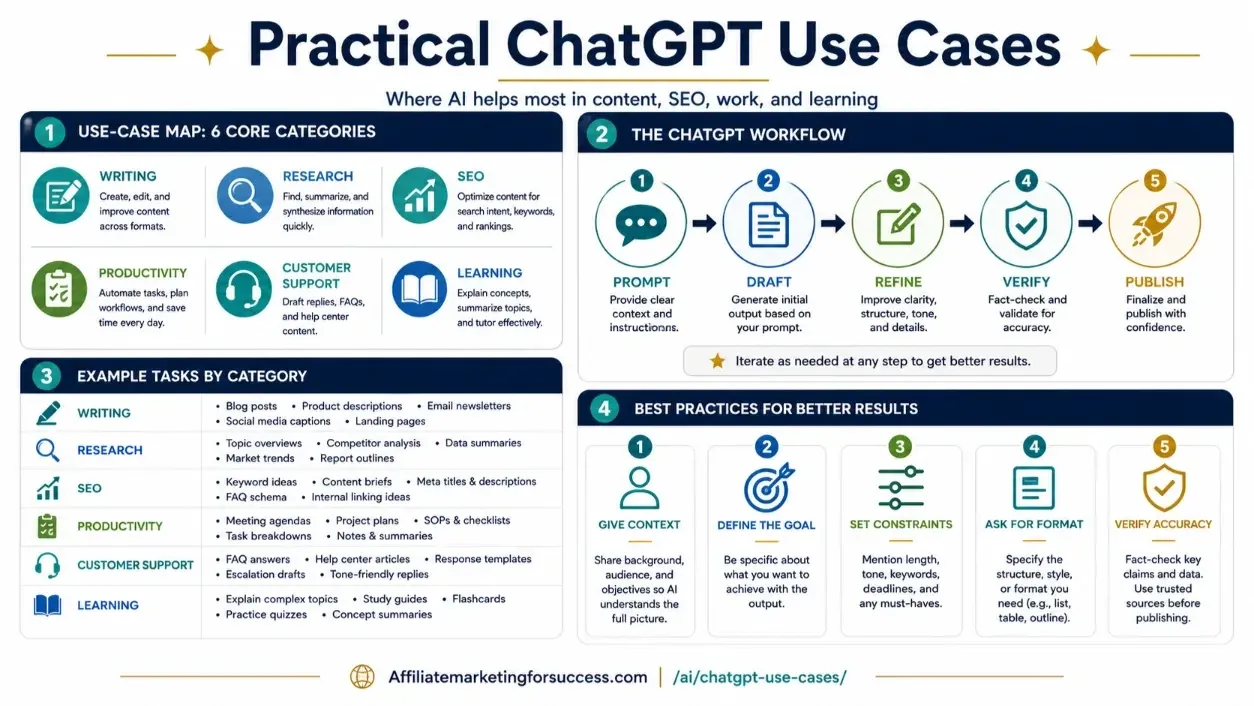
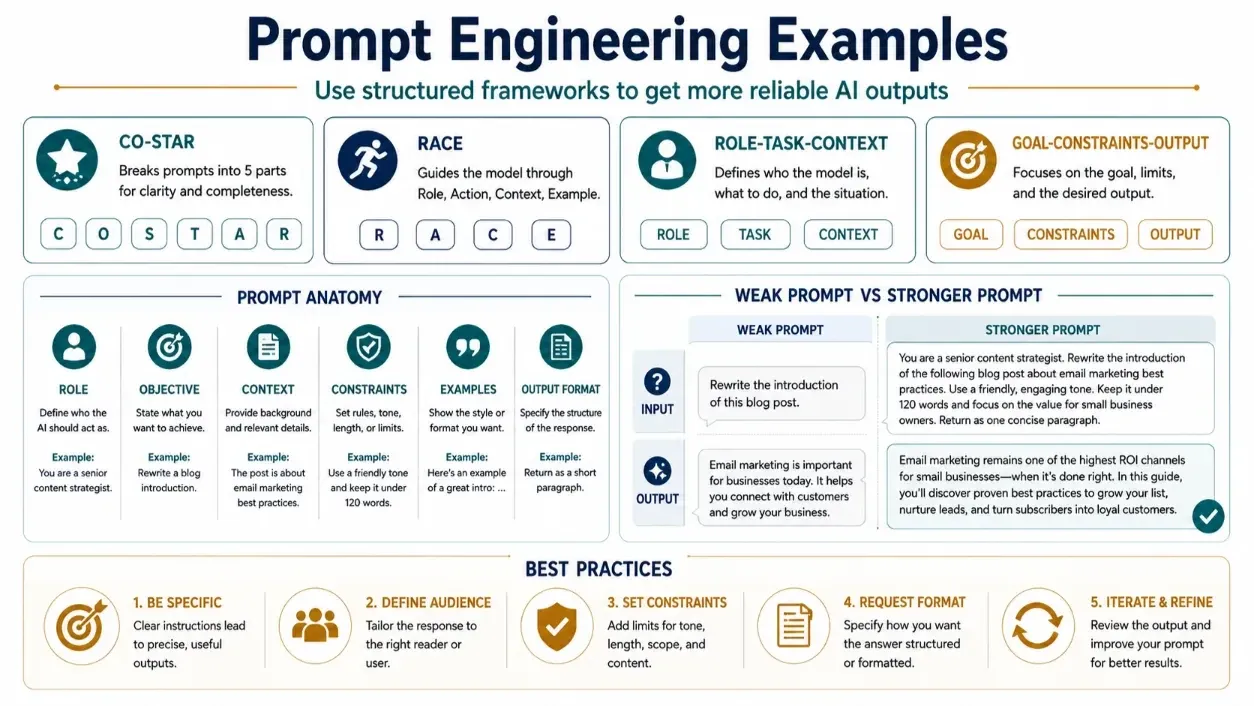
These prompts are not magic formulas. They are structured frameworks that help you do affiliate content work faster and more consistently. Each prompt below includes a use case, the exact prompt to paste, required inputs, what good output looks like, common mistakes, and a human review checklist.
1. Niche Research Prompts
I am considering building a content site about [niche]. I want to understand: (1) the main sub-topics and questions people search for, (2) the types of products available with affiliate programs, (3) how competitive the search results are for “[primary keyword]”. Give me a structured overview without making income claims.
- Required inputs: Your niche topic, primary keyword, one product you could promote
- Good output: A topic cluster map, a list of search intent types, a note on competitive density
- Common mistake: Accepting the output as the final word — always verify keyword data in a real SEO tool
- Human review: Does the niche feel real to you? Are there products you could honestly test?
2. SERP Intent Analysis Prompts
Here are the titles and URLs of the top 10 results for “[keyword]”: [paste titles]. Analyse the intent behind these results. What does Google seem to reward? What questions remain unanswered? What content angle is missing from the current results?
- Required inputs: Top 10 page titles from the SERP for your target keyword
- Good output: Intent type classification (informational/navigational/commercial/transactional), content gaps, angle opportunities
- Common mistake: Assuming the AI knows the actual content quality — it only sees titles
- Human review: Open the top 3 pages yourself. Does the gap analysis match what you see?
3. Review Article Outline Prompts
Create a detailed outline for an honest product review of [product name]. The review is for [target audience]. I have tested [specific things you tested]. I want the outline to cover: key buying criteria, a pros and cons section based on verified experience, a comparison section with at least one competitor, a “best for” recommendation, and a clear verdict. Do not invent pricing or performance data — I will provide that from my own testing.
- Required inputs: Product name, target audience, what you tested, at least one competitor product
- Good output: A logical outline with clear sections, buying criteria that match what your audience actually cares about
- Common mistake: Using the outline without filling in real test data — a review without personal experience fails E-E-A-T requirements
- Human review: Have you actually tested the product? Can you back up every claim in the outline?
4. Comparison Table Prompts
Create a comparison table framework for [Product A] vs [Product B] vs [Product C]. The audience is [audience]. Include these comparison criteria: [list criteria]. Mark each cell as “[verified]”, “[needs testing]”, or “[N/A]”. The “[verified]” cells are where I have personal experience; I will fill those in from my own testing.
- Required inputs: 2-3 products to compare, your audience type, specific comparison criteria you care about
- Good output: A table structure with all criteria mapped to products, honest gaps marked
- Common mistake: Leaving “[needs testing]” cells empty or filling them with unverified information
- Human review: Have you tested all marked “[verified]” cells? Can you confirm the data is accurate?
5. Product Proof Checklist Prompts
Review this product review content: [paste your draft]. Check it against these E-E-A-T criteria: (1) does it demonstrate first-hand experience with the product, (2) is expertise clearly attributed, (3) is the comparison data verifiable, (4) are affiliate links clearly disclosed, (5) does the recommendation section clearly state who the product is best for and who should avoid it? Flag any gaps with specific suggestions.
- Required inputs: Your draft review content in full
- Good output: A section-by-section E-E-A-T audit with specific improvement suggestions
- Common mistake: Accepting the audit without cross-checking against Google’s actual E-E-A-T guidance
- Human review: Does the audit miss anything you know about the product from your own testing?
6. Internal Linking Prompts
Here are my 5 existing blog posts with their topics and target keywords: [paste post titles and topics]. I want to add 2-3 internal links from my new post, “[new post title]”, to these existing posts. Suggest specific anchor text and placement for each link. Only suggest links that feel natural within the context of the new post’s content.
- Required inputs: Your new post title and a brief description, plus 3-5 existing post titles
- Good output: Specific anchor text and context for each suggested link
- Common mistake: Forcing links that do not fit naturally — Google’s algorithm detects this
- Human review: Does the suggested link actually appear naturally in your new post?
7. AEO and GEO Answer Block Prompts
Here is a section of my article about [topic]: [paste section]. Rewrite it as a direct, factual answer suitable for a featured snippet or People Also Ask box. The answer should be 40-60 words, state a clear fact, and use a simple sentence structure. Do not add information I have not verified.
- Required inputs: The specific section of your article you want to optimise
- Good output: A concise, factual 40-60 word answer block
- Common mistake: Including claims the AI generates that you cannot back up with sources
- Human review: Is the rewritten answer factually accurate? Can you link to the source?
8. Email Capture and Newsletter Prompts
Write a newsletter email promoting [product name] to my [newsletter audience description]. The email should: open with a relatable problem my audience faces, introduce the product as a solution I have genuinely used, explain why I recommend it specifically for this audience, include one honest caveat or limitation, and end with a clear CTA linking to [affiliate link]. Keep it under 300 words. I am disclosing this as an affiliate link.
- Required inputs: Product name, affiliate link, your audience description, one honest limitation of the product
- Good output: A 250-300 word email that reads as helpful, not salesy
- Common mistake: Writing something that sounds like an advertisement rather than a genuine recommendation
- Human review: Have you actually used this product? Does the caveat feel genuine?
9. Content Refresh Prompts
Here is my existing article about [topic], published [year]: [paste article]. Identify which sections are likely outdated based on current search intent. For each outdated section, suggest: what has changed, what new information should replace it, and a specific sentence I can add to signal the update to readers. Do not invent new facts.
- Required inputs: Your full article, publication year, a link to your update source
- Good output: Section-by-section analysis of what is outdated and how to update it
- Common mistake: Accepting new claims from the AI without verifying them against real sources
- Human review: Does the update suggestion actually reflect what your source says?
10. Affiliate Disclosure and Compliance Prompts
Draft an FTC-compliant affiliate disclosure for my page about [topic]. I earn a commission when readers click links to [product/program name] and make a purchase. The disclosure should: appear near the top of the content, be written in plain language, make clear that I earn commission at no extra cost to the reader, and link to the FTC guidelines page. Keep it under 50 words.
- Required inputs: Product or program name, placement of your CTA links
- Good output: A short, plain-language disclosure that satisfies FTC requirements
- Common mistake: Burying the disclosure at the bottom of the page — it must be visible near the top
- Human review: Does this disclosure appear where you plan to put it? Has it been reviewed by a legal professional for your jurisdiction?
Lead Magnet: Download the Affiliate SEO Prompt Bank
Want all 50 prompts in one document?
Get the full Affiliate SEO Prompt Bank as a downloadable resource — organised by workflow, with inputs, output criteria, and human review checklists for each prompt.
Download the Affiliate SEO Prompt Bank
No spam. One email with the download link. Unsubscribe anytime.
Frequently Asked Questions
Can I use these prompts to generate full articles automatically?
No — and you should not try. These prompts are workflow accelerators, not article generators. Full AI-generated articles without human expertise, personal testing, and editorial review fail Google’s helpful content requirements and will not rank consistently. Use these prompts to structure research and outlines, then write and fact-check the final content yourself.
Do I need ChatGPT Plus to use these prompts?
No. All prompts in this guide work with the free version of ChatGPT. Some work equally well in Claude, Gemini, or other LLMs. The output quality depends more on the specificity of your inputs and your human review than on which model you use.
How do I know if AI-generated content will hurt my SEO?
Google’s guidance is clear: AI-assisted content is not automatically penalized, but content generated without genuine expertise, experience, or original insight is unlikely to rank well. The test is simple: if you removed the AI, would the content still demonstrate your expertise and provide value a human expert could not? If yes, it is helpful content. If not, it is not.
How often should I refresh content using these prompts?
Review your top 10 pages by traffic every 6 months. Check whether product information, pricing, or competitive data has changed. If any section is outdated, use the content refresh prompt to identify what needs updating. Add an “updated” note to the page and, if possible, reference the source of your update.
How This Guide Was Created
These prompts were created by testing and refining AI workflows against real affiliate content production needs. Each prompt was evaluated for accuracy of structure, specificity of inputs, and whether it produces output that requires human verification. No AI output in this guide was published without human review.
Sources
- Google Search Central — Creating Helpful, People-First Content
- Google Search Central — AI-Generated Content Guidance
- FTC — Affiliate Marketing Disclosure Requirements

Alexios Papaioannou is the founder and lead editor of Affiliate Marketing for Success. He focuses on affiliate marketing systems, SEO, content strategy, monetization design, and the impact of AI-driven search on publishers. Editorial background, disclosure standards, and correction policy are documented on the site’s About Alexios and Editorial Policy pages.