
Impact Affiliate Network Review 2026: Is impact.com Worth It for Publishers?
The short answer: Yes — impact.com is one of the strongest affiliate marketing networks for publishers in 2026. It is free to join, hosts 5,000+ brands including Walmart, Uber, Shopify, and Lenovo, consolidates all your brand payouts into one payment with a low minimum (reported around $10–$50 depending on payout method), and gives you direct relationships with advertisers instead of opaque sub-network deals. The catch: every brand sets its own commission terms and approval bar, so your results depend heavily on which programs you get into.
Key takeaways
- Free for publishers — only brands pay for the platform. Signing up and joining programs costs you nothing.
- 5,000+ brands, $110B+ in annual GMV — one of the largest affiliate networks by enterprise-brand volume.
- One consolidated payout from a low minimum balance (reported ~$10–$50 depending on payout method), instead of waiting on each brand separately.
- Customizable contracts per brand — you can negotiate terms, promo codes, and flat-fee placements directly.
- Approval is per program — getting into impact.com does not mean getting into every brand program on it.
Choosing between affiliate networks is one of the first strategic decisions a publisher makes — and it shapes which brands you can promote, how you get paid, and how much control you have over your partnerships. impact.com (formerly Impact Radius) has spent nearly two decades repositioning itself as something broader than a classic network: a partnership-management platform where brands run their own programs and publishers plug in directly.
This review breaks down exactly what that means for you as a publisher in 2026: how the platform works, what it costs (nothing, for publishers), how payouts and tracking work, how it stacks up against other affiliate marketing networks like Awin and ShareASale, and whether it is worth joining for your kind of site. If you have ever wondered whether the biggest affiliate marketing platforms are reserved for large media companies, this guide will show you exactly where a solo publisher or small content team fits in — and how to get the most out of the network once you are inside.
What is impact.com, exactly?
impact.com is a partnership-management platform founded in 2008 in Santa Barbara, California, originally under the name Impact Radius. Its founders were veterans of Commission Junction, and they built impact.com around a simple thesis: brands should be able to run affiliate, influencer, and referral programs directly with partners, on one platform, with full visibility into every relationship.
Today the company describes itself as the infrastructure for partnership-driven commerce, with three product lines: Performance (traditional affiliate programs), Creator (influencer partnerships), and Advocate (customer referrals). For publishers, the Performance side is what matters most — it is where thousands of affiliate marketing programs live, from retail giants to SaaS companies.
Scale-wise, the numbers are striking. According to the company’s own 2026 figures, over 5,000 global brands — including Walmart, Uber, Shopify, Lenovo, L’Oréal, and Fanatics — use impact.com to power a stated 2 million+ partnerships, generating over $110 billion in annual gross merchandise value. (The company’s FY2025 year-end release separately reported ~350,000 active partnerships — these figures use different definitions.) That puts it in the top tier of affiliate marketing networks by enterprise-brand volume, well beyond niche or coupon-only networks.
How impact.com works for publishers
If you are new to how an affiliate network works, the journey on impact.com follows five steps:
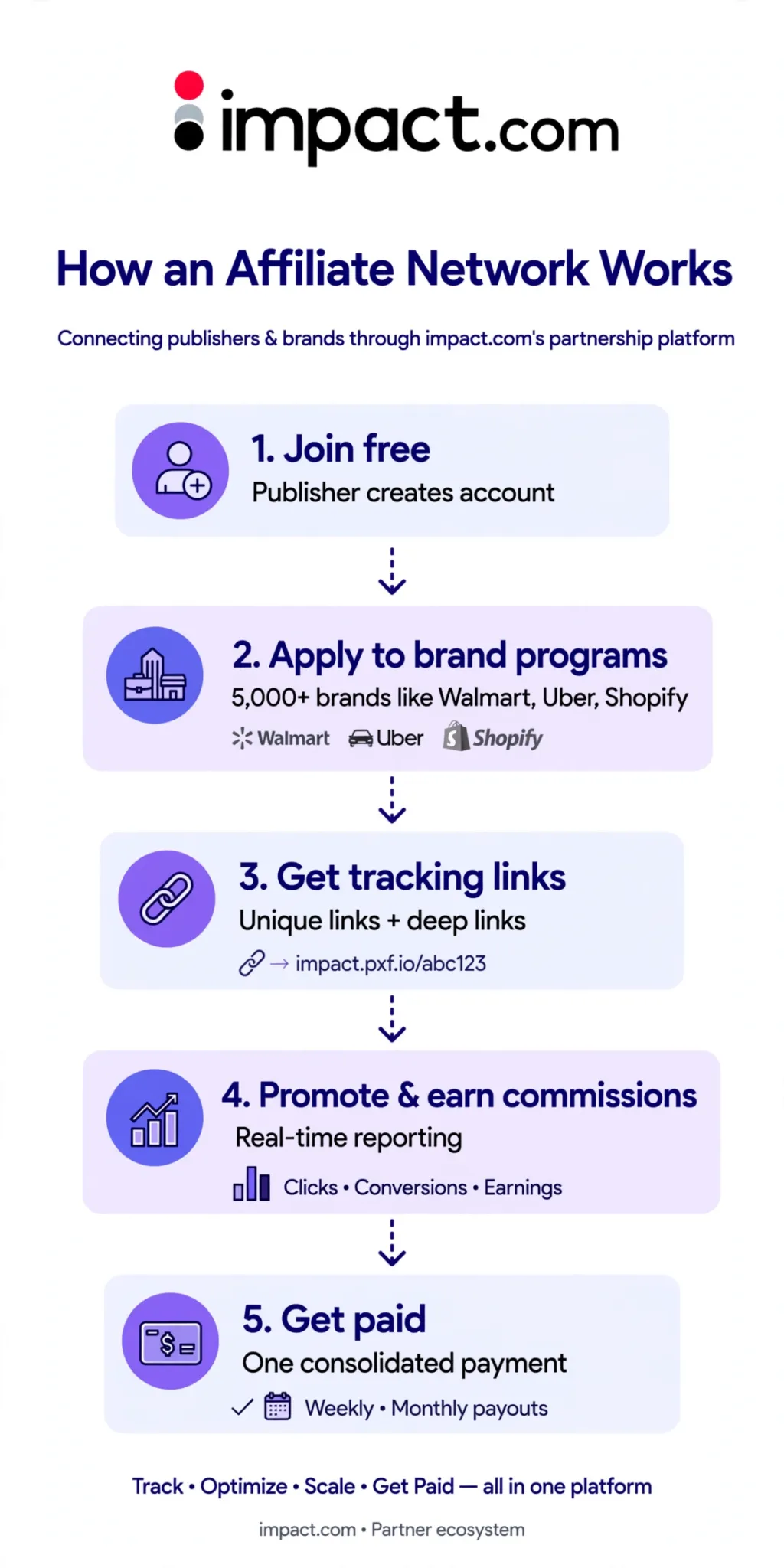
- Create your publisher account. Sign up is free and asks about your promotional methods — website, social, email, paid media — so brands can vet fit.
- Browse the marketplace and apply to brand programs. Each brand sets its own terms, commission rates, cookie windows, and approval criteria. You apply per program, and brands accept or decline individually.
- Generate tracking links and deep links. Once approved, you pull unique tracking links for any page on the advertiser’s site — no waiting for creative uploads.
- Promote and monitor. Clicks, conversions, and commissions show up in real-time reporting. You can watch which content drives revenue and renegotiate terms with brands that perform.
- Get paid in one consolidated payment. Instead of collecting small checks from dozens of brands, impact.com pools your earnings and pays you once your balance clears a low $10 minimum.
This is the fundamental difference from old-school networks: you hold direct relationships with each brand. Terms are visible, negotiable, and enforceable per contract — which also means more diligence is required on your side. Our guide to getting approved for affiliate programs covers how to present your site to raise your acceptance rate.
The publisher dashboard and brand marketplace
The publisher experience inside impact.com revolves around two screens: your performance dashboard and the brand marketplace. The platform interface is built around task management, brand applications, and approval workflows — you can see pending brand applications, tasks like “put together special terms for this partner,” and approval queues all in one place.
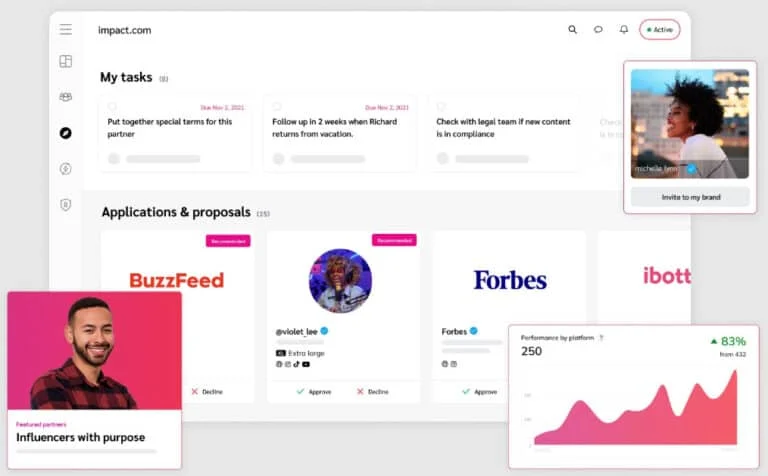
The discovery side lets you filter creators, brands, and programs — with retail preferences listing recognizable names like Walmart and Adidas — and reach out to brands with campaign or survey invitations. For a publisher, the equivalent view is the marketplace: searchable brand programs with terms, commission rates, and EPC data visible before you apply.
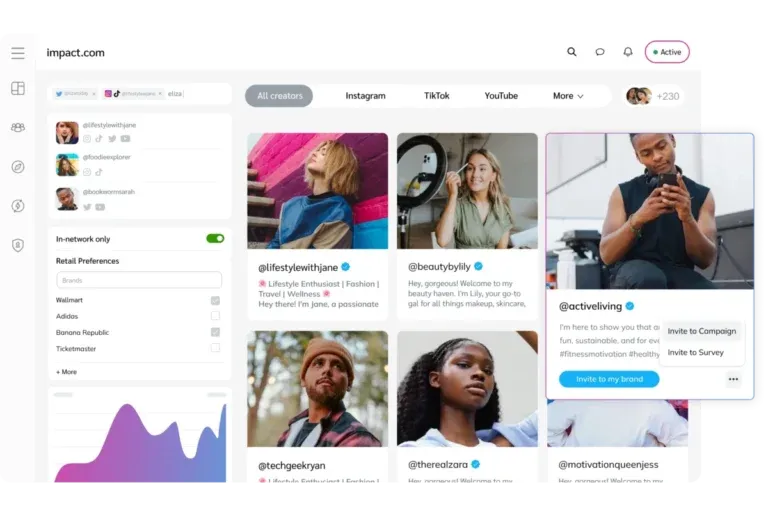
Two things stood out to me when I mapped the publisher dashboard against our rubric: the depth of the contracting workflow (you are not just grabbing links, you are entering agreements), and the granularity of the reporting. Both are strengths if you treat affiliate partnerships as a business, and both can feel like overhead if you just want quick links.
Commission structures and contract terms
There is no single “impact.com commission rate” — every brand sets its own structure, which can include:
- Percentage-of-sale CPA — the classic model, varying widely by vertical (retail often 1–5%, SaaS and software often 20–50% recurring).
- Flat-fee per action — common for lead generation, free-trial signups, and app installs.
- Custom or tiered terms — brands can offer you exclusive promo codes, boosted rates for top performers, or bonuses for hitting volume thresholds.
- Mixed flat-fee + commission — increasingly common with creator-style placements, where a sponsorship fee pairs with a performance kicker.
Because terms are contract-based, you can propose custom arrangements once you have traffic. This is where impact.com beats networks that hide advertisers behind fixed, take-it-or-leave-it terms: the platform is explicitly designed for negotiation. If a brand’s program underperforms at the listed rate, you contact the program manager with evidence and ask for better terms — a skill worth building, since it compounds across every network you join.
Reality check: big-brand programs on impact.com often have strict approval bars — established sites, relevant traffic, quality content. New publishers should apply to mid-size programs first to build a track record inside the platform, then work up to the marquee brands.
Commission calculator: estimate your impact.com earnings
Plug in rough numbers to see what a typical month could look like. This is an estimate, not a promise — every brand sets its own rates and validation rules.
Estimated monthly earnings: $400.00
Estimated yearly earnings: $4800.00
The math: monthly = sales × average commission; yearly = monthly × 12. Real payouts also depend on each brand’s validation lock, reversal rate, and the payout minimum in your account.
Tracking, attribution, and reporting
Tracking is impact.com’s heritage strength, and it shows. The platform’s affiliate tracking software includes:
- Universal tracking tag — one tag deployed by the brand tracks across the customer journey rather than relying solely on cookies.
- Cross-device attribution — clicks that start on mobile and convert on desktop still credit your account, which matters enormously as cookie-based tracking degrades.
- Real-time reporting — clicks, conversions, reversals, and payouts visible in near real time, with sub-ID support so you can tag links per page, campaign, or placement.
- Fraud monitoring — automated detection of suspicious traffic patterns, which protects both your commissions and the brands you promote.
In practical terms, this means fewer “my click didn’t track” headaches than on older cookie-only networks. The reporting depth also feeds a smarter workflow: you can see exactly which article drives revenue and double down on it. If you are still planning your content map, our list of the first 10 affiliate blog posts to write pairs well with sub-ID tracking — each post gets its own tag.
Payouts: how and when publishers get paid
Payouts are one of impact.com’s clearest advantages over juggling multiple independent affiliate marketing programs:
| Payout factor | How impact.com handles it |
|---|---|
| Minimum balance | Low — reported between ~$10 and $50 depending on source and payout method (verify the current figure in your account’s Payment Settings, as thresholds can vary) |
| Payment method | Bank transfer / ACH, PayPal, depending on region |
| Schedule | Typically twice monthly; exact payout dates and lock periods can vary by advertiser |
| Consolidation | One combined payment across all your brand earnings — no per-brand minimums |
| Currencies | Multi-currency support for international publishers |
The consolidation point deserves emphasis. On networks where each brand pays separately, small publishers can have earnings trapped below per-brand thresholds for months. impact.com pools everything, so a $4 commission from one brand and $8 from another combine toward the same payout. This is a genuine quality-of-life difference for publishers promoting a broad mix of programs.
Does it have the brands you need?
A network is only as useful as its roster. impact.com’s marketplace skews toward established, recognizable brands — the 5,000+ advertiser list includes Walmart, Uber, Shopify, Lenovo, L’Oréal, and Fanatics, alongside thousands of mid-size retailers, travel companies, financial services, and SaaS vendors.
That skew is a double-edged sword:
- Pro: big brands convert. Readers already trust them, which lifts click-through and conversion rates on review and comparison content.
- Con: big brands are selective. Approval often requires an established site with relevant, quality content — and some programs restrict promotional methods (no coupon sites, no paid search on brand terms).
Before committing your content calendar, search the marketplace for your niche’s key advertisers and read each program’s terms and creative guidelines. A close audience fit at a mid-size brand consistently outperforms a marquee logo with weak relevance — and if your niche is beginner-friendly programs, start with our roundup of the best affiliate programs for beginners.
impact.com vs other affiliate marketing networks
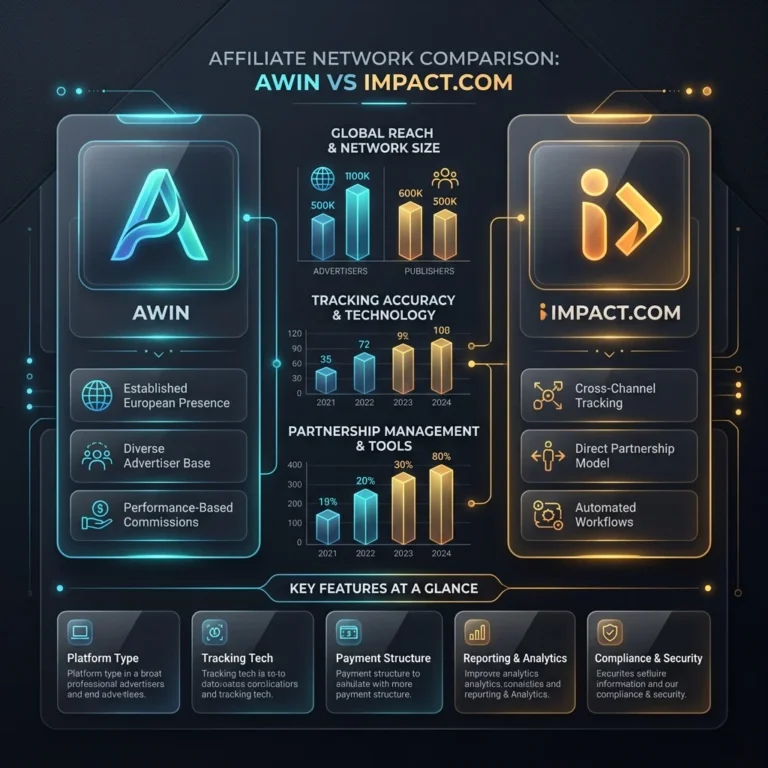
How does impact.com stack up against the other major affiliate marketing networks? The short version: it is the most brand-direct and enterprise-heavy of the big four, with the strongest tracking and the most negotiable terms — at the cost of a steeper learning curve than plug-and-play networks.
| Factor | impact.com | Awin | ShareASale (Awin) |
|---|---|---|---|
| Publisher cost | Free | Free | Free |
| Payout threshold | Low (~$10–$50 reported) | €20 per region | $50 |
| Payment schedule | Typically twice monthly | Twice monthly | Monthly (20th) |
| Brand relationship | Direct contracts, negotiable terms | Direct, some negotiation | Direct, mostly fixed terms |
| Tracking depth | Cross-device, universal tag, real-time | Strong, cross-device | Solid, less granular |
| Brand roster skew | Enterprise / big brands | Broad, strong in EU/retail | Broad, strong in SMB |
Note: terms, thresholds, and schedules can change — always confirm current figures inside your account before planning around them. For a deeper head-to-head with its closest rival, see our Awin vs impact.com comparison.
Is impact.com free for publishers?
Yes. Joining impact.com as a publisher, browsing the marketplace, applying to programs, generating links, and receiving payouts all cost nothing. The platform’s revenue comes from brands, which pay subscription and transaction fees for the partnership-management software. This is the standard model across major affiliate networks: publishers are the supply, and the network monetizes the demand side.
Your real costs are the ones every affiliate business carries regardless of network — content creation, traffic acquisition, tools, and your time. If someone asks you to pay a fee to join impact.com as a publisher, you are not on the real site.
Strengths and limits: our assessment
Strengths
- Direct, negotiable brand contracts
- Consolidated payouts, low minimum (~$10–$50 reported)
- Best-in-class tracking and attribution
- 5,000+ brands incl. household names
- Real-time reporting with sub-IDs
- Free for publishers
Limits
- Per-program approval — access is not automatic
- Steeper learning curve than simple networks
- Big-brand programs can be selective
- Payment timing varies by advertiser
- Contract workflow adds admin overhead
Verdict: best for publishers who want direct brand relationships
Choose impact.com if: you run a content site, review blog, or creator channel; you want to negotiate terms rather than accept fixed ones; you promote multiple brands and want one consolidated payout; you value deep tracking and reporting.
Consider alternatives if: you are brand-new with no traffic yet (build content first, then apply); you only promote coupon/deal offers (dedicated coupon networks may convert better); you want zero admin overhead and fixed terms.
How we evaluated impact.com
We assess affiliate marketing networks against a consistent rubric: publisher cost and signup friction, breadth and quality of the brand roster, approval transparency, commission and contract flexibility, tracking and attribution quality, payout terms (threshold, schedule, consolidation), reporting depth, and support/dispute handling. Where we cannot verify a live fact from the publisher side — exact current thresholds, payout calendars — we say so and point to where to check inside your account. We re-check key facts against the platform’s public materials and current publisher reporting before publishing. For this 2026 refresh, I re-verified the brand count, GMV figure, founding year, and payout terms against impact.com’s own 2026 releases and third-party publisher data — see References.
Practical next steps
- Shortlist 5–10 programs in the marketplace that match your top traffic pages — relevance beats brand size.
- Apply with a complete profile. A real site with real content and a clear promotional method gets approved far faster.
- Test one deep link per target page and tag placements with sub-IDs so you know exactly what converts.
- Add a clear affiliate disclosure on every page with links — see our affiliate disclosure examples.
- Build a post-click email follow-up for review traffic — our affiliate email sequence template is a solid starting point.
Ready to browse the brand marketplace?
Joining impact.com as a publisher is free, and one application puts thousands of brand programs — with negotiable terms and one consolidated payout — within reach.
Getting approved: how the application process works
Joining impact.com itself is straightforward — the application friction comes from the individual brand programs, and it helps to know what each side checks.
- Platform account: you provide your promotional methods, website URLs, and contact details. Standard verification may include email confirmation and tax documentation, since you will be paid through the platform.
- Program applications: each brand reviews your site, traffic relevance, content quality, and promotional methods. Some programs auto-approve; premium brands review manually and can take days or weeks.
- Rejections are normal. Brands decline publishers whose traffic does not fit their customer profile — it is not a judgment on your site’s quality. Apply to programs where your audience genuinely overlaps with their buyers, and rejections drop sharply.
Three things raise your acceptance rate across affiliate marketing networks generally, and impact.com is no exception: a live site with real, original content (not a template with three posts); a clear “about” page and contact information that signals you are a real publisher; and promotional methods that match what the brand wants — review content for review programs, social proof for creator programs. Our full walkthrough of getting approved for affiliate programs goes deeper on each of these.
Common publisher complaints — and what’s actually behind them
No affiliate network is complaint-free, and impact.com’s publisher reviews surface a few recurring themes. Here is the honest read on each:
- “Too many rejections.” This is the per-program approval model working as designed — big brands protect their programs. The fix is targeting: apply where your niche fits, build performance history, then climb to bigger programs.
- “The interface is complex.” Fair. The contracting workflow, custom terms, and reporting depth come with a learning curve that simpler networks skip. Budget a couple of hours to learn the dashboard, and it pays off quickly.
- “Payment timing varies.” Also fair — payout dates and validation locks differ by advertiser. The consolidated payout and low minimum still make this better than most alternatives, but check each program’s payment terms before you scale promotion.
- “Support is brand-dependent.” True by design: your day-to-day relationship is with each brand’s program manager, not a central network rep. Responsive brands are a pleasure; unresponsive ones are a signal to deprioritize them.
None of these are dealbreakers for a serious publisher — they are the known costs of a platform that gives you direct brand relationships and negotiable terms instead of a one-size-fits-all network.
References & further reading
- impact.com — official platform — verifies the Performance (affiliate), Creator (influencer), and Advocate (referral) product lines, cross-device tracking, and $100B+ in partnership commerce.
- impact.com Q1 2026 momentum release (Business Wire) — company statement verifying 5,000+ brands (Walmart, Uber, Shopify, Lenovo, L’Oréal, Fanatics), 2M+ partnerships, and $110B+ annual GMV.
- Affilae vs impact.com (Slashdot) — verifies impact.com founded in 2008 (as Impact Radius), Santa Barbara, US; plus a feature and integration matrix.
- Affiliate networks roundup (Lasso) — lists impact.com’s publisher payout threshold at $50 and documents the per-program approval model (tax docs W-8/W-9, payment method).
- impact.com hits $270M revenue (PPC Land) — FY2025 results: ~$120B in partner-referred GMV, $5B+ in partner payouts, ~350,000 active partnerships, 3,500+ new customers.
- impact.com case studies — brand-side proof of partnership outcomes, including Semrush’s reported 400% lift in new partner registrations after migrating to the platform.
Publisher payout figures vary across sources ($10–$50 reported) because thresholds differ by payout method and region; the official figure inside your account’s Payment Settings is the one that counts.
FAQ
Is impact.com free for publishers?
Yes. Publishers join, browse programs, generate links, and get paid at no cost. Brands pay for the platform’s partnership-management software, which is the standard model across major affiliate networks.
What are affiliate networks, and how does impact.com differ from a traditional one?
Affiliate networks connect publishers with brands and handle tracking and payouts. impact.com goes further than a traditional network: it is a partnership-management platform where you hold direct, negotiable contracts with each brand, with deeper tracking and consolidated payments.
Is impact.com one of the best affiliate marketing networks for beginners?
It is one of the strongest networks overall, but beginners should know that each brand program approves publishers individually. New sites often do better starting with a few mid-size programs, building a track record, then applying to bigger brands.
How do payments work on impact.com?
Impact.com pools your earnings from all brands into one consolidated payment, typically issued twice monthly once your balance clears a low minimum (reported around $10–$50 depending on payout method). Exact payout dates and lock periods can vary by advertiser, so confirm them in your account’s Payment Settings.
Does impact.com have the brands I need?
With 5,000+ advertisers including Walmart, Uber, Shopify, Lenovo, L’Oréal, and Fanatics, coverage is broad — but approval is per program. Search the marketplace for your niche and read each program’s terms before planning content around a brand.
Can I negotiate commission rates on impact.com?
Yes — this is one of the platform’s standout features. Because terms are contract-based, you can propose custom rates, exclusive promo codes, and flat-fee placements once you have performance data to justify them.
How does impact.com’s affiliate tracking software compare?
It is among the best in the industry: a universal tracking tag, cross-device attribution, real-time reporting, and sub-ID support for granular placement tracking — a meaningful step up from older cookie-only systems.
Is impact.com legit and safe for publishers?
Yes. Founded in 2008 (as Impact Radius), headquartered in Santa Barbara, it is a well-established, privately held company processing billions in partner payments annually. Standard due diligence still applies: read each brand program’s terms before promoting.
Bottom line
impact.com earns its place as a top-tier pick among affiliate marketing networks for publishers in 2026: free to join, deep brand roster, negotiable direct contracts, best-in-class tracking, and one consolidated low-minimum payout. The trade-offs — per-program approvals and a contract-based workflow with real admin overhead — are the price of that power. If you treat affiliate partnerships as a business rather than a side hustle, it is worth joining. If you want the simplest possible plug-and-play network, start simpler and graduate to impact.com as your traffic grows.