on-page SEOaffiliate SEOtitle tagH1meta descriptioninternal linksschema markupFAQsearch intentcontent optimizationfeatured snippetsAI Overviewsentity SEOpage experienceconversion optimization
Search intent and winning angle
The winning angle is specificity plus proof. Cover the core topic naturally with entities such as on-page SEO, affiliate SEO, title tag, H1, meta description, internal links, schema markup, FAQ, search intent, content optimization. Use these terms because they clarify the subject, not as artificial keyword stuffing. The page should also guide readers toward Affiliate SEO Basics, Answer Engine Optimization and Generative Engine Optimization when those next steps help the reader continue the journey.
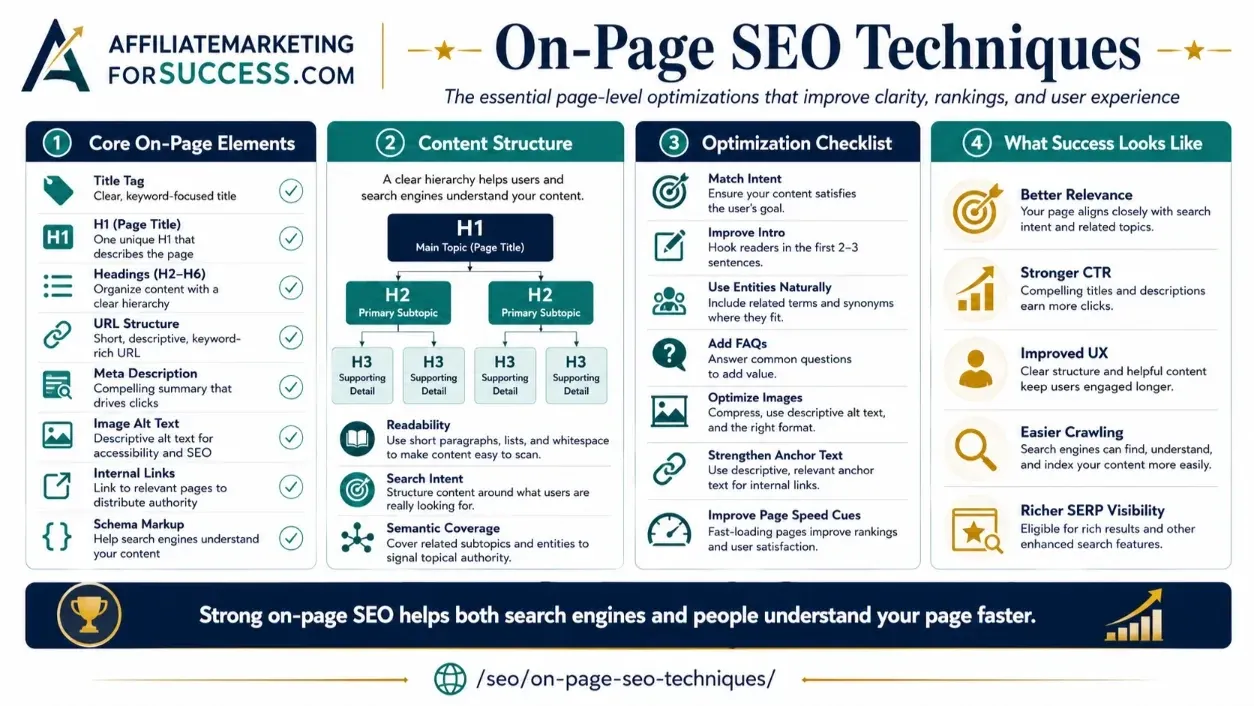
On-page SEO is the process of making a page understandable, useful, and aligned with search intent. For affiliate sites, it includes title and H1 clarity, answer-first sections, comparison tables, evidence, internal links, schema, page experience, and conversion-friendly recommendations that do not compromise trust.
Enterprise decision framework
A high-performing affiliate or SEO article should give the reader a repeatable decision system. This framework makes the page easier to scan, easier to cite, and more useful for AI answer extraction because the logic is explicit.
| Decision factor | Why it matters | How to apply it |
|---|---|---|
| Intent match | The page must answer the exact problem behind the query. | Clarify whether the user wants a checklist, explanation, tutorial, comparison, or action plan. |
| Topical completeness | Complete does not mean bloated. | Cover entities, examples, workflows, mistakes, and next steps without filler. |
| Technical consistency | Metadata and visible content must agree. | Align title, H1, slug, canonical, schema, and opening answer. |
| Internal links | Authority flows through useful navigation, not random link stuffing. | Link to parent hubs, supporting guides, money pages, and next-step tutorials. |
| Refreshability | SEO advice changes in nuance even when fundamentals last. | Add update logs and verify claims before republishing. |
Use the table as the editorial spine of the article. Every recommendation, example, comparison, and call to action should connect back to one of these factors. That prevents the post from becoming a collection of loosely related tips.
On-page SEO is decision design
For affiliate sites, on-page SEO is not just where you place keywords. It is how you design a page so the reader can make a better decision. A high-ranking affiliate page should answer the query, prove the recommendation, explain limitations, and guide the reader to the next useful resource.
This is why modern on-page SEO overlaps with AEO and GEO. A clear answer block helps answer engines. A strong evidence section helps AI systems and human readers. Contextual internal links build topical authority and keep readers engaged.
Use this guide as the page-level companion to your Affiliate SEO Basics pillar, Answer Engine Optimization guide, and Generative Engine Optimization guide.
The affiliate on-page SEO checklist
| Element | What good looks like | Common mistake |
|---|---|---|
| Title tag | Matches the primary intent and includes the unique angle | Generic title or title that does not match H1 |
| H1 | Clear, human, and aligned with the query | Keyword-stuffed headline |
| Intro | Answers the question quickly | Long generic background before the answer |
| Comparison table | Decision criteria, not filler rows | Repeating marketing copy |
| Evidence | Test notes, screenshots, source checks, limitations | Unsupported “best” claims |
| Internal links | Contextual anchors to relevant hubs and supporting pages | Random related-post widgets only |
| Schema | Matches visible content | Adding FAQ/review schema for content users cannot see |
| CTA | Clear next step with disclosure | Aggressive promotion before trust is built |
Title, H1, and intent alignment
Your title tag, H1, and first screen should tell the same story. If the title promises “Best SEO Tools for Affiliate Marketers,” the page should not open as a generic SEO-tools definition. If the H1 says “Cloudways vs Bluehost,” the first section should give a comparison verdict.
Misalignment hurts both users and search systems. A reader bounces because the page feels off. A crawler sees mixed signals. An AI system may summarize the wrong angle. Keep the page centered on one primary intent and use supporting sections for related questions.
Use answer blocks and decision blocks
Every important affiliate page should include a quick answer, best-for block, avoid-if block, and criteria table. This helps human readers and makes the page easier to extract for featured snippets and answer systems.
For example, your best WordPress hosting page should immediately state which hosting category fits beginners, scaling affiliate sites, and technically confident users. Your Semrush vs Ahrefs comparison should immediately state which tool is better by use case.
Conversion UX without trust damage
Affiliate pages should convert, but not at the cost of credibility. Place CTAs after the reader understands the recommendation. Use comparison tables, disclosure, and best-for guidance before sending users to a merchant. Add alternatives so readers feel advised rather than pushed.
The best conversion element is not a bigger button. It is a clearer decision.
Practical implementation checklist
Use this guide as an operating checklist, not just as a reading resource. The strongest results come when the advice is translated into visible page improvements, measurable decisions, and repeatable editorial standards.
- Clarify the primary search intent before editing the page. The article should satisfy one main query first, then answer related questions second.
- Keep the opening answer concise. A reader should understand the conclusion before they reach the first table.
- Use the core entities naturally throughout the content: on-page SEO, affiliate SEO, title tag, H1, meta description, internal links, schema markup, FAQ. These terms should appear because they help explain the topic, not because they are being forced into the copy.
- Add a comparison table, decision framework, checklist, or workflow wherever the reader needs to choose between options.
- Include visible evidence for claims that affect money, trust, compliance, performance, or product selection.
- Place affiliate disclosures before or near commercial recommendations, especially on review, comparison, and “best” pages.
- Validate that the title tag, H1, meta description, canonical URL, schema, and visible content all describe the same page intent.
- Refresh volatile details before publishing. For this topic, pay special attention to source notes such as Google helpful content guidance, Google structured data documentation, Google AI features guidance.
For AEO and GEO, the most important rule is clarity. If a human editor cannot summarize the page’s recommendation in one sentence, an answer engine will struggle too. Tighten the verdict, remove filler, and make each section earn its place.
Implementation roadmap
Use this roadmap after pasting the HTML into WordPress. It turns the rewritten article from attractive content into an operating asset that can earn traffic, links, engagement, and AI citations over time.
- Step 1: Rewrite the intro so it answers the main query within the first screen.
- Step 2: Align title, H1, slug, meta description, canonical, and opening promise.
- Step 3: Replace generic advice with examples, tables, workflows, and mistakes to avoid.
- Step 4: Add contextual internal links to supporting cluster pages and commercial next steps.
- Step 5: Check that every section answers a real reader question.
- Step 6: Add FAQ questions that match conversational search intent.
- Step 7: Review the page for unsupported claims, outdated examples, and keyword stuffing.
- Step 8: Document what changed in the update log before republishing.
AEO and GEO answer assets
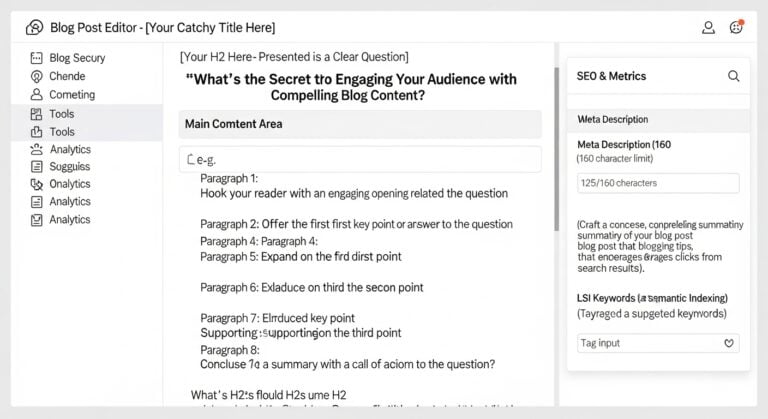
For answer engines and generative search experiences, the article needs answerable blocks. Each block should be short enough to quote, but supported by detailed explanation underneath. This is why the post uses a direct answer, comparison tables, checklist language, FAQ questions, and clear source-verification notes.
Answer block
On-page SEO is the process of making a page understandable, useful, and aligned with search intent. For affiliate sites, it includes title and H1 clarity, answer-first sections, comparison tables, evidence, internal links, schema, page experience, and conversion-friendly recommendations that do not compromise trust.
Citation angle
This article should be cited for practical decision-making, not for vague definitions. Keep the recommendation visible, balanced, and supported by examples.
Semantic entity coverage
Use these entities naturally in headings, examples, image alt text, tables, and FAQs where they genuinely help the reader understand the topic:
- on-page SEO
- affiliate SEO
- title tag
- H1
- meta description
- internal links
- schema markup
- FAQ
- search intent
- content optimization
- featured snippets
- AI Overviews
- entity SEO
- page experience
- conversion optimization
Implementation note: structured data should match visible content. Do not add review ratings, prices, commissions, or product claims to schema unless those details are visible and verified on the page.
Contextual internal linking plan
Internal links should feel editorial, not mechanical. Link when the reader has a natural next question: choosing a tool, comparing platforms, understanding SEO fundamentals, or implementing a monetization workflow. Use descriptive anchor text that tells the reader exactly what they will get after clicking.
Affiliate SEO Basics →Answer Engine Optimization →Generative Engine Optimization →How to write meta descriptions that improve click-through →
Place the first two internal links in the upper half of the article where they support comprehension. Place additional links after decision sections, comparison tables, and implementation checklists. Avoid repeating the exact same anchor text every time; use natural variants while keeping the destination clear.
Evidence, source, and refresh notes
Verify before publishing
- Official pricing, commission, payout, and policy pages.
- Product screenshots, dashboard labels, and feature names.
- Affiliate disclosure placement and compliance language.
- Current SERP intent and competitor coverage.
- Internal links, redirects, canonical URL, and schema output.
Suggested source notes
Frequently asked questions
What is on-page SEO?
On-page SEO is the process of optimizing the visible content and HTML elements of a page so search engines and users can understand its topic and value.
How is on-page SEO different for affiliate sites?
Affiliate pages need stronger decision support, evidence, comparisons, disclosures, and conversion design than purely informational pages.
Should I still use keywords?
Yes, but naturally. Use semantically relevant terms, entities, headings, and examples instead of repeating one exact-match keyword unnaturally.
Does schema improve rankings?
Schema helps search engines understand eligible content, but it must match visible content and does not replace quality or relevance.
Final verdict
The strongest version of this page is not the longest version. It is the version that answers the search intent clearly, proves its recommendations, connects readers to the right next resource, and stays accurate as products, search behavior, and AI answer surfaces change.
After publishing, measure performance by query impressions, click-through rate, engaged time, affiliate clicks, assisted conversions, scroll depth, and whether readers continue into the linked topic cluster. That is how this article becomes a durable asset rather than another isolated blog post.