Why Affiliate Marketing is the Best Business Model (2026)
Quick Answer
Why Affiliate Marketing Can Be a Strong Business Model (2026 Analysis): choose one monetization path, publish intent-matched content, and optimize offers based on weekly conversion data.
Related resources: Success Blueprint · ROI Benchmarks · Semrush Review · Affiliate Disclosure
This page may include affiliate links. We may earn a commission at no extra cost to you.
Last reviewed: 2026-02-20. Updated for trust, clarity, and current implementation guidance.
Most people spend years building businesses that trap them—inventory nightmares, customer service headaches, massive upfront capital. Meanwhile, affiliate marketing quietly generates $17+ billion globally with people working from laptops, no warehouse, no employees, no product development. Here’s why it’s not even close.
⚡
The Bottom Line
Affiliate marketing is the best business model because it eliminates the three biggest business killers: startup capital requirements, inventory management, and customer service overhead. You earn commissions (5-70%) by recommending products you believe in, while someone else handles fulfillment, returns, and support.
✓ Perfect If You:
- Want location-independent income
- Have limited startup capital
- Prefer marketing over operations
- Want passive income potential
✗ Consider Other Models If:
- You want 100% pricing control
- You need to own customer data
- You prefer building sellable assets
- You want higher profit margins (20-40%)
📊 Key Statistics at a Glance
$17B+
Global Market Size (2026)
15.2%
Annual Growth Rate (CAGR)
16%
US E-commerce Influenced
$71.7B
Projected by 2026

1
Near-Zero Startup Capital Required
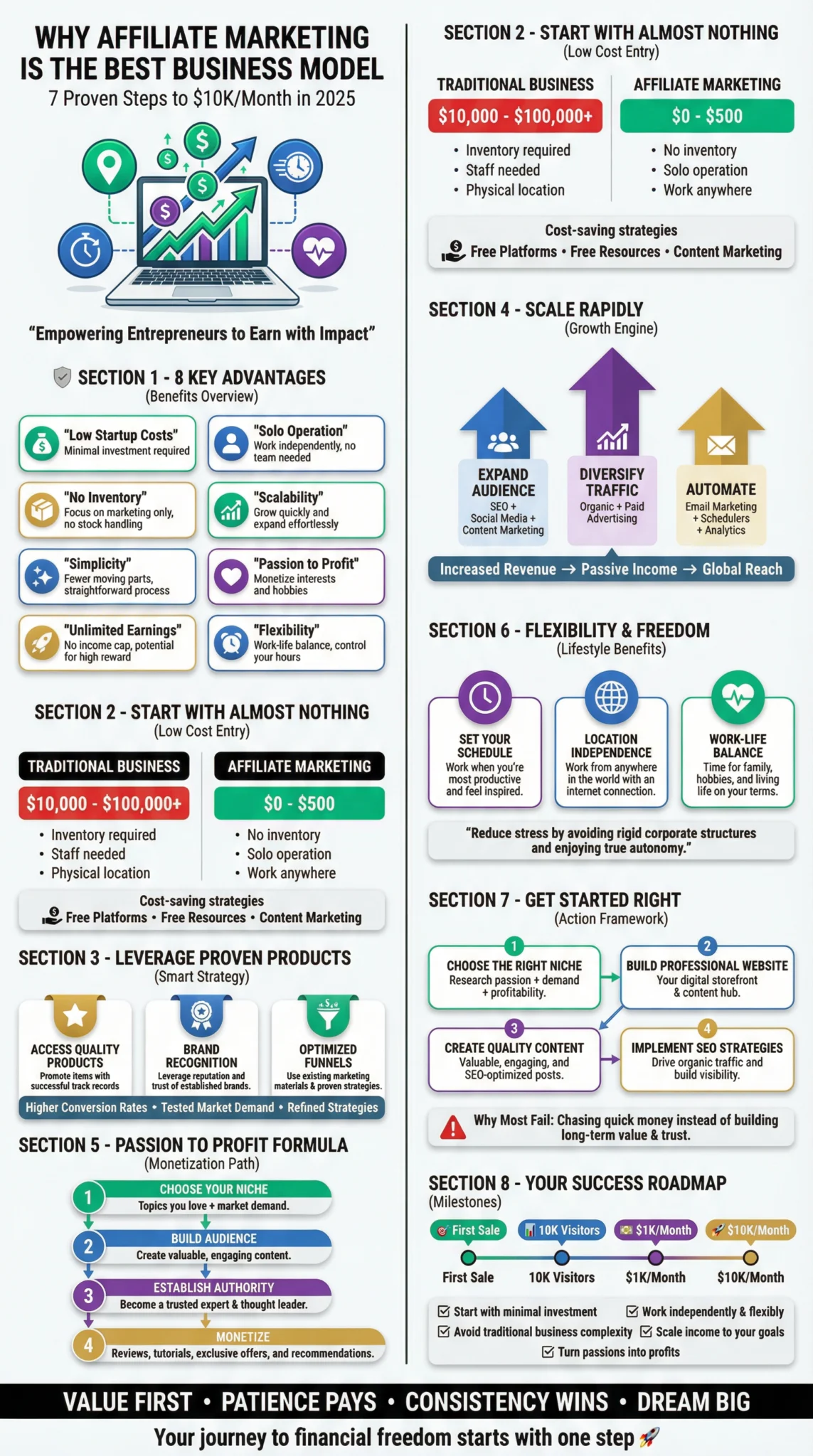
Most businesses require significant upfront investment—inventory, equipment, office space, employees. Affiliate marketing flips this entirely. You need a domain ($10-15/year), hosting ($3-30/month), and your time. That’s it.
💡 The Math That Changes Everything:
Traditional e-commerce startup: $5,000 – $50,000+ (inventory, warehousing, returns)
Franchise business: $50,000 – $500,000+ (fees, buildout, staff)
Affiliate marketing website: $50 – $500 (domain, hosting, basic tools)
New entrepreneurs often choose expensive options like bank loans or venture capital. The affiliate model eliminates this barrier entirely. You can rely on affiliate networks to provide the products while you focus on creating content that converts. If you’re wondering about the actual costs to start affiliate marketing, they’re lower than you’d expect.
2
Zero Inventory & Fulfillment Headaches
E-commerce owners spend 30-50% of their time on operations: managing stock levels, dealing with suppliers, processing returns, handling shipping delays. Affiliate marketers spend 100% of their time on what actually makes money: creating content and driving traffic.
✓
What YOU Handle
- Content creation
- SEO & traffic generation
- Email list building
- Product recommendations
- Conversion optimization
→
What MERCHANTS Handle
- Product development
- Inventory management
- Order fulfillment
- Customer service
- Returns & refunds
- Payment processing
This division of labor is why affiliate marketing scales so efficiently. While a dropshipper still handles payments and customer support, affiliates simply send traffic to external sites where customers complete purchases. Your only job past recommending products is ensuring your audience trusts your recommendations.
3
Unlimited Scalability Without Proportional Costs
With most businesses, growth requires proportional investment. Double your revenue, you need double the inventory, staff, and infrastructure. Affiliate marketing breaks this rule completely.
📈 The Scalability Equation
Traditional Business
2x Revenue = 1.5-2x Costs
More staff, inventory, overhead
Affiliate Marketing
2x Revenue = 1.1x Costs
Just more content & traffic
Companies can scale their affiliate compensation to match business growth. Affiliates with larger reach have more influence and help direct traffic through their partnerships. The more competitive your content, the higher your earning potential—without hiring a single employee. Learn how to properly create an affiliate marketing strategy that scales.
4
True Passive Income Potential
Most “passive income” claims are exaggerated. But affiliate marketing comes closest to the real thing. Content you create today can generate commissions for years—while you sleep, travel, or work on new projects.
🔄 The Evergreen Content Engine
Affiliates remain motivated to promote as long as partnerships continue, keeping your brand consistently visible. This continuous engagement creates lasting impact:
- Consistent exposure: Content reaches new audiences daily through search
- Steady traffic flow: SEO-optimized content compounds over time
- Repeat conversions: Evergreen guides generate sales months or years later
- No short-term spikes: Build sustainable systems, not launch-dependent income
The key is creating evergreen content that solves problems people will have for years. A well-written product comparison or how-to guide can rank in Google and convert visitors into commissions indefinitely.
5
Superior ROI Compared to Other Models
Affiliate marketing isn’t just cost-effective—it delivers measurable, trackable returns. With real-time tracking and performance-based compensation, you only invest in what works.
With affiliate marketing, you pay only when sales are made. Traditional marketing requires upfront spend with uncertain returns. The affiliate model transforms content into direct conversions with measurable, real-time data.
6
Complete Flexibility & Location Independence
Unlike other business models bound by clauses, detailed agreements, and physical locations, affiliate marketing offers unmatched flexibility. Work from anywhere with an internet connection. Set your own hours. Scale at your own pace.
🌍
Work From Anywhere
No office, no commute
Your laptop is your office. Coffee shop in Bali, home office in Athens, or beach in Thailand—your business travels with you.
⏰
Set Your Own Hours
No boss, no schedule
Night owl or early bird—work when you’re most productive. Your content works 24/7 regardless of when you create it.
🚀
Scale On Your Terms
No investors, no pressure
Grow as fast or slow as you want. Side hustle or full-time empire—you control the pace without external pressure.
7
Leverage Built-In Trust & Social Proof
An affiliate relationship demonstrates to customers that another business or influential person believes in your recommended products so much that they’re willing to endorse them personally. This built-in social proof accelerates conversions.
The Trust Transfer Effect:
Collaborations with trusted blogs, influencers, and media outlets not only expand reach and build credibility but also effectively drive leads and sales. When your audience trusts you, that trust transfers to products you recommend—creating a powerful conversion advantage that traditional advertising can’t match.
This is why affiliate marketing often outperforms paid ads. People trust recommendations from content creators they follow more than corporate advertisements. Learn how to leverage social media for affiliate marketing to maximize this trust factor.
8
Riding a $71 Billion Growth Wave
You’re not just starting a business—you’re entering one of the fastest-growing industries in digital marketing. The numbers tell the story:
Affiliate Marketing Industry Trajectory
$9.56B
$17B+
$36.9B
$71.7B
Source: Business Research Insights, Rewardful, Emarketer (2026)
U.S. affiliate marketing spending alone is projected to cross $12 billion in 2026—the first time it’s exceeded $10 billion. Between 2026 and 2026, spending is expected to grow by 65%. Mobile affiliate conversions have increased 49% year-over-year. This isn’t a fad—it’s the future of digital commerce.
🎯 Quick Decision: Is Affiliate Marketing Right For You?
Answer honestly—here’s the fastest path to the right choice:
Low risk, location freedom, passive income potential
→
Affiliate Marketing ✓
Higher margins, customer data ownership, sellable asset
→
Consider Dropshipping
Maximum control, brand building, long-term equity
→
Consider E-commerce
❓ Frequently Asked Questions
📚 Sources & References
Data and statistics referenced in this article:
- Rewardful: 18 Affiliate Marketing Statistics for 2026
Market size, e-commerce influence, mobile conversion data - Udonis: 33 Affiliate Marketing Statistics 2026-2026
Business Research Insights projections, CAGR data - Affiliate Statistics Marketing: 66 Statistics for 2026
US spending data, Emarketer projections, industry trends - Shopify: Affiliate Marketing vs Dropshipping 2026
Business model comparison, profit margins, responsibilities - Business.com: Affiliate Marketing Benefits for Small Businesses
ROI data, social proof benefits, tracking capabilities
Written By
Alexios Papaioannou
Affiliate marketing practitioner and founder of Affiliate Marketing for Success. Helping beginners navigate the affiliate marketing landscape with actionable, experience-based guidance.
Last Updated: January 13, 2026
Our Editorial Standards:
- No paid placements or rankings
- Statistics sourced from verified industry reports
- All affiliate relationships clearly disclosed
- Content updated regularly for accuracy
Affiliate Disclosure: This article may contain affiliate links. If you click through and make a purchase, we may earn a commission at no additional cost to you. This helps support our content creation while providing you with honest, helpful information. We only recommend products and services we believe will genuinely help you succeed in affiliate marketing.
Quick Resource Guide
- Essential Growth: Use the best SEO tools for affiliate marketers to find high-traffic keywords.
- Affiliate Infrastructure: Compare Cloudways vs Bluehost to find the best host for your niche.
- Content Strategy: Check our Semrush review to see how to outrank your competition.

Alexios Papaioannou is the founder and lead editor of Affiliate Marketing for Success. He focuses on affiliate marketing systems, SEO, content strategy, monetization design, and the impact of AI-driven search on publishers. Editorial background, disclosure standards, and correction policy are documented on the site’s About Alexios and Editorial Policy pages.