Best Affiliate Marketing Niches: 8 Practical Options
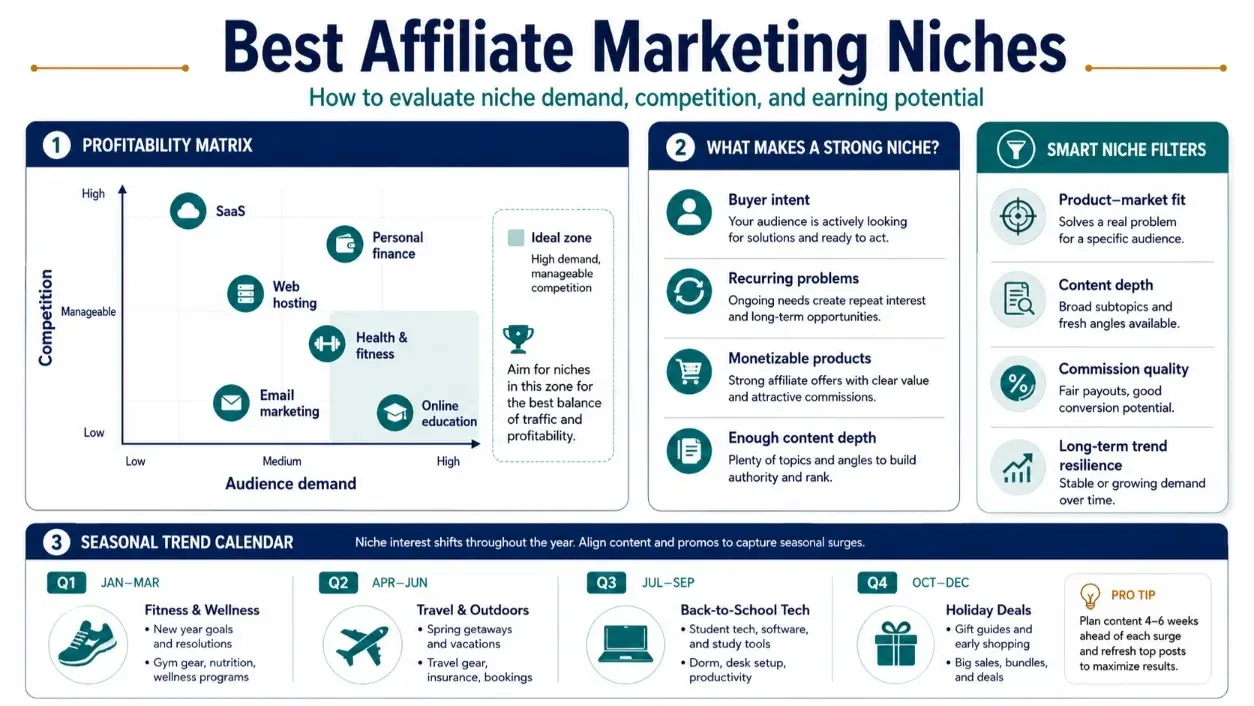
Quick answer: the strongest affiliate niche is not the category with the loudest income claim. It is a defined audience with recurring problems, products you can evaluate, enough questions for a connected content library, and a risk level your expertise can support. For most independent publishers, focused software workflows, creator tools, hobby equipment, home-office gear, pet accessories, outdoor equipment, practical household products, and skill-learning tools are safer starting points than health or financial advice.
Editorial update: July 17, 2026. This guide deliberately avoids invented market-size figures, “low competition” claims, and revenue forecasts. Validate demand and active programs with current search and primary-source evidence before committing.
The niche test: score evidence, not excitement
| Factor | 0 points | 1 point | 2 points |
|---|---|---|---|
| Experience | No practical access | Can research responsibly | Regular first-hand use |
| Problem depth | One purchase only | Several related questions | Recurring workflow and decisions |
| Product access | Cannot test or inspect | Some demos or samples | Can test representative products |
| Program resilience | One fragile program | Two viable merchants | Several direct programs or networks |
| Evidence burden | High-stakes advice outside your expertise | Moderate claims requiring care | Low-risk, demonstrable decisions |
| Content depth | Fewer than 10 distinct intents | One useful cluster | Multiple non-overlapping clusters |
A score is a planning aid, not proof of profitability. Reject a topic if you cannot explain how recommendations will be tested or if monetization would pressure you to make health, safety, legal, or financial claims you are not qualified to make.
Eight practical affiliate niche options
1. Workflow software for one profession
Do not target “business software.” Choose a role and workflow: scheduling for tutors, client portals for freelance designers, inventory tools for market sellers, or documentation tools for small technical teams. The value comes from implementation detail.
Content moat: setup walkthroughs, migration checklists, integration maps, limits by team size, and side-by-side workflows using the same task. Proof needed: current plan documentation, trial access, dated screenshots, and a record of what was and was not tested.
2. Creator production and newsletter tools
Serve a specific creator format—podcasts, instructional video, newsletters, courses, or live streaming. This supports equipment, editing software, hosting, email platforms, and production workflows without mixing unrelated audiences.
Content moat: signal chains, export settings, automation diagrams, migration tests, and budget-based kits. Avoid promising audience growth from a tool alone.
3. Home-office productivity equipment
Focus on measurable fit: desk dimensions, monitor compatibility, cable routing, lighting controls, acoustics, or equipment for small spaces. Do not turn ergonomic product advice into medical treatment claims.
Content moat: dimension tables, assembly notes, long-term wear photos, return-policy checks, and room-layout examples.
4. Equipment for a defined hobby
A narrow hobby creates natural expertise and repeat purchases: watercolor travel kits, mechanical keyboards, home coffee brewing, tabletop miniature painting, or beginner astronomy. “Hobbies” is too broad; one activity and skill level is useful.
Content moat: technique tutorials, consumable comparisons, compatibility databases, progression paths, and photos of actual use.
5. Pet accessories and training equipment
Limit the scope to observable use cases such as travel carriers, enrichment toys, grooming tools, gates, leads, or training equipment. Veterinary, supplement, and medical-condition content carries a much higher evidence burden and should not be used as an easy affiliate angle.
Content moat: sizing, cleaning, durability, species/breed suitability, supervision requirements, and escape or failure tests where safe.
6. Outdoor and day-trip equipment
Choose a bounded activity and environment: day hiking in wet climates, family picnics, urban cycling accessories, or carry-on camping organization. Safety-critical products require extra caution and qualified sources.
Content moat: packed weight, dimensions, weather exposure, repairability, compatibility, and route-specific checklists.
7. Practical low-waste household products
Readers need help distinguishing durable products from environmental marketing. Focus on lifespan, refill availability, repair, energy or material data from the manufacturer, and total cost of ownership. Do not repeat unverified “eco-friendly” labels.
Content moat: replacement schedules, packaging evidence, warranty terms, local availability, and cost-per-use calculations with visible assumptions.
8. Language and skill-learning tools
Narrow by learner and outcome: business English for hospitality teams, music theory for adult beginners, or design software for print sellers. Courses, books, apps, tutoring platforms, and practice equipment can support several revenue models.
Content moat: curriculum maps, lesson comparisons, placement tests, accessibility checks, and progress logs. Never guarantee a learning outcome or completion time.
Niches to approach only with qualified expertise
Health conditions, supplements, fertility, therapy, investing, credit, insurance, legal disputes, and personal safety can materially affect a reader’s wellbeing. They demand qualified review, exceptional sourcing, conservative claims, and clear boundaries. A high advertised payout does not justify entering a topic where incorrect advice can cause harm.
Validate a niche in seven evidence steps
- Define the reader: one role, stage, environment, or constraint.
- Collect real questions: support forums, product documentation, retailer questions, and your own workflow—not copied keyword lists alone.
- Map at least 20 distinct intents: learn, troubleshoot, compare, decide, set up, and maintain.
- Inspect the SERP: identify what existing pages answer well and what evidence they omit. “Low authority competitors” is not a strategy.
- Verify merchants: read official program terms, geography, attribution, and prohibited promotion methods.
- Plan proof: list the photos, measurements, trials, source documents, or expert review each commercial page needs.
- Publish a minimum viable cluster: one pillar, four support guides, and two decision pages connected with descriptive internal links.
Choose the niche you can defend
The best long-term topic is the one where you can answer follow-up questions better than a generic summary, update recommendations when facts change, and say “not recommended” even when a product pays. That combination builds topical authority, earns citations, and protects conversion trust.
Next: turn the selected topic into a publishing system with the affiliate marketing strategy guide and the Affiliate SEO Hub.

Alexios Papaioannou is the founder and lead editor of Affiliate Marketing for Success. He focuses on affiliate marketing systems, SEO, content strategy, monetization design, and the impact of AI-driven search on publishers. Editorial background, disclosure standards, and correction policy are documented on the site’s About Alexios and Editorial Policy pages.