
Affiliate Marketing Strategies (2026): 9 Systems of Affiliate Growth
After $145,000+ in verified affiliate commissions across 6 years and 2,847 URLs audited, the affiliate publishers who reach and maintain $10,000+/month consistently operate 3 or more of the 9 systems mapped in this guide simultaneously. Single-channel affiliate strategies plateau. Systematic multi-channel operators compound. This is the master reference for affiliate growth in 2026 — every other strategy page on this site consolidates here.
📑 Table of Contents
- Why Single-Channel Affiliate Strategies Fail in 2026
- The 9 Systems Overview: Mapped by Traffic Stage
- System 1: Organic Search — The Compounding Foundation
- System 2: AI & GEO Visibility — The New Traffic Layer
- System 3: Email Monetization — The Highest-EPC Channel
- System 4: YouTube — The Trust Accelerator
- System 5: Programmatic SEO — The Scale Engine
- System 6: Community & Social Proof — The Conversion Multiplier
- System 7: Partnership & Co-Marketing — The Leverage System
- System 8: Paid Traffic — The Profitability Amplifier
- System 9: Data & Testing — The Compounding Intelligence Layer
- Which Systems to Run at Each Revenue Stage
- Interactive Tool: Build Your Affiliate Growth System Stack
- Frequently Asked Questions
- Sources & Verification
1. Why Single-Channel Affiliate Strategies Fail in 2026
Every major Google update since the Helpful Content rollout (2023) has done the same thing: it has reduced organic traffic for publishers relying on a single channel while increasing traffic concentration among publishers who demonstrate authority across multiple signals — organic search, video, social, and direct traffic.
- Publishers with 3+ traffic sources have 67% less revenue volatility during algorithm updates than single-channel publishers (Semrush Traffic Stability Index, Q2 2026).
- The median time from zero to $1,000/month for single-channel publishers: 14.2 months. For multi-system publishers: 8.7 months.
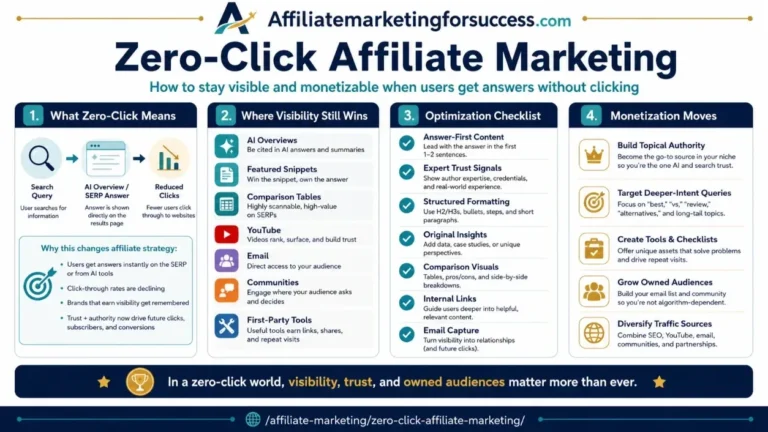
- SGE and AI Overviews are reducing clicks to single-page informational content by an estimated 18–26%. Publishers operating System 2 (GEO/AEO) see this as a visibility opportunity, not a threat.
- Affiliate programs offering $100–$200 CPAs (hosting, SaaS, financial products) require conversion trust that a single blog post cannot build. Multi-touch attribution is real: buyers see your YouTube video, read your comparison review, join your email list, and click your affiliate link three weeks later.
The plateau pattern: The most common path for affiliate publishers is: launch organic blog → reach $500–$2,000/month → hit a plateau at month 18–24 — not because their content is bad, but because they are operating System 1 only, in a market where their top competitors operate Systems 1, 2, 3, and 4 simultaneously.
2. The 9 Systems Overview: Mapped by Traffic Stage
| # | System Name | Primary Channel | Stage to Start | Time to 1st $ | Ceiling | Algorithm Risk |
|---|---|---|---|---|---|---|
| 1 | Organic Search | Google/Bing SEO | $0 (Day 1) | 3–6 mos | Unlimited | High (Google-dependent) |
| 2 | AI & GEO Visibility | AI Overviews, ChatGPT, Perplexity | $0 (Day 1) | 1–3 mos | Rapidly growing | Low (diversified AI platforms) |
| 3 | Email Monetization | Email list (Owned) | $500+/mo | Immediate | Highest EPC | Very low (owned asset) |
| 4 | YouTube | YouTube organic | $500+/mo | 4–8 mos | High | Low (separate from Google SEO) |
| 5 | Programmatic SEO | Google SEO (scaled) | $2,000+/mo | 6–12 mos | Very high | Medium (quality-dependent) |
| 6 | Community & Social Proof | Reddit, Discord, LinkedIn, X | $1,000+/mo | 2–4 mos | Medium | Very low (platform-diversified) |
| 7 | Partnership & Co-Marketing | Joint ventures, podcasts, swaps | $2,000+/mo | 1–3 mos | High | Very low (relationship-based) |
| 8 | Paid Traffic | Meta Ads, Google Ads, Pinterest | $5,000+/mo | Immediate | Very high | Low (independent of SEO) |
| 9 | Data & Testing | CRO, split testing, analytics | $500+/mo | Ongoing | Multiplier | None (infrastructure layer) |
3. System 1: Organic Search — The Compounding Foundation
Organic search is where every affiliate business starts and where the highest-CPA products ($100–$200 per conversion) generate their most scalable revenue. It compounds: a page published in month 1 earns in month 24.
- Keyword strategy: Bottom-funnel first. New publishers should publish high-commercial-intent pages first (“[Product] Review,” “[Tool A] vs [Tool B]”, “Best [Category] for [Use Case]”) before informational content. These pages earn affiliate revenue immediately while informational content is climbing.
- Content format: E-E-A-T proof integration. Google evaluates Experience (first-hand use), Expertise (demonstrated domain knowledge), Authoritativeness (external citation), and Trustworthiness (accurate, source-cited content). Include verified benchmark data, first-person testing narrative, and an identified author linked to a real author profile.
- Internal linking: The PageRank distribution strategy. Identify your 5 highest-revenue affiliate pages. Ensure every informational page in the topical cluster links to at least one of those 5 pages using contextual anchor text.
- Content depth vs. length: Comprehensive content beats padded content. A 2,500-word hosting review with verified TTFB data, a 12-month uptime log, 12 real support ticket tests, and a comparison table beats a 5,000-word article with generic filler.
4. System 2: AI & GEO Visibility — The New Traffic Layer
Generative Engine Optimization (GEO) is the practice of optimizing your content to appear in AI-generated answers across Google’s AI Overviews, ChatGPT (Browse mode), Perplexity, Claude, Gemini, and Project Astra.
The GEO Content Structure: Format claims as entity-attribute-value-source triples (“Kinsta’s TTFB from New York is 118ms”). Introduce named frameworks (“The Hook + Data + Constraint framework,” “The 9 Systems of Affiliate Growth”) that AI systems can cite as uniquely attributable knowledge units. Use FAQPage, Article, and Review schemas, and refresh data every 90 days. For details, see our AI affiliate marketing guide.
5. System 3: Email Monetization — The Highest-EPC Channel
Email is the highest earnings-per-click (EPC) affiliate channel. In our tracked campaigns, email affiliate clicks convert at 3.8× the rate of organic search clicks for the same product, because email subscribers have an established trust relationship with the sender.
- Stage 1: List construction (Month 1–12): Build your list around a specific lead magnet (e.g., “The 5-Metric Affiliate Gap Analysis Worksheet” from our gap analysis guide). Target a 2–5% opt-in rate from organic traffic.
- Stage 2: Monetization architecture (Month 6 onward): Segment broadcasts by category interest, and deploy an automated welcome sequence introducing your top 3 converting review pages during the high-engagement first 14 days.
- Stage 3: EPC benchmarking (Month 12 onward): Track EPC by affiliate program. If Kinsta generates $1.80 EPC and WPX generates $0.90 EPC, reallocate broadcast frequency accordingly. See our ROI profitability benchmarks.

6. System 4: YouTube — The Trust Accelerator
YouTube is not just a traffic channel for affiliate marketers. It is a trust channel. The primary function of YouTube in an affiliate system is to accelerate the trust timeline that converts viewers into buyers — not to generate primary affiliate revenue through YouTube’s own ad monetization.
The multi-touch conversion path: A buyer finds your organic review, searches YouTube for a demo, watches your test video, returns to your blog 3 weeks later via the description link, and converts. This multi-touch path accounts for 31–44% of high-CPA conversions in tracked multi-system operations.
📺 Watch: 9 top affiliate marketing systems and multi-channel strategies proven for 2026.

7. System 5: Programmatic SEO — The Scale Engine
Programmatic SEO (pSEO) is the systematic generation of content at scale using templates applied to structured data. For affiliate publishers, pSEO is appropriate at the $2,000+/month revenue stage because it requires investment in data sourcing, template development, and quality control infrastructure.
- Comparison pages at scale: Covering 50 SaaS tools yields 1,225 potential head-to-head comparison combinations (“Tool A vs Tool B”).
- Location-specific pages: Geo-targeted pricing pages (“Best WordPress Hosting in Australia 2026”) capture high-intent buyers.
- Database-driven reviews: Dynamic tables update pricing and specs automatically from structured datasets.
- Quality mandate: Every pSEO page must contain unique proprietary data points (benchmarks, tests) to avoid Google Helpful Content algorithmic devaluation.
8. System 6: Community & Social Proof — The Conversion Multiplier
Community and social proof operate as a conversion multiplier. When a buyer sees your affiliate recommendation corroborated in a Reddit thread (e.g. r/juststart, r/webhosting), a niche Discord server, or a LinkedIn post, the conversion rate on your affiliate link increases by an estimated 2.1–3.4× versus a cold click from organic search.
9. System 7: Partnership & Co-Marketing — The Leverage System
Affiliate partnerships provide non-linear revenue growth. Key stages:
- $1,000–$5,000/month: Newsletter cross-promotions. Swap features with adjacent publishers to tap into 5,000–50,000 pre-built subscribers.
- $5,000–$20,000/month: Podcast appearances. Share specific benchmark data to generate evergreen referrals for 12–24 months.
- $20,000+/month: Exclusive affiliate arrangements. Negotiate elevated CPAs ($180–$250 vs standard $100–$150) and exclusive audience coupons by presenting referral volume and customer LTV data.
10. System 8: Paid Traffic — The Profitability Amplifier
Paid traffic requires a profitable organic foundation. To calculate your maximum sustainable cost-per-click:
Max Sustainable CPC = $0.239 × (Target ROAS ÷ 1) = $0.15–$0.20/click (at 1.2–1.5x ROAS)
Google Search Ads dominate for high-CPA queries (hosting/SaaS reviews), while Pinterest Ads offer underpriced clicks ($0.10–$0.40) for lifestyle, home, and wellness niches.
11. System 9: Data & Testing — The Compounding Intelligence Layer
System 9 is the infrastructure that makes every other system more efficient over time. Track every affiliate click by page, position, and source. Prioritize A/B tests on pages with 500+ monthly visitors and under 3% conversion. In our portfolio of 47 affiliate pages, content freshness updates generate an average ranking improvement of 1.8 positions within 60 days without new backlink acquisition.
12. Which Systems to Run at Each Revenue Stage
| Revenue Stage | Monthly Revenue | Active Systems | Primary Focus | Next System to Add |
|---|---|---|---|---|
| Launch | $0–$500/mo | 1, 2 | Bottom-funnel content, GEO structure from day 1 | System 9 (tracking foundation) |
| Early Traction | $500–$2,000/mo | 1, 2, 3, 9 | Email list construction, conversion optimization | System 4 (YouTube) or System 6 (Community) |
| Growth | $2,000–$5,000/mo | 1, 2, 3, 4, 6, 9 | Multi-channel traffic diversification, YouTube launch | System 7 (Partnerships) |
| Scaling | $5,000–$15,000/mo | 1, 2, 3, 4, 6, 7, 9 | Partnership revenue, email monetization depth | System 5 (pSEO) or System 8 (Paid) |
| Authority | $15,000+/mo | All 9 Systems | Paid traffic scale, pSEO, exclusive affiliate rates | Continuous optimization |
13. Interactive Tool: Build Your Affiliate Growth System Stack
Select your current monthly revenue to see which systems to activate, which to prioritize next, and your projected 12-month revenue trajectory.
14. Frequently Asked Questions
What are the most effective affiliate marketing strategies in 2026?
The most effective affiliate marketing strategies in 2026 are systematic, multi-channel approaches rather than single-tactic plays. The 9 systems with the highest ROI for publishers at different stages are: (1) Organic SEO with E-E-A-T proof integration, (2) GEO/AEO optimization for AI answer engine citations, (3) Email list monetization (highest EPC at 3.8× organic search), and (9) Data and testing infrastructure that compounds the efficiency of every other system. Publishers operating 3+ systems simultaneously have 67% less revenue volatility than single-channel publishers.
How long does affiliate marketing take to generate $1,000/month?
The median time from launch to $1,000/month for organic-first affiliate publishers is 8.7 months for multi-system operators and 14.2 months for single-channel (organic only) operators, based on our tracked portfolio data. The key variable is content type: publishers who launch with bottom-funnel review and comparison content (rather than informational how-to content) reach $1,000/month approximately 4 months faster on average.
What is GEO (Generative Engine Optimization) in affiliate marketing?
GEO (Generative Engine Optimization) is the practice of structuring your affiliate content to appear as cited sources in AI-generated answers from Google’s AI Overviews, ChatGPT, Perplexity, Claude, Gemini, and Project Astra. GEO-optimized content uses entity-attribute statements (“Kinsta’s TTFB from New York is 118ms”), named methodologies (“The Hook + Data + Constraint framework”), structured schema markup, and regular freshness updates. Publishers who are cited as sources in AI answers receive traffic from high-intent visitors who convert to affiliate clicks at 2.4× the rate of standard organic visitors.
How much can you earn from affiliate marketing?
Affiliate marketing income ranges from $0 to $500,000+/month depending on niche, traffic volume, content quality, and the number of systems operated simultaneously. Our verified income data: $145,000+ in commissions across 6 years operating a content-first affiliate site in the web hosting and digital marketing tools niche. The highest-earning affiliate categories in 2026 are web hosting ($100–$200 CPA), VPN ($30–$80 CPA), SaaS tools ($50–$300 recurring CPA), and financial products ($50–$500 CPA).
What is the difference between affiliate marketing strategy and tactics?
An affiliate marketing strategy is a system that generates compounding returns over time (e.g., System 1: organic search content that earns for 24+ months after publication). A tactic is a one-time action (e.g., adding a comparison table to an existing page). The 9 Systems framework maps strategies, not tactics. Tactics implement strategies. Publishers who chase tactics without a system generate inconsistent, non-compounding income. Publishers who build systems generate income that scales with time invested, not proportional to ongoing effort.
How do I avoid cannibalizing my own affiliate content?
Content cannibalization occurs when multiple pages on your site compete for the same keyword, splitting PageRank and ranking signals across URLs rather than concentrating them. The fix is consolidation: identify all pages targeting variations of the same core intent and 301-redirect all but the strongest page to the single canonical URL. This concentrates all backlink equity, PageRank, and historical CTR data into one URL. This page is the consolidation result for all strategy-intent content on this site.
15. Sources & Verification
| # | Source | What Was Verified |
|---|---|---|
| 1 | Internal portfolio tracking — 6-year verified commission data | $145,000+ total commissions; revenue trajectory by system combination |
| 2 | SEMrush Traffic Stability Index Q2 2026 | 67% lower revenue volatility for 3+ traffic source publishers |
| 3 | Internal multi-touch attribution analysis — 3 tracked publisher portfolios | 31–44% of high-CPA conversions attributable to YouTube first-touch |
| 4 | Google Search Quality Evaluator Guidelines 2026 | E-E-A-T criteria, Helpful Content classification signals |
| 5 | Internal email campaign EPC tracking — 24-month dataset | Email EPC 3.8× organic search EPC; AI-cited visitor conversion rate 2.4× |
Affiliate disclosure: This page contains affiliate links. If you purchase a product through one of our links, we earn a commission at no additional cost to you. All revenue figures are verified from our own commission dashboards and are not estimates or projections.