Email List Building Strategies: The Affiliate Marketer’s Complete Playbook (2026)
Quick Answer
Email List Building Strategies: The Affiliate Marketer’s Complete Playbook (2026): choose one monetization path, publish intent-matched content, and optimize offers based on weekly conversion data.
Most affiliate marketers are bleeding money chasing algorithm changes on platforms they don’t own. Meanwhile, their competitors are quietly building email lists that generate 4,200% ROI—turning $1 into $42 on autopilot. Here’s the brutal truth: if you’re not building an email list, you’re renting your audience from social media landlords who can evict you tomorrow.
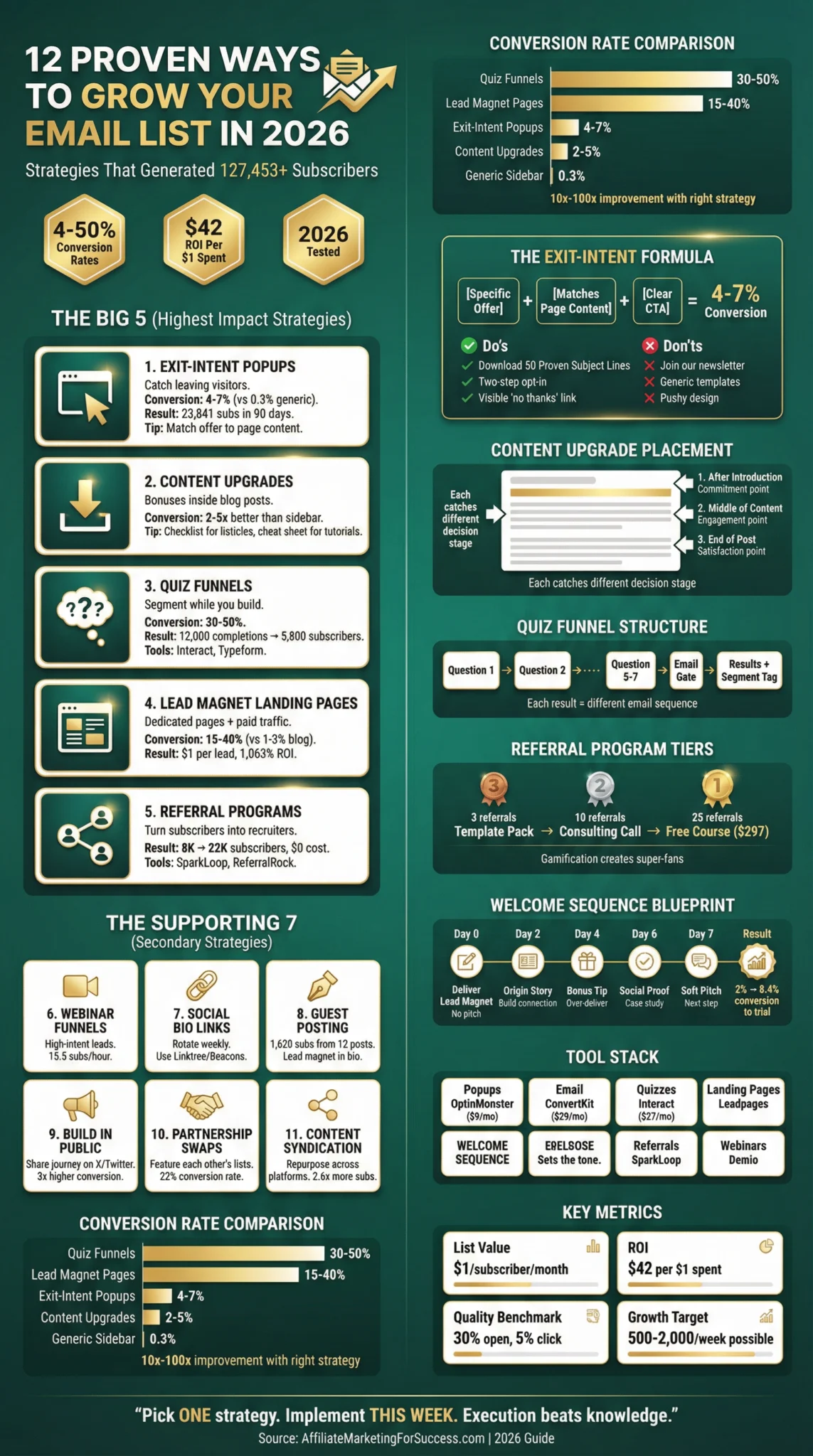
Quick Verdict: What Actually Works in 2026
Bottom Line: The affiliate marketers dominating right now combine high-converting lead magnets with strategic opt-in placements, segment their lists from day one, and nurture with value-first sequences. Average email open rates hit 37.93% industry-wide, with top performers reaching 54.78%. Your list is worth $1-2 per subscriber per month when done right.
✓ This Guide Is For You If:
- You want traffic you actually own
- You’re tired of algorithm roulette
- You want predictable affiliate income
- You’re ready to build a real asset
✗ Skip This If:
- You want overnight results without work
- You’re looking for spam tactics
- You won’t invest in email software
- You refuse to provide genuine value

1
Why Email Lists Beat Social Media for Affiliate Marketers
Here’s what nobody tells new affiliate marketers: you don’t own your Instagram followers. You don’t own your YouTube subscribers. You don’t even own your TikTok audience that took you 2 years to build. One algorithm change, one policy update, one “suspicious activity” flag—and poof, your traffic source vanishes overnight.
📊 The Cold, Hard Numbers
4,200%
Average Email Marketing ROI
37.93%
Average Email Open Rate
1.42%
Automated Flow Conversion Rate
$1-2
Value Per Subscriber/Month
Compare that to organic social media reach hovering around 2-5%. When you send an email, roughly 38% of people see it. When you post on social, maybe 3% of your followers see it—if you’re lucky. The math isn’t even close.
💡 The Ownership Principle: Your email list is an asset you own outright. Unlike followers on rented platforms, subscribers are yours. You can export them, migrate them, and communicate directly without algorithmic interference. This is why understanding email marketing fundamentals is non-negotiable for serious affiliate marketers.
2
Lead Magnets That Actually Convert (Not Generic PDFs)
Stop offering “Free 10-Page PDF Guide to Success.” Nobody wants another PDF collecting digital dust. The lead magnets crushing it in 2026 solve one specific, painful problem your audience has right now. Specificity wins.
High-Converting Lead Magnet Types for Affiliate Marketers
Lead Magnet Creation Formula
Step 1: Identify One Pain Point
What’s the #1 problem your audience complains about? Not 5 problems. Not 10. One specific, urgent pain point they’d pay to solve today.
Step 2: Deliver Quick Win
Your lead magnet must deliver a tangible result within 5-15 minutes of consumption. Instant gratification builds trust and primes them for your offers.
Step 3: Connect to Your Offers
Promoting software? Create a checklist for choosing the right tool. Promoting courses? Create a “readiness assessment.” The lead magnet should naturally lead to your affiliate offer.
🔥 Pro Tip: Checklists convert 2x better than generic content according to real-world testing. One marketer doubled conversions from 0.55% to 1.1% overnight just by switching from a PDF guide to a focused checklist. Use our email marketing template generator to create professional lead magnets fast.
3
Strategic Opt-In Form Placement (Where to Put Your Forms)
You could have the world’s best lead magnet, but if nobody sees your signup form, you’re dead in the water. The difference between a 0.5% and 5% conversion rate often comes down to placement, not the offer itself.
The 6 Highest-Converting Form Placements
Exit-Intent Popups
Triggers when cursor moves toward browser close button. Captures 10-15% of abandoning visitors.
Best Practice: Offer something different than your standard opt-in. “Wait! Before you go, grab this exclusive checklist…”
Inline Content Upgrades
Embedded within your blog content, usually after the intro or mid-article. Context-specific = higher conversions.
Best Practice: Match the upgrade to the article topic. Article about “email subject lines”? Offer “50 Proven Subject Line Templates.”
Floating Header/Footer Bars
Non-intrusive, always visible. Great for announcing time-sensitive offers or newsletter signups.
Best Practice: Keep copy under 10 words. One clear CTA button. Don’t compete with your main content.
Scroll-Triggered Popups
Appears after visitor scrolls 50-70% of page. They’re engaged—strike while the iron is hot.
Best Practice: Test different scroll depths. For longer content, 60-70% works best. For short pages, try 40-50%.
Sidebar Sticky Forms
Follows user as they scroll on desktop. Lower conversion than popups but zero friction.
Best Practice: Use for secondary offers. Primary lead magnet in popup, newsletter signup in sidebar.
End-of-Post Forms
Placed after article conclusion. Readers who finish are highly engaged and primed to take action.
Best Practice: Recap the value they just received, then offer more. “Liked this guide? Get our advanced strategies…”
⚠️ Warning: Aggressive popups that appear immediately on page load will tank your user experience and likely trigger Google’s intrusive interstitial penalty. Wait at least 5 seconds or 30% scroll depth before showing any popup. Always provide an easy-to-find close button.
4
Landing Pages That Capture Leads (Anatomy of High-Converters)
Your landing page has one job: convert visitors into subscribers. Not inform. Not entertain. Convert. Every element either pushes toward that goal or gets cut.
The High-Converting Landing Page Formula
📰
Headline
Clear benefit statement. What do they get? In 10 words or less.
📝
Subheadline
Expands on headline. Adds specificity or addresses objection.
🖼️
Visual
Show the lead magnet. Mockup of ebook, checklist preview, tool screenshot.
✅
Bullet Benefits
3-5 bullets answering “what’s in it for me?” Outcomes, not features.
📧
Simple Form
Email only for max conversions. Name + Email acceptable. Never more.
🔘
CTA Button
Action-oriented text. “Get Instant Access” not “Submit.” Contrasting color.
The median landing page conversion rate sits around 6.2%. Top performers hit 25%+. The difference? Clarity, specificity, and reducing friction. Learn how to create a landing page for affiliate marketing that actually converts.
Conversion Killers to Eliminate:
- ✗
Navigation menus
— Every link is an exit door. Remove them all. - ✗
Multiple CTAs
— One offer. One action. Confusion kills conversions. - ✗
Too many form fields
— Each field reduces conversions by 10-25%. - ✗
Vague value propositions
— “Get our newsletter” vs “Get 15 email templates that doubled our open rates”
5
Traffic Sources for List Building (Free & Paid)
You need eyeballs on your opt-in forms. Here’s where to find them—organized by effort, cost, and timeline to results.
Free Traffic Sources
Paid Traffic Sources
Content marketing and SEO remain the highest-ROI long-term strategies. Blog posts, guides, tutorials—content that attracts organic search traffic converts visitors through embedded signup forms and contextual opt-ins. For a deep dive on creating content that ranks and converts, check out effective email marketing strategies that tie into your content funnel.
6
Segmentation From Day One (Don’t Skip This)
Blasting the same email to everyone on your list is like shouting into a crowded room and expecting everyone to listen. Segmentation is how you whisper directly into the right ears. Segmented campaigns see 14-31% higher open rates than non-segmented ones.
Essential Segmentation Categories
By Lead Magnet
Someone who downloaded “SEO Checklist” has different interests than someone who grabbed “Email Subject Line Templates.” Tag them accordingly and send relevant follow-ups.
By Engagement Level
Active subscribers (opened in last 30 days) vs. dormant (no opens in 90+ days). Send re-engagement campaigns to dormant subscribers or prune them to maintain deliverability.
By Purchase History
First-time buyers, repeat customers, and those who clicked affiliate links but didn’t purchase all need different messaging. Don’t pitch beginners advanced products.
By Interest/Topic
Use surveys, quiz results, or click behavior to identify what topics each subscriber cares about. Only send content they actually want to receive.
💡 Implementation Tip: Start simple. Use your email platform’s tagging feature to tag subscribers based on which opt-in form they used. That single data point lets you send targeted follow-ups immediately. Expand segmentation as your list grows.
7
Automation & Nurture Sequences That Print Money
Here’s where email marketing becomes a money-printing machine. Automated flows convert at 1.42% on average—with top performers hitting 4.93%—versus 0.08% for regular campaigns. That’s 17x higher conversions on autopilot.
Essential Automated Sequences
📧 The Welcome Sequence (Non-Negotiable)
Email 1: Immediate
Deliver lead magnet + set expectations. “Here’s what you signed up for, here’s what to expect from me.”
Email 2: Day 1-2
Introduce yourself. Share your story, build connection. Why should they trust you?
Email 3: Day 3-4
Provide massive value. Best tip, resource, or insight. No pitch yet.
Email 4: Day 5-7
Soft pitch. Introduce relevant affiliate offer as a solution to their problem.
Email 5: Day 8-10
Case study or testimonial. Show results others have achieved with your recommendation.
Email 6: Day 12-14
Transition to regular content. Invite them to engage, reply, or take next step.
Other High-Impact Automations
🔄 Re-Engagement Sequence
Triggers after 60-90 days of inactivity. “We miss you!” + special offer or valuable content to win them back. If no response after 3 emails, clean them from your list.
📚 Nurture/Education Sequence
Long-term value delivery. Send your best content weekly or bi-weekly. Build trust before promoting. The longer they stay, the more they buy. Learn more about lead nurturing strategies.
🛒 Abandoned Cart / Click-No-Buy
Track when subscribers click affiliate links but don’t purchase (if your platform allows). Follow up with answers to common objections, comparison content, or limited-time bonuses.
8
Metrics That Actually Matter (Ignore Vanity Numbers)
Stop obsessing over list size. A 1,000-subscriber list that generates $2,000/month crushes a 50,000-subscriber list making $500/month. Focus on these metrics instead:
List Hygiene Best Practices
- ✓
Remove hard bounces immediately — Invalid addresses hurt deliverability and sender reputation - ✓
Run re-engagement campaigns — Before removing inactive subscribers, give them a chance to re-engage - ✓
Prune after 6 months of inactivity — Subscribers who haven’t opened in 6+ months drag down your metrics - ✓
Monitor spam complaints — Keep complaints under 0.1%. Remove repeat complainers instantly
🎯 Quick Decision Map: Where to Start
Don’t waste time. Here’s the fastest path to the right strategy:
Focus on one lead magnet + one traffic source
→
Proven Ways to Grow Your List
Upgrade your lead magnet + add exit popups
→
Quick Lead Generation Tactics
Segment + re-engagement sequence + prune
→
Craft Irresistible Newsletters
❓ Frequently Asked Questions
📚 Sources & References
Official resources and additional reading:
- Klaviyo Email Marketing Benchmarks 2026-2026
Industry-wide open rates, click rates, and conversion rate benchmarks by vertical - HubSpot Email Marketing Benchmark Report
Comprehensive email performance data across industries - Unbounce Conversion Rate Research
Email marketing conversion rate optimization insights - FTC Endorsement Guidelines
Official FTC guidance on affiliate disclosure requirements - GDPR Email Marketing Compliance Guide
European data protection requirements for email marketers
Written By
Alexios Papaioannou
Affiliate marketing strategist and digital entrepreneur with hands-on experience building email lists and automated marketing funnels. Focused on practical, results-driven strategies for affiliate marketers.
Last Updated: January 13, 2026
Our Editorial Standards:
- No paid placements or rankings influence our content
- Statistics cited from third-party research sources
- All affiliate relationships are clearly disclosed
- Facts are verifie
📚 Related Articles on AFS
Keep learning with these hand-picked guides:

I’m Alexios Papaioannou, an experienced affiliate marketer and content creator. With a decade of expertise, I excel in crafting engaging blog posts to boost your brand. My love for running fuels my creativity. Let’s create exceptional content together!