Technical SEO Foundations for a Blog: 2026 Setup Checklist
Quick answer
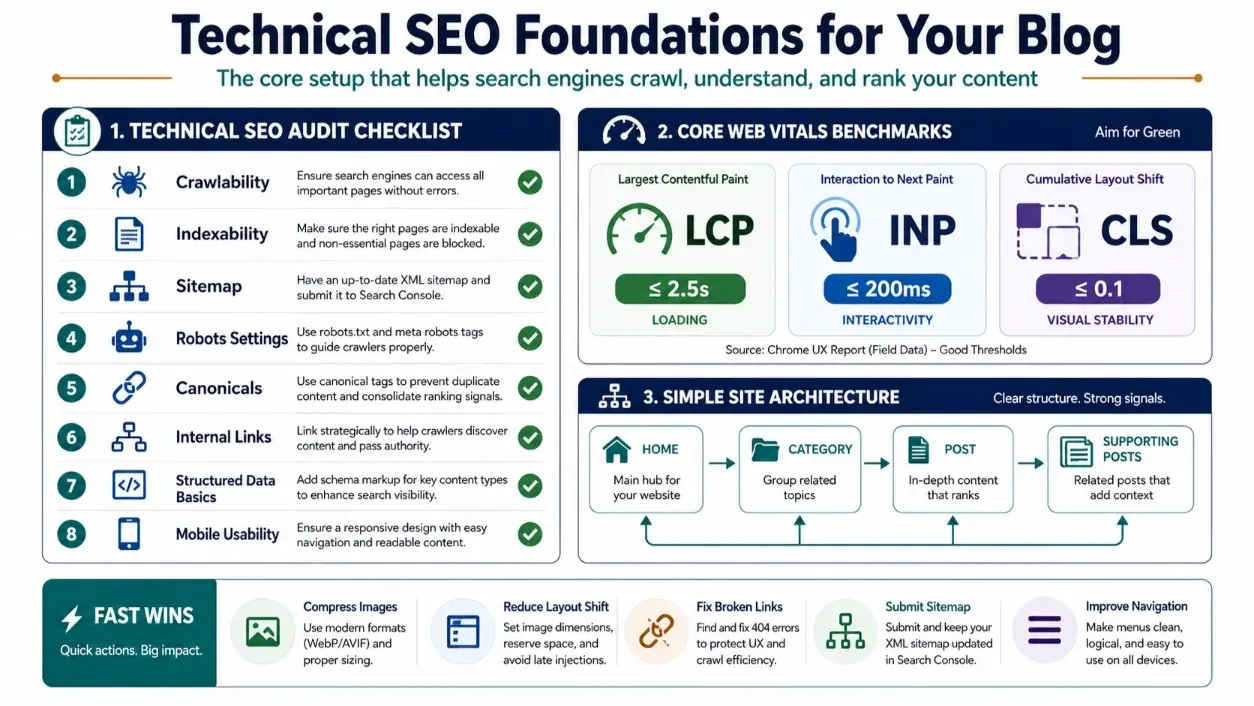
The basic technical SEO foundation for a blog is crawlable architecture, clean indexation, fast Core Web Vitals, secure HTTPS, structured data, and a repeatable publishing checklist. You do not need a complicated stack, but you do need a site that search engines can crawl, understand, and trust.
Technical SEO checklist
- Use HTTPS sitewide and redirect HTTP to HTTPS.
- Keep one canonical version of every important URL.
- Submit an XML sitemap that contains only indexable URLs.
- Block thin internal search, tag spam, duplicate archives, and low-value parameter URLs where appropriate.
- Use descriptive titles, one H1 per page, and clean internal links.
- Make the site mobile-friendly and readable without layout shifts.
- Monitor Core Web Vitals: LCP, INP, and CLS.
Core Web Vitals targets
Google’s current Core Web Vitals focus on LCP for loading performance, INP for responsiveness, and CLS for visual stability. Older guides mention FID, but INP replaced FID as the responsiveness metric. Treat performance as a user-experience requirement, not only an SEO checkbox.
Indexation setup
- Every money page should return 200, have a self-referencing canonical, and be included in the sitemap.
- Redirect moved pages with one-hop 301 redirects.
- Noindex thin tag/search/archive pages that do not help users.
- Check that redirected, noindexed, and 404 URLs are not listed in the sitemap.
Blog structure
Build topic hubs before publishing dozens of isolated posts. Each hub should explain the topic, link to the best supporting guides, and give beginners a clear path. Supporting posts should link back to the hub and to related comparison, tutorial, and glossary pages.
Schema basics
- Use Article schema for posts.
- Use Breadcrumb schema when breadcrumbs are visible.
- Use FAQ schema only when the FAQ is visible on the page and genuinely helpful.
- Do not mark up fake ratings, fake reviews, hidden FAQs, or claims you cannot support.
Publishing QA
- Check title, meta description, H1, canonical, and robots meta.
- Open the page on mobile and desktop.
- Verify affiliate disclosure before commercial CTAs.
- Click every important internal and affiliate link.
- Run a speed check on representative templates, not just the homepage.
Verdict
Technical SEO is not a one-time plugin setting. The winning system is simple: keep important pages crawlable, remove index bloat, make pages fast and stable, and verify every new post before it enters the sitemap.

Alexios Papaioannou is the founder and lead editor of Affiliate Marketing for Success. He focuses on affiliate marketing systems, SEO, content strategy, monetization design, and the impact of AI-driven search on publishers. Editorial background, disclosure standards, and correction policy are documented on the site’s About Alexios and Editorial Policy pages.