
YouTube Affiliate Marketing: Links, Disclosure and Tracking
Updated 2026-07-10 | Research synthesis and implementation guide
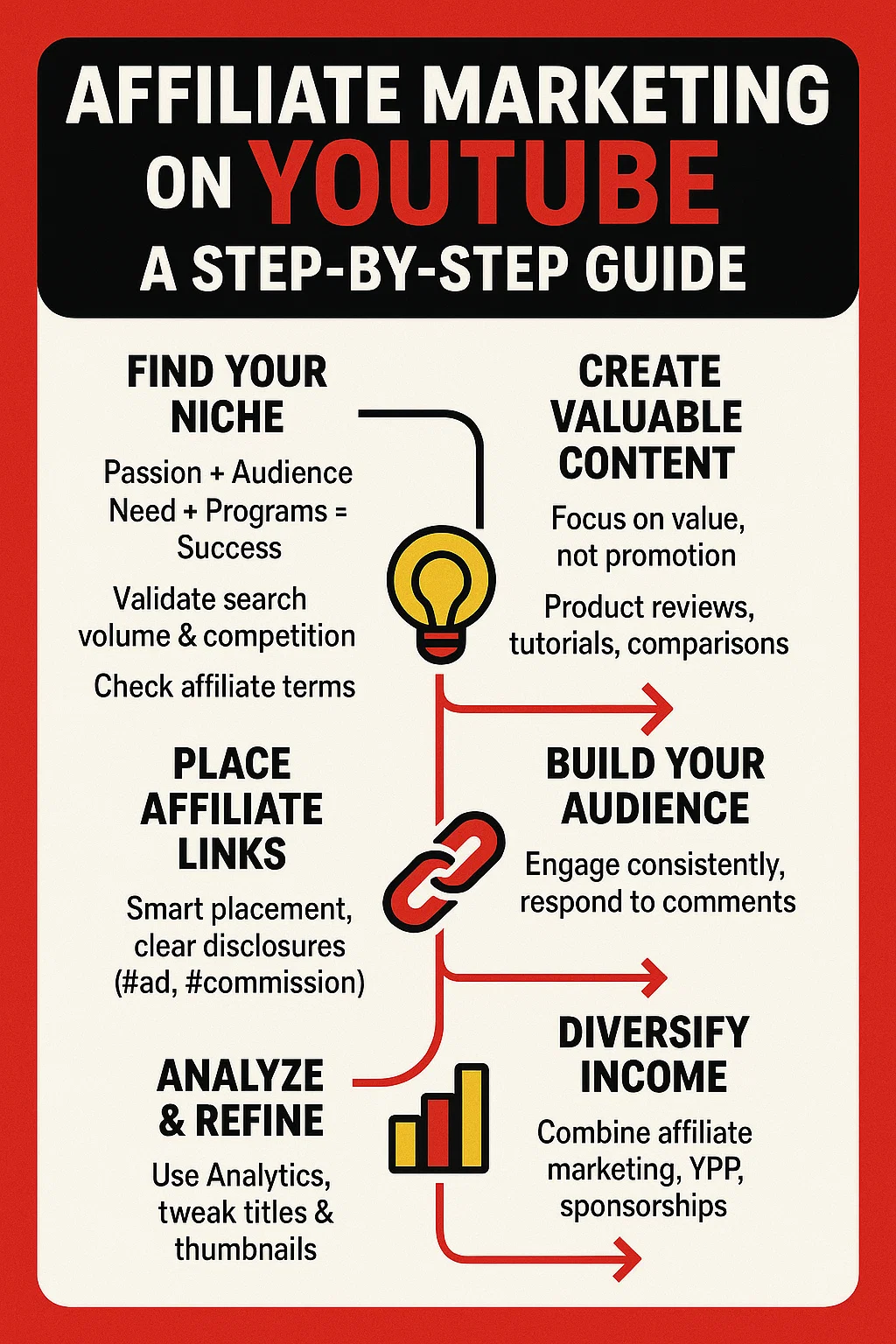
Quick answer: YouTube affiliate marketing works when you publish useful videos for a clear niche, disclose paid relationships, place affiliate links where viewers expect them (description, pinned comment, cards), and support videos with SEO titles, chapters, and a simple tracking workflow. Treat it as a content business, not a shortcut.
| Step | What to do | Why it matters |
|---|---|---|
| 1. Niche + offer fit | Pick topics you can cover repeatedly and programs with cookie/commission terms you understand | Avoid random product spam and policy risk |
| 2. Channel setup | About page, channel keywords, playlists, end screens, and disclosure language ready | Trust + discoverability |
| 3. Link placement | Description timestamps, pinned comment, cards/end screens where allowed | Viewers can act without friction |
| 4. SEO package | Title intent, chapters, transcript-friendly speech, related videos/internal site links | Search + suggested traffic |
| 5. Measure | UTM or network subIDs + retention/CTR notes | Double down on formats that convert |
Related guides: affiliate marketing tips for beginners, affiliate SEO hub, AI affiliate workflows, and answer engine optimization.
Quick answer: YouTube affiliate marketing works best when a video solves a specific viewer problem, demonstrates or explains the decision, discloses the commercial relationship, and sends interested viewers to a useful destination with tracked links. Use clear descriptions, pinned comments only where appropriate, companion pages for complex comparisons, and analytics that connect video topic, link placement, click quality, and confirmed outcomes.
 our full affiliate compliance guides” class=”wp-image-207948124″/>
Written and reviewed by: Alexios Papaioannou. Method: the live article was reviewed for intent, unsupported claims, structure, internal linking, disclosure, schema eligibility, mobile readability, and measurement. Official platform documentation is prioritized for policy-dependent statements. No revenue, ranking, product-testing, or AI-citation outcome is guaranteed.
Who this guide is for and who should skip it
This is for you if
- Creators who publish tutorials, comparisons, reviews, or demonstrations
- Bloggers adding video to high-value search content
- Affiliate teams that need consistent disclosure and link tracking
Skip or adapt this guide if
- Channels built around copied clips or unverified claims
- Creators who will not disclose paid or affiliate relationships
- Anyone expecting description links to compensate for weak videos
What YouTube affiliate marketing means
YouTube affiliate marketing is the use of videos and approved channel surfaces to recommend products or services through tracked affiliate links. The creator may earn a commission on eligible actions, but must follow the affiliate program's terms, YouTube policies, applicable disclosure rules, and any product-claim requirements.
Which YouTube affiliate format should you use?
| Viewer need | Best format | Link destination | Primary success signal |
|---|---|---|---|
| Learn a process | Step-by-step tutorial | Detailed guide or relevant tool | Completion and qualified clicks |
| Compare options | Side-by-side comparison | Comparison page or disclosed direct links | Clicks by option and viewer retention |
| See a result | Demonstration or case-based walkthrough | Methodology and resource page | and downstream actions |
| Get a quick answer | Short plus deeper companion content | Focused landing page | Follow-through, not views alone |
The practical framework
Problem
Start with the viewer's question and context.
Proof
Show the process, interface, result, or decision criteria.
Disclosure
State the relationship in the video and near the link.
Destination
Send viewers to the most useful next step.
Tracking
Use UTMs, affiliate sub-IDs, and placement labels where permitted.
Maintenance
Update descriptions, pinned comments, and companion pages when facts change.
Step-by-step method
- Choose one high-intent viewer question
Use a clear problem such as comparison, setup, alternative, or troubleshooting. - Validate the offer and rules
Read the merchant terms and confirm where links may be placed. - Write a proof-led outline
Open with the outcome, show the decision criteria, and include limitations. - Record original value
Demonstrate, explain, annotate, or compare rather than reading a sales page. - Disclose clearly in the video
Use understandable language before or near the recommendation. - Build a structured description
Include a short summary, disclosure, primary link, companion guide, and resources. - Use a companion page for complex decisions
Keep detailed tables, sources, updates, and alternatives on an owned page. - Track each link placement
Differentiate description, pinned comment, channel page, and companion-page clicks. - Review audience retention and clicks together
A click spike with weak trust or retention is not a complete success. - Maintain the video ecosystem
Update links and notes, and publish a correction or new video when the core information changes.
How to find YouTube topics with commercial intent
Look for questions where viewers need to see a process, interface, product fit, or trade-off before they act.
Begin by turning this subject into a concrete decision. Define the audience, the situation that triggers the question, the choices available, and the information a reasonable reader needs before acting. For How to find YouTube topics with commercial intent, this means prioritizing criteria and trade-offs over broad claims. A section is complete only when it helps the reader understand what to do, when the advice applies, and when a different route is more appropriate.
Document the assumptions behind the recommendation. Separate stable principles from facts that can change, such as pricing, product features, platform rules, or commission terms. When a claim depends on current information, identify its source and review date. When evidence is incomplete, state the uncertainty and propose a small validation step instead of presenting an estimate as fact.
Finish with an operational next step. The reader should be able to apply the criteria, collect the necessary evidence, and make a decision without searching for missing instructions elsewhere. The editor should also be able to audit the section later using the same criteria.
The proof-led affiliate video script
A trustworthy script moves from problem and context to criteria, demonstration, limitations, recommendation, disclosure, and next step.
The quality of this section depends on the evidence chain. Start with primary documentation, direct records from the real workflow, or clearly identified research synthesis. Do not convert a vendor statement, model output, or anecdote into an independent conclusion. For The proof-led affiliate video script, list the material claims, the source for each claim, the date checked, and the person responsible for approving the wording.
Evidence also needs context. A feature can exist without being useful for every audience, and a result observed in one campaign does not prove a universal effect. Explain the conditions, exclusions, and limitations that change the recommendation. This gives readers a reasoned basis for acting and gives future editors a clear update path.
Use a claims ledger for policy-sensitive, commercial, technical, and numerical statements. When the source changes or expires, the ledger should trigger review of the affected paragraph, table, CTA, and schema rather than relying on a calendar-only refresh.
Where to put affiliate links on YouTube
Descriptions, pinned comments, channel surfaces, and companion pages have different context and policy considerations.
Implementation should be divided into a small repeatable sequence: capture the current state, choose one change, assign an owner, define the expected reader benefit, and set a validation method. For Where to put affiliate links on YouTube, avoid changing several variables at once when a controlled test is possible. A focused change makes success and failure easier to interpret.
Build the workflow so that it can be repeated without depending on one person’s memory. Store the brief, sources, decisions, final copy, links, screenshots, and analytics labels together. Use staging or a review copy for risky technical or commercial changes, and retain a rollback path before publishing.
After release, inspect the rendered page rather than assuming the editor view is correct. Confirm mobile layout, links, disclosure placement, tracking, structured data, and the actual destination experience. Implementation is complete only when the public output matches the approved plan.
How to write a YouTube description that helps viewers
The description should summarize the video, disclose the relationship, identify the primary resource, and avoid a wall of unrelated links.
Every recommendation has boundaries. Identify the audience it does not serve, the circumstances that would change the answer, and the evidence that remains unavailable. In How to write a YouTube description that helps viewers, this prevents the article from turning a conditional recommendation into a universal claim. Limitations are useful decision information, not a weakness to hide.
Consider operational risk as well as content risk. Platform dependence, merchant changes, product availability, account restrictions, privacy obligations, licensing, and maintenance effort can change the value of a tactic. Rank these risks by likelihood and impact, then define a prevention or fallback step for the material ones.
Use stop conditions. Publication should pause when a required source cannot be verified, a commercial relationship is undisclosed, a destination is broken, or a claim implies experience that did not occur. Clear stop conditions protect the reader and reduce expensive corrections.
Using Shorts without losing context
Shorts can introduce a problem or comparison, but complex recommendations often require a longer video or companion page.
Measure this topic with a chain of indicators rather than one headline metric. Visibility, engagement, email action, affiliate click, merchant outcome, refund, and net contribution describe different stages. For Using Shorts without losing context, choose the smallest set that explains whether the page reached the right audience, helped the decision, and produced an appropriate next action.
Use defined comparison windows and annotate meaningful changes. A title rewrite, redirect, platform update, campaign, product launch, or tracking change can alter the numbers. Avoid claiming causation from a simple before-and-after chart when several variables changed.
Translate measurement into a decision: keep, improve, expand, consolidate, pause, or stop. Record the evidence and the next review date so the team learns from the result rather than repeatedly debating the same assumption.
YouTube disclosure and paid-promotion settings
A creator should use clear spoken or on-screen disclosure and the relevant platform tools when content includes a material relationship.
Maintenance should be designed at publication time. Classify each fact in YouTube disclosure and paid-promotion settings as stable, periodically reviewable, or event-triggered. Stable principles can follow a slower editorial cycle, while prices, features, policies, links, and product availability require a current source and a faster trigger.
Assign ownership for the page and for high-risk components such as affiliate boxes, comparison tables, screenshots, and structured data. A visible review date is meaningful only when the underlying facts were actually checked. Do not change a date merely to imply freshness.
When the recommendation changes, update the explanation and not only the product or CTA. Preserve a concise correction or revision note when the earlier conclusion could materially affect a reader’s decision. This creates a trustworthy history and prevents silent contradictions across the site.
Tracking YouTube affiliate performance
Connect the video, topic, placement, destination, and merchant so you can distinguish qualified behavior from broad view counts.
Run a separate editorial challenge pass for Tracking YouTube affiliate performance. The reviewer should look for intent drift, unsupported precision, circular reasoning, commercial bias, missing alternatives, inaccessible formatting, and claims that depend on unstated assumptions. The goal is to find defects, not to defend the draft.
Check the content against the actual page role. A definition page, tutorial, comparison, review, compliance guide, and strategy article need different evidence and structures. Remove sections that exist only because a template expects them, and add the decision support the reader genuinely needs.
Close the review with explicit gates for facts, sources, disclosure, links, images, schema, mobile behavior, and analytics. Record PASS or STOP for each gate and resolve critical failures before publication.
Refreshing evergreen affiliate videos
Update links and descriptions when possible, and create a new version when the product, policy, or decision has materially changed.
Design this section around the reader’s next question. After learning about Refreshing evergreen affiliate videos, the reader may need a comparison, checklist, calculator, tutorial, policy source, or relevant merchant destination. Provide that next step in context and explain why it is useful instead of appending a generic list of links.
Keep the commercial path proportional to the reader’s stage. Early educational sections should not pressure a purchase, while a well-supported decision section can offer a clear disclosed CTA. The page should remain complete for readers who do not click an affiliate link.
Review the experience on mobile, where long headings, wide tables, repeated boxes, and dense paragraphs can obscure the answer. Use scannable sections, descriptive anchors, and enough spacing to make the guidance usable without turning it into superficial fragments.
30-day implementation plan
Use this plan to turn YouTube Affiliate Marketing in 2026: How to Add Links, Disclose, Track, and Convert into a controlled operating change rather than a one-time reading exercise. Keep the scope small enough to complete, document the baseline before editing, and assign a named owner for each deliverable. The purpose of the month is to produce one validated workflow and a clear next decision, not to scale unproven output.
| Period | Primary work | Deliverable | Validation |
|---|---|---|---|
| Days 1-7 | Choose one high-intent viewer question; Validate the offer and rules; Write a proof-led outline | Approved brief, baseline, sources, and decision criteria | Owner confirms the audience, intent, evidence, exclusions, and current technical state |
| Days 8-14 | Record original value; Disclose clearly in the video; Build a structured description | First complete implementation or content asset | Fact, disclosure, rights, link, and usability review passes |
| Days 15-21 | Use a companion page for complex decisions; Track each link placement | Connected distribution, tracking, and supporting assets | Events, destinations, mobile behavior, and ownership are verified |
| Days 22-30 | Review audience retention and clicks together; Maintain the video ecosystem | Performance review and next-action record | Keep, improve, expand, consolidate, pause, or stop is documented with evidence |
During the month, maintain a compact decision log with the date, change, reason, source, owner, and expected reader benefit. Record unexpected defects and corrections as carefully as positive outcomes. This prevents later teams from repeating failed assumptions and helps separate the effect of the implementation from unrelated platform, market, or seasonal changes.
At the end of the cycle, do not scale automatically. Confirm that the workflow produced an accurate, useful, compliant result and that the measurement is trustworthy. If the result is inconclusive, define the smallest next test. If the process created repeated factual, legal, technical, or editorial failures, repair the system before producing more content.
Editorial acceptance criteria
- The page or asset has one clear audience, intent, and primary action.
- Every material claim is sourced, qualified, or removed.
- Research synthesis, hands-on experience, and editorial judgment are labeled accurately.
- Commercial relationships are disclosed before or close to the recommendation.
- Links reach the intended final destination and tracking does not obscure user choice.
- Images, product data, quotations, and logos have an approved source or license.
- The mobile experience preserves the answer, tables, controls, and reading order.
- A named owner, review trigger, correction path, and measurement plan are recorded.
Examples by situation
| Situation | Recommended move | Why it fits |
|---|---|---|
| Software tutorial | Show the exact workflow and link to a detailed setup guide | The viewer can evaluate usefulness before clicking |
| Product comparison | Explain decision criteria and send viewers to a current comparison table | The owned page can be updated more easily than the video |
| Short-form tip | Use a Short to introduce the problem and route to a full tutorial | The recommendation retains context |
| Troubleshooting channel | Link to a checklist and compatible alternatives | The destination extends the solution rather than repeating the pitch |
Original methodology, evidence boundaries, and limitations
This article uses a research-synthesis method rather than fabricated first-hand testing. The process begins with the reader’s decision, maps the claims that require current evidence, checks official rules where policies matter, and turns the result into a workflow that can be measured. Examples are illustrative unless they are explicitly attributed to a source. Tool features, prices, commission terms, platform interfaces, and program rules can change after the review date.
The strongest evidence for an affiliate article is not a generic content score. It is a traceable combination of primary-source documentation, screenshots or records from the real workflow, accurate disclosures, reproducible steps, and performance data tied to a defined period. Where that evidence is unavailable, this guide avoids invented numbers and recommends a controlled test instead.
Helpful video walkthrough
Video topic: Affiliate disclosure and compliance overview. The written guide contains the complete method independently of the embed.
How to choose the next action
After applying this guide, choose the next action from evidence rather than enthusiasm. Keep the current approach when it is accurate, useful, maintainable, and producing qualified behavior. Improve it when the audience and intent are correct but the evidence, explanation, usability, or conversion path is weak. Expand only when the existing workflow is stable and an adjacent need serves the same audience. Consolidate when several assets compete for the same intent or repeat the same value. Pause or stop when the tactic depends on unverifiable claims, poor-fit offers, unsustainable cost, or a policy risk that cannot be controlled.
Record the decision with the relevant metrics, source checks, owner, and review date. This makes YouTube Affiliate Marketing in 2026: How to Add Links, Disclose, Track, and Convert part of an operating system rather than an isolated article. A documented decision also prevents a future editor from reversing the change without understanding the evidence that supported it.
Common mistakes and troubleshooting
| Common mistake | Why it fails | Practical correction |
|---|---|---|
| Putting links before explaining value | The viewer lacks context and trust | Demonstrate or explain before the CTA |
| Using vague disclosure | The material relationship may not be understood | Say plainly that you may earn a commission |
| Adding dozens of unrelated links | The description becomes confusing | Prioritize one primary action and a few relevant resources |
| Reusing merchant footage as the whole video | The creator adds little original value | Record original explanation, demonstration, or analysis |
| Tracking only views | Views do not reveal qualified commercial action | Use link-level and destination analytics |
| Leaving old descriptions untouched | Links and claims can become stale | Maintain a review log and update policy-sensitive elements |
Frequently asked questions
Can I put affiliate links in YouTube descriptions?
Often yes, when the merchant terms and YouTube policies permit it. Use clear disclosure and avoid prohibited or deceptive destinations.
Do I need to disclose affiliate links in the video?
A clear disclosure in the content and near the link is the safer reader-first approach because viewers should understand the relationship before acting.
Should I link directly to the product or to my website?
Use the destination that best serves the viewer. Complex decisions benefit from an updateable companion page; simple, well-explained actions may use a disclosed direct link.
Are pinned comments good for affiliate links?
They can be useful when relevant and disclosed, but should not replace a structured description or necessary context.
Can I use affiliate links in YouTube Shorts?
Use only supported surfaces and follow current YouTube and merchant rules. A companion page can preserve context for a short video.
What videos work best for affiliate marketing?
Tutorials, demonstrations, comparisons, alternatives, setup guides, and troubleshooting videos often align with real decisions.
How do I track YouTube affiliate sales?
Use UTMs, affiliate sub-IDs where allowed, GA4 events, and merchant reporting to connect video and placement to outcomes.
How often should I update affiliate videos?
Review links and claims on a schedule and act sooner when a product, interface, policy, or recommendation changes.
Recommended next reading
- Affiliate marketing compliance
- Affiliate marketing strategy
- Improve affiliate content
- Affiliate SEO guide
- Affiliate marketing hub
- Start affiliate marketing
- Affiliate disclosure
- Email marketing hub
- AI and automation guides
- Affiliate tools and reviews
FAQ: YouTube affiliate marketing
Quick FAQ summary: YouTube affiliate marketing works best with niche-fit offers, clear disclosures, useful videos, clean link placement, and tracking. Optimize for viewer trust first, then conversion.
How do you do affiliate marketing on YouTube?
Pick a niche audience, join relevant programs, create useful videos, disclose relationships, place links in the description and other allowed placements, and track results with UTMs or subIDs.
Where should affiliate links go on YouTube?
Usually in the video description near the top, in a pinned comment when helpful, and in cards/end screens when allowed. Keep links labeled clearly and paired with disclosure.
Do you need to disclose affiliate links on YouTube?
Yes. Use clear spoken and written disclosure when promoting affiliate offers, and follow YouTube paid-promotion settings plus FTC/advertising rules in your market.
What is the best YouTube format for affiliate marketing?
Comparison, tutorial, and review-style videos usually convert better than generic hype because viewers can evaluate fit, limitations, and next steps.
How long does YouTube affiliate marketing take to work?
It usually takes consistent publishing and SEO compounding over weeks or months. Treat it as a content system, not a quick payout tactic.
Can YouTube Shorts work for affiliate marketing?
Shorts can drive discovery, but longer videos and strong descriptions usually handle deeper product decisions better. Use Shorts to route viewers into fuller explainers.
Related guides: beginner affiliate tips, affiliate SEO hub, AEO, and tool reviews.
Sources and editorial note
Editorial note: Reviewed 2026-07-10. Policy-dependent instructions should be checked again before major campaigns, migrations, or commercial updates. The page is designed to retain its existing URL and to use a self-referencing canonical when published at the stated target URL.

Alexios Papaioannou is the founder and lead editor of Affiliate Marketing for Success. He focuses on affiliate marketing systems, SEO, content strategy, monetization design, and the impact of AI-driven search on publishers. Editorial background, disclosure standards, and correction policy are documented on the site’s About Alexios and Editorial Policy pages.

![7 Hard Truths Why 95% of Affiliate Marketers Fail [2026] featured infographic image](https://affiliatemarketingforsuccess.com/wp-content/uploads/2026/06/why-affiliate-marketers-fail-featured-image-amfs-2-768x432.webp)