
Recommended stack
Best Affiliate Marketing Tools for Beginners and Growing Sites (2026)
If you want the short answer, the best affiliate marketing tools for most content-led publishers in 2026 are simple: Cloudways for long-term hosting performance, Semrush for the broadest SEO workflow, and Kit for owned-audience growth and email automation. Everything else should be added only when it solves a real bottleneck in traffic, workflow, or conversions.
This page is built to help you choose the right affiliate website tools without wasting money on software bloat. Instead of dumping dozens of logos into one list, it organizes the stack by the systems that actually make an affiliate site grow: hosting, SEO, email, content production, media, workflow efficiency, and owned-audience compounding.
Affiliate disclosure
Some links on this page are affiliate links. That means Affiliate Marketing for Success may earn a commission if you buy through them. We still try to match each recommendation to the actual use case instead of treating the highest payout as the automatic winner. Read the full affiliate disclosure.
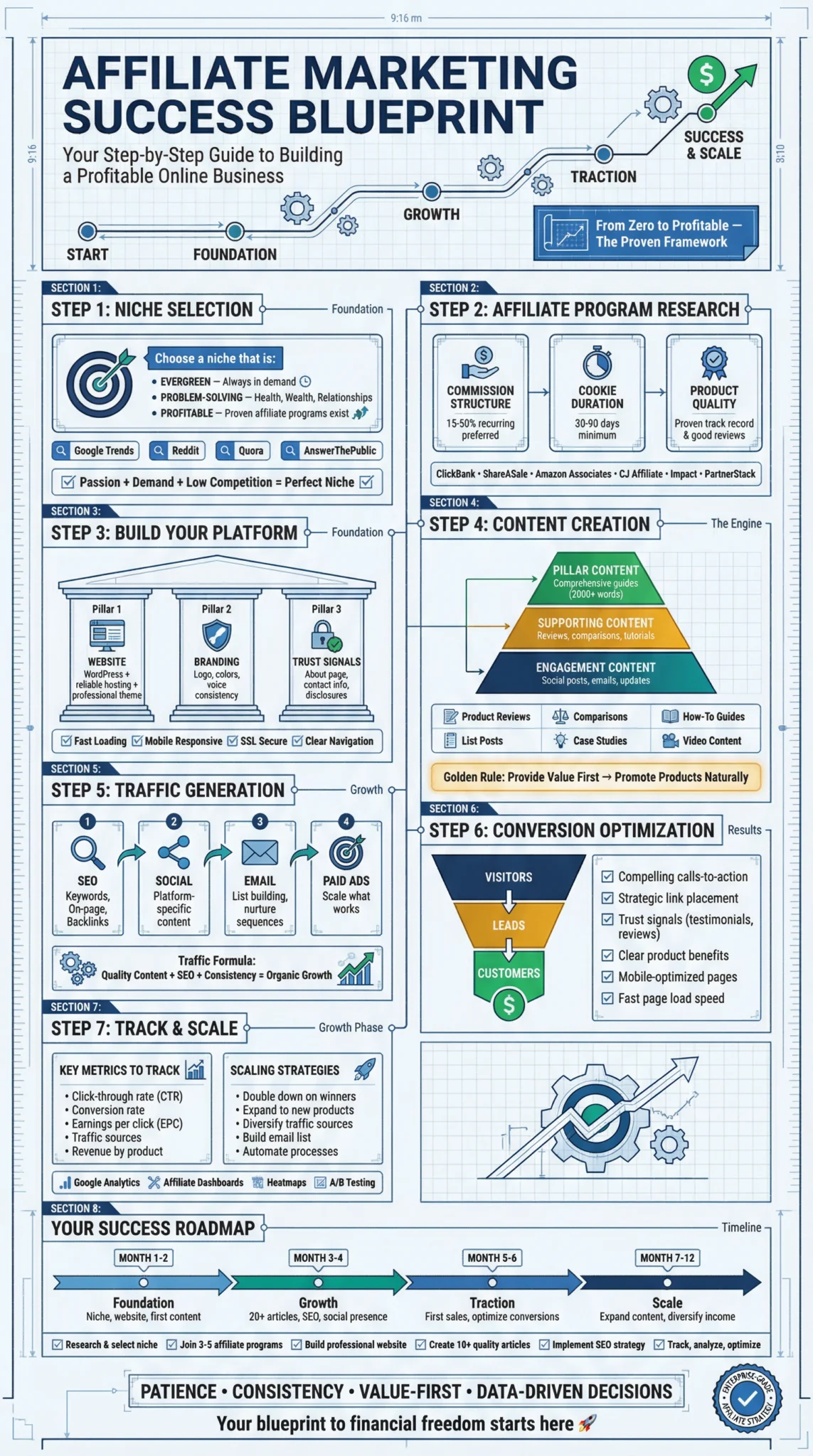
What most affiliate site builders actually need
Most affiliate marketers do not fail because they picked the wrong logo once. They fail because they build a messy stack with no operating logic. They buy too many tools too early, skip the systems that matter, and end up with a site that feels slow, a content workflow that breaks, and an email list that never compounds.
The right stack is not the one with the most software. It is the one that helps your affiliate site do four things well: publish content consistently, rank for the right searches, convert some of that traffic into an owned audience, and create a cleaner path to monetization. That means the best affiliate marketing tools depend on your stage, your bottleneck, and your business model.
For most content-led affiliate sites, the practical stack starts with three layers: reliable hosting, one strong SEO workflow, and one email platform that fits your growth model. Then you add supporting tools for video, AI-assisted workflows, content optimization, or quality control only after the core system is stable.
| Tool | Best for | Why it makes the shortlist | Primary caution | Best next step |
|---|---|---|---|---|
| Cloudways | Performance-first affiliate sites | Stronger speed, flexibility, and long-term hosting headroom | More setup complexity than a beginner host | Compare Cloudways vs Bluehost |
| Bluehost | Beginners launching a first site | Easier onboarding and lower-friction setup | Weaker long-term fit for speed-sensitive growth | See when Bluehost still makes sense |
| Semrush | Broad SEO workflow and content planning | Still the strongest editorial recommendation for most affiliate SEO workflows | Commercial link paused until a new verified partner link exists | See Semrush vs Ahrefs |
| Ahrefs | Backlink research and deeper competitor teardown | Excellent for research-heavy SEO operators | Less ideal as the first all-in-one workflow for many affiliate beginners | Compare Ahrefs vs Semrush |
| Kit | Lead magnets, list building, and nurture automation | Better fit for site-led affiliate funnels and owned audiences | Less publication-oriented than Beehiiv | Compare Kit vs Beehiiv |
| Beehiiv | Newsletter-first growth | Better if the newsletter itself is the product | No verified affiliate link stored yet | See the use-case breakdown |
| Pictory | Repurposing articles into video assets | Useful for turning written content into video-led traffic and distribution assets | Not a core tool unless video is part of the strategy | See video repurposing strategy |
| Originality.ai | Quality control and AI-content review | Useful when editing, outsourcing, or tightening editorial quality governance | Should support editorial judgment, not replace it | See AI writing detector guidance |
Quick answer: the highest-leverage stack for most affiliate sites
If your affiliate site is content-led, the strongest default stack right now is Cloudways for performance-first hosting, Semrush editorially for the broadest SEO workflow, and Kit for owned-audience growth. That combination gives you a stronger base for rankings, email capture, topical authority, and monetization than spreading your budget across too many tools too early.
The best affiliate marketing tool stack by stage
The right tool stack for a first-time affiliate site builder is not the same as the right stack for a publisher already managing topic clusters, comparison pages, and an owned-audience funnel. That distinction matters because people often overspend on advanced software before they have even fixed the basics.
If you are just starting, your priority is not maximizing optionality. It is reducing failure risk. You need a host that gets the site online, a content system that helps you publish useful pages, and an email platform that captures value before search volatility hits. If you already have traction, then performance, SEO workflow depth, and audience segmentation become much more important.
If you are just starting
Keep the stack lean. A beginner affiliate site does not need ten subscriptions. Start with hosting, a content plan, and one owned-audience layer.
- Bluehost if you want the easiest launch
- Kit if you want to build an email list early
- Use the Affiliate Growth Checklist to avoid tool sprawl
If you want a higher-performance stack
Once rankings, content volume, and monetization matter, stronger infrastructure pays off faster than adding random tools.
- Cloudways for better hosting headroom
- Semrush editorially for a broader SEO workflow
- Kit for turning traffic into an owned audience
If your stack feels bloated
The right stack is not the one with the most logos. It is the one that removes the next bottleneck with the least waste.
- Keep one primary SEO system
- Keep one primary email platform
- Add media or QA tools only when they solve a real workflow problem

Hosting tools for affiliate sites
Hosting affects more than technical comfort. It influences page speed, crawlability, plugin stability, Core Web Vitals, and how resilient your site feels as it grows. That makes hosting one of the few tool decisions that can affect both rankings and monetization at the same time.
For most beginners, Bluehost still has a valid role because it reduces onboarding friction. But for content-led affiliate sites that expect to scale, Cloudways is the stronger long-term bet because it gives better performance headroom and a better fit for more serious WordPress operations.
- Use Bluehost if your main objective is getting the first site online fast.
- Use Cloudways if you already know your site will need better speed, better flexibility, and less friction later.
- Read Cloudways vs Bluehost for Affiliate Sites before choosing.
SEO tools for affiliate content, topical authority, and AI visibility
SEO tools matter because affiliate marketers need a repeatable way to find search intent, evaluate competition, group topics into clusters, and identify which pages deserve priority. The wrong SEO software usually creates one of two problems: either you cannot see enough, or you see too much but cannot turn that information into action.
That is why Semrush remains the stronger editorial recommendation for most affiliate site builders. It is easier to use as a complete operating system for keyword research, topic planning, ranking visibility, and competitor analysis. Ahrefs is still outstanding, especially when your edge comes from backlink research and deeper SERP teardown. But for many publishers, Semrush is more actionable as a day-to-day workflow platform.
- Choose Semrush editorially if you need broader workflow support and easier content-planning leverage.
- Choose Ahrefs if your process is already mature and your edge comes from research depth and backlink intelligence.
- See Semrush vs Ahrefs for Affiliate Marketing for the detailed verdict.

Email tools for owned audience growth
Email is the owned-audience layer most affiliate site owners delay too long. That delay is expensive. Search traffic can fluctuate, rankings can stall, and content can take months to mature. An email list helps you keep attention, deepen trust, and create a more stable path to monetization.
Kit is the stronger default for most affiliate site owners because it fits lead magnets, segmentation, creator-style automation, and nurture sequences tied to a content site. Beehiiv can absolutely be the better option, but mostly when the newsletter itself is the product or the main publication engine. If your site is still the center of gravity, Kit usually makes more sense.
- Choose Kit if your site is the acquisition engine and email is the owned-audience layer.
- Choose Beehiiv if your newsletter is the primary product and growth asset.
- See Kit vs Beehiiv for Affiliate Newsletters before committing.
Media, repurposing, and workflow-support tools
Once your core stack is working, supporting tools can make the system more efficient. Pictory is useful if you want to repurpose articles into video assets for YouTube, short-form distribution, or social amplification. Originality.ai can help when quality-control risk exists, especially if you outsource content, edit AI-assisted drafts, or want tighter editorial review.
The key is to treat these as secondary tools. They should improve the workflow after the fundamentals are in place. They should not distract from publishing better pages, choosing the right topics, or building the email layer that protects you from search volatility.
How to choose the right affiliate website tools without wasting money
Use this rule: buy the tool that fixes the next real bottleneck, not the tool with the loudest reputation. If your site is slow, stronger hosting matters more than another AI helper. If you cannot decide what to publish, a better SEO workflow matters more than another dashboard. If you are getting traffic but not keeping it, email matters more than almost anything else.
That is also why the best affiliate marketing software stack changes over time. The right stack at zero traffic is different from the right stack at 50 published posts. Your tools should evolve with the site, but they should evolve logically. A stack built around bottlenecks stays efficient. A stack built around hype gets expensive fast.
Common affiliate tool-stack mistakes that waste money and slow growth
One of the most common mistakes is buying advanced software before the site has earned the right to use it. A new affiliate site with almost no content does not need a bloated software stack. It needs a publishable setup, a practical content plan, and a simple monetization path. Another common mistake is paying for multiple overlapping tools that all claim to solve the same problem while none of them are actually integrated into a real workflow.
- buying too many SEO tools before publishing enough useful content
- using expensive email software before having a clear lead magnet or list-building path
- choosing hosting based only on first-year promo pricing instead of long-term site quality
- adding AI or media tools that create more output but not better output
- copying another creator’s stack without matching your own stage, niche, or traffic model
The practical fix is to treat every tool as part of a system. If you cannot explain exactly what problem it solves, what business outcome it should improve, and how it fits with the rest of the stack, you probably do not need it yet.
What a high-quality affiliate site stack should help you do
A premium affiliate stack should make the site easier to operate, not more complicated. At a minimum, it should help you publish better pages, improve search visibility, keep the site stable, build an owned audience, and create cleaner paths from traffic to monetization. That means the winning tool stack should improve both efficiency and outcome quality.
- Operational clarity, so you know what to publish, what to fix, and what to measure next
- Search support, so keyword research, entity coverage, and internal-link planning become easier
- Audience growth, so a portion of search traffic becomes a reusable owned audience
- Quality governance, so content output stays useful, credible, and worth ranking
- Monetization fit, so the stack supports affiliate revenue instead of distracting from it
That standard is what separates a real affiliate operating system from a random bundle of subscriptions. The best tools are not the tools with the most features. They are the tools that improve your publishing, ranking, audience, and monetization loop in the clearest possible way.
Helpful video
Watch this before choosing your SEO stack
This video is embedded directly so readers can watch the comparison without leaving the page. It is especially relevant because SEO software is one of the earliest expensive decisions many affiliate site builders make.
Helpful video: choosing the right SEO stack
This video is useful because it helps contextualize one of the most common affiliate tool decisions, Semrush vs Ahrefs. That is relevant here because SEO software is usually one of the first expensive subscriptions affiliate site builders consider, and choosing the wrong one can create a lot of wasted motion.
A practical buying framework for affiliate site builders
If you are deciding whether a tool belongs in your stack, run it through four questions. First, what bottleneck does it remove right now? Second, what outcome should improve if you use it correctly, traffic, rankings, email growth, speed, or content quality? Third, what would break or stay weak if you skip it? Fourth, does it replace another tool or just add more complexity? If the answers are vague, it is probably not a priority purchase yet.
This framework is especially important for affiliate marketers because software spending can quietly erase margin. It is easy to justify a subscription when the marketing page sounds impressive. It is harder to admit later that the tool did not materially improve publishing velocity, ranking potential, or monetization quality. Buying with a framework protects you from that trap.
- Buy now when the tool removes an obvious bottleneck that is actively limiting growth.
- Delay when the site is not mature enough to use the tool properly yet.
- Skip when the tool duplicates something you already have or solves a problem you do not have.
- Replace when one stronger tool can remove the need for two weaker ones.
The best affiliate stack decisions usually look boring at first. They feel practical, not flashy. But those practical decisions compound because they make the core growth loop smoother month after month.
Best next reads by decision type
- Cloudways vs Bluehost for Affiliate Sites
- Semrush vs Ahrefs for Affiliate Marketing
- Kit vs Beehiiv for Affiliate Newsletters
- Affiliate SEO in 2026
- AI Affiliate Marketing
- Best Affiliate Gap Analysis Tools
Best tools by category
Hosting
Performance-first stack
Use Cloudways if you want more flexibility and long-term headroom. Use WPX if you want premium managed WordPress simplicity and stronger support.
SEO workflow
Optimization and planning tools
Choose NeuronWriter for optimization discipline, Scalenut for broader workflow unification, and Frase for faster research-to-brief planning.
Email and growth
List building and automation
Use GetResponse when you want email plus funnels and automation in one platform. Use Kit when creator-style newsletter growth is the main goal.
Content production
Video and writing acceleration
Use Pictory when repurposing written content into video is a real bottleneck. Use QuillBot when rewriting and cleanup speed matter more than net-new strategy.
Frequently asked questions
What tools do I need to start an affiliate marketing website?
At minimum, you need reliable hosting, a content plan, and a way to build an owned audience. For many site builders, that means beginner-friendly hosting or higher-performance hosting depending on stage, one SEO workflow system, and one email platform that fits the site’s growth model.
What is the best hosting for affiliate marketing websites?
For most serious affiliate site builders, Cloudways is the stronger long-term option because it gives better performance headroom and a stronger fit for scaling WordPress sites. Bluehost still makes sense when beginner simplicity is the highest priority.
What is the best SEO tool for affiliate marketers?
Semrush is still the stronger editorial default for most affiliate site owners because it is easier to use as a broad SEO workflow for keyword research, content planning, and rankings. Ahrefs is still excellent for deeper backlink and competitor analysis.
Do affiliate site builders need an email platform early?
Yes, if they want to reduce dependence on search traffic. Email gives affiliate publishers an owned audience, a stronger trust layer, and a way to nurture readers beyond one pageview.
Recommended default stack for most affiliate site builders
If you want the cleanest default recommendation for a content-led affiliate site, the strongest stack right now is:
- Cloudways for hosting if you care about long-term performance and scaling headroom
- Semrush editorially for the broader SEO workflow, pending a new verified partner link
- Kit for owned-audience growth and nurture automation
Then add supporting tools only when they solve a real bottleneck in media, workflow efficiency, or editorial quality control.
Related guides
Build the rest of your affiliate growth stack
If you are comparing affiliate tools, these are the next pages worth reading based on your growth stage and bottleneck.
- Semrush vs Ahrefs for Affiliate Marketing — choose the right SEO workflow
- Cloudways vs Bluehost for Affiliate Sites — match hosting to your site stage
- Kit vs Beehiiv for Affiliate Newsletters — pick the right email growth model
- AI Affiliate Marketing — use AI without hurting trust or conversions
- Programmatic SEO for Affiliate Sites — scale topic coverage carefully
- Free Affiliate Growth Checklist — turn this stack into an execution plan
For transparency, review our editorial policy and review methodology.
Affiliate Stack FAQ
What are the essential tools for a new affiliate site?
The leanest effective stack includes reliable hosting (Cloudways or Bluehost), an SEO tool for keyword research (Semrush), and an email platform (Kit) to build an owned audience.
Is AI software necessary for affiliate marketing?
AI tools like SEOWriting.ai or Frase are not “required,” but they significantly accelerate content production and SEO optimization workflows for growing sites.
Affiliate Tool Stack FAQ
What are the must-have tools for affiliate marketing in 2025?
The essential stack includes high-performance hosting (Cloudways), a comprehensive SEO suite (Semrush), and an email automation platform (Kit) to build an owned audience.
Is free affiliate marketing software worth it?
Free tools like Google Search Console and Canva are essential. However, investing in a professional SEO tool for affiliate marketers is often necessary to find low-competition keywords effectively.