How to Start an Affiliate Marketing Blog in 2026: A 7-Step Roadmap
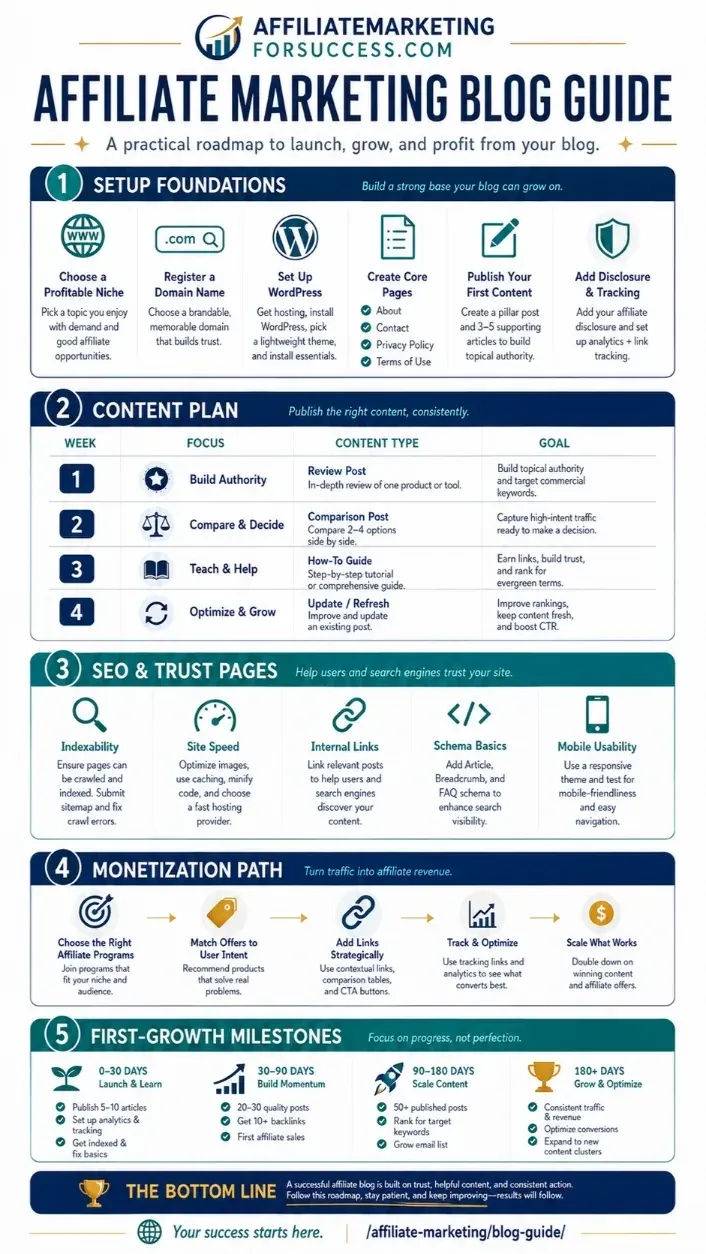
Quick Answer: To start an affiliate marketing blog, choose a niche you understand, set up WordPress on managed hosting, publish 8–12 targeted posts, join Amazon Associates and at least one affiliate network, add clear disclosures, and set up Google Analytics 4 click tracking. Most bloggers see their first affiliate click within 60–90 days of launching.
What You Need Before You Start
Starting an affiliate marketing blog requires three things: a niche you can write honestly about, a basic web presence, and realistic expectations. The process takes 30–90 days before you see meaningful traffic, and most affiliate blogs earn nothing meaningful in their first year.
If you want to skip ahead to a specific step:
- Step 1: Choose your niche
- Step 2: Set up your domain and hosting
- Step 3: Configure WordPress
- Step 4: Install essential plugins
- Step 5: Publish your first content cluster
- Step 6: Join affiliate programs
- Step 7: Add disclosures and start tracking
Step 1: Choose a Niche You Can Write About
Your niche is the topic area your blog covers. The best affiliate niches balance three factors:
- Your knowledge or genuine interest — You need to write honestly and research thoroughly.
- Search demand from buyers — People searching for information that leads to purchases.
- Available affiliate programs — At least two or three programs paying real commissions.
Strong affiliate niches with proven programs:
| Niche | Program Examples | Typical Commission | Difficulty |
|---|---|---|---|
| WordPress hosting and web tools | Cloudways, Bluehost, Kinsta | 10–30% recurring | Moderate |
| SEO and marketing software | Semrush, Ahrefs, Surfer | 15–40% recurring | High |
| Personal finance | Credit cards, banks, loans | 1–5% | High competition |
| Health and fitness | Supplements, equipment, programs | 5–20% | Moderate |
| Home improvement | Tools, furniture, organization | 3–15% | Moderate |
See the best affiliate programs for beginners for specific program recommendations by niche.
Step 2: Register a Domain and Set Up Hosting
Your domain name and hosting are your foundation. Choose a domain that:
- Is easy to spell and remember
- Does not use numbers or hyphens
- Reflects your niche or brand identity
- Is available at Namecheap, Cloudflare, or your hosting provider
For WordPress hosting, use managed WordPress hosting from a provider with a good affiliate program so you can also recommend the hosting you use. See the best WordPress hosting for affiliate sites for a detailed comparison of Cloudways, Bluehost, Kinsta, SiteGround, and WPX.
Step 3: Configure WordPress
After installing WordPress through your host, configure these settings first:
- Set your site title and tagline — Reflects your niche and what you help readers do.
- Choose a clean theme — Use a lightweight, fast-loading theme. Avoid bloated page builder themes.
- Set URLs to HTTPS — Redirect all HTTP to HTTPS in your host’s SSL settings.
- Set permalink structure to “Post name” — Clean URLs help both SEO and readability.
- Set up user profile — Add your author bio, photo, and social links.
Step 4: Install Essential Plugins
Install only what you need. More plugins slow your site down.
| Plugin | Purpose | Free Option |
|---|---|---|
| Yoast SEO or Rank Math | On-page SEO, XML sitemap | Free version sufficient to start |
| WP Fastest Cache | Site speed and caching | Free |
| Wordfence | Security and login protection | Free |
| Pretty Links or ThirstyAffiliates | Affiliate link management | Free / Freemium |
| SiteKit by Google | Analytics, Search Console, AdSense in dashboard | Free |
Step 5: Publish Your First Content Cluster
Before joining affiliate programs, publish at least 3–5 substantive posts. Your first cluster should include:
- 1 informational guide — A comprehensive how-to post in your niche
- 1 comparison post — A comparison of two related products or approaches
- 1 review post — An honest review of a product relevant to your niche
Each post should be at least 1,500 words with real substance, not padded content. See the affiliate content strategy hub for the full cluster-building guide and post templates.
Step 6: Join Affiliate Programs
Apply to these in order:
- Amazon Associates — Apply after 3 posts are live. Easy approval, low commissions, enormous product range. Amazon Associates guide
- Affiliate networks — ShareASale, Impact, Awin. Apply when you have 10+ posts and 300+ monthly visitors.
- Direct affiliate programs — Higher commissions, requires individual applications. Apply when you have 500+ monthly visitors and can show what you’ve published.
See the ShareASale review and Impact review for network comparisons.
Step 7: Add Disclosures and Start Tracking
Add an affiliate disclosure to your site footer and include a specific disclosure above the fold on every review post. FTC regulations require clear disclosure before any affiliate link appears.
Set up Google Analytics 4 with custom events for affiliate link clicks. Track:
- Which posts send the most affiliate clicks
- Which affiliate programs are converting
- Revenue per click (RPC) by content type
The tracking guide covers GA4 setup in detail.
Common Beginner Mistakes
- Joining too many programs at once — Start with Amazon Associates and one network.
- Publishing thin content — Posts under 1,000 words rarely rank. Aim for 1,500+.
- Skipping disclosures — Required by FTC regulations.
- Promoting products you have not used or researched — Honesty is your only real competitive advantage.
- Expecting fast results — First affiliate income typically takes 6–12 months of consistent publishing.
Frequently Asked Questions
How much does it cost to start an affiliate marketing blog?
A basic affiliate blog costs $100–500 in the first year: domain ($10–15), hosting ($60–300/year), and optional tools. You do not need paid SEO tools or premium themes to start.
How many posts do I need before joining Amazon Associates?
Amazon requires at least three published posts with substantive content. Publish at least 5–8 posts before applying to improve your approval odds and have enough content to place meaningful links.
Can I start an affiliate blog for free?
Technically yes, using free blogging platforms, but this is not recommended for serious affiliate marketing. Free platforms limit your monetization options, give you no ownership of your content, and look unprofessional with subdomain URLs.
What is the best hosting for affiliate bloggers?
Managed WordPress hosting works best for affiliate bloggers because it handles speed, security, and WordPress updates. Cloudways, Kinsta, WPX, and SiteGround are all commonly used by affiliate bloggers. See the hosting comparison guide.
How long does it take to earn money from an affiliate blog?
Most affiliate blogs earn nothing in their first 90 days. Realistic timeline: first affiliate click in 60–90 days, first sale in 3–12 months, and consistent monthly income in 12–24 months with consistent publishing.
This guide was last reviewed and updated in February 2026. Amazon Associates program terms and FTC affiliate disclosure requirements change — verify current requirements directly.

Alexios contributes to Affiliate Marketing for Success with a focus on affiliate SEO, monetization strategy, and practical publishing systems. For full editorial background and site standards, see the About Alexios page and editorial policy.