
How to Choose an Affiliate Marketing Niche in 2026
Updated 2026-07-10 | Reprogrammatic SEO synthesis and implementation guide
 AI Affiliate Marketing 2026” class=”wp-image-207957025″/>
Quick answer: Choose an affiliate marketing niche by validating seven factors together: a specific audience, recurring problems, observable demand, realistic competition, relevant affiliate programs, enough content depth, and a credibility path you can sustain. Do not choose only by commission rate or broad market size. Score several niche options, publish a small validation set, and use real search and audience behavior before committing.
Written and reviewed by: Alexios Papaioannou. Method: the live article was reviewed for intent, unsupported claims, structure, internal linking, disclosure, schema eligibility, mobile readability, and measurement. Official platform documentation is prioritized for policy-dependent statements. No revenue, ranking, product-testing, or AI-citation outcome is guaranteed.
Who this guide is for and who should skip it
This is for you if
- New affiliates comparing several topic ideas
- Publishers repositioning a broad or unfocused site
- Experts who want to translate knowledge into a commercial content system
Skip or adapt this guide if
- Anyone choosing a topic solely because a trend is popular
- Publishers who cannot responsibly cover the topic's trust or safety requirements
- People unwilling to validate demand and competition before building
What an affiliate marketing niche means
An affiliate marketing niche is a defined market segment in which a publisher helps a specific audience solve related problems and evaluate relevant products or services. A useful niche is narrow enough to create a clear promise but broad enough to support a durable content system, multiple offers, and future expansion.
Niche decision matrix
| Factor | Strong signal | Warning signal | How to validate |
|---|---|---|---|
| Audience problem | Specific and recurring | Vague inspiration only | Interviews, forums, search results, support questions |
| Demand | Multiple stable question types | One temporary spike | Search Console, trend context, SERP review |
| Competition | Clear differentiation path | Only dominant authorities with the same format | SERP weakness and content-gap review |
| Monetization | Several relevant programs | One fragile offer | Program terms and merchant quality |
| Credibility | Experience or evidence path | Claims require expertise you do not have | Author fit and review requirements |
| Content runway | Dozens of distinct intents | Repeated versions of one keyword | Cluster and journey map |
| Risk | Manageable compliance burden | High YMYL or policy exposure without review | Legal, platform, and editorial assessment |
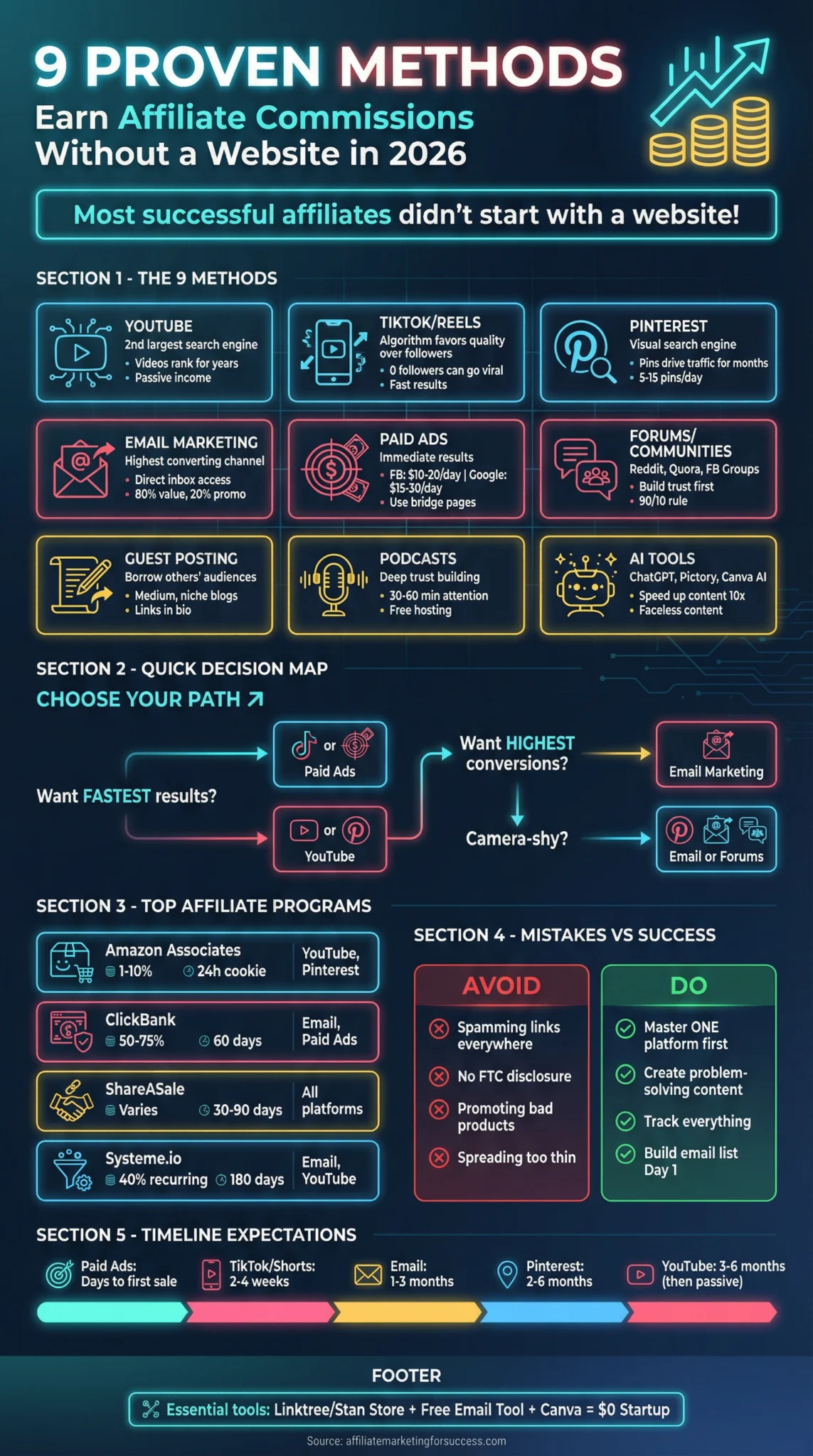


The practical framework
Audience
Name a person, context, and recurring problem.
Demand
Look for stable questions across the reader journey.
Competition
Find a format, evidence, or audience angle competitors miss.
Monetization
Confirm multiple relevant and reputable offers.
Credibility
Plan how claims will be supported and reviewed.
Runway
Map enough unique pages to build a real topical system.
Step-by-step method
- List five possible audiences
Use work, hobbies, life stages, constraints, or professional roles. - Write ten recurring problems for each
Prefer problems that require explanation, comparison, or implementation. - Map search and community evidence
Review SERPs, forums, videos, newsletters, and product-support questions. - Inspect the competitive page types
Identify what already ranks and where current results are weak or generic. - Check affiliate program diversity
Compare merchant fit, terms, product quality, support, and reputation. - Assess your credibility path
Identify experience, sources, reviewers, screenshots, tests, or methodology needed. - Build a 30-topic content runway
Separate learn, compare, choose, use, maintain, and troubleshoot intent. - Score risk and sustainability
Consider policy changes, seasonality, YMYL exposure, and production cost. - Publish a small validation set
Create several complete pages rather than dozens of thin drafts. - Commit based on evidence
Choose the niche that demonstrates qualified attention and sustainable execution.
Factor 1: A specific audience with a recurring problem
A niche becomes practical when you can describe the person, the context, the obstacle, and the desired outcome in one sentence.
Begin by turning this subject into a concrete decision. Define the audience, the situation that triggers the question, the choices available, and the information a reasonable reader needs before acting. For Factor 1: A specific audience with a recurring problem, this means prioritizing criteria and trade-offs over broad claims. A section is complete only when it helps the reader understand what to do, when the advice applies, and when a different route is more appropriate.
Document the assumptions behind the recommendation. Separate stable principles from facts that can change, such as pricing, product features, platform rules, or commission terms. When a claim depends on current information, identify its source and review date. When evidence is incomplete, state the uncertainty and propose a small validation step instead of presenting an estimate as fact.
Finish with an operational next step. The reader should be able to apply the criteria, collect the necessary evidence, and make a decision without searching for missing instructions elsewhere. The editor should also be able to audit the section later using the same criteria.
Factor 2: Demand that exists beyond one keyword
A durable niche contains multiple questions across discovery, comparison, purchase, setup, and troubleshooting.
The quality of this section depends on the evidence chain. Start with primary documentation, direct records from the real workflow, or clearly identified research synthesis. Do not convert a vendor statement, model output, or anecdote into an independent conclusion. For Factor 2: Demand that exists beyond one keyword, list the material claims, the source for each claim, the date checked, and the person responsible for approving the wording.
Evidence also needs context. A feature can exist without being useful for every audience, and a result observed in one campaign does not prove a universal effect. Explain the conditions, exclusions, and limitations that change the recommendation. This gives readers a reasoned basis for acting and gives future editors a clear update path.
Use a claims ledger for policy-sensitive, commercial, technical, and numerical statements. When the source changes or expires, the ledger should trigger review of the affected paragraph, table, CTA, and schema rather than relying on a calendar-only refresh.
Factor 3: Competition you can approach differently
Low authority alone is not the opportunity; the opportunity is a meaningful gap in usefulness, evidence, format, or audience fit.
Implementation should be divided into a small repeatable sequence: capture the current state, choose one change, assign an owner, define the expected reader benefit, and set a validation method. For Factor 3: Competition you can approach differently, avoid changing several variables at once when a controlled test is possible. A focused change makes success and failure easier to interpret.
Build the workflow so that it can be repeated without depending on one person’s memory. Store the brief, sources, decisions, final copy, links, screenshots, and analytics labels together. Use staging or a review copy for risky technical or commercial changes, and retain a rollback path before publishing.
After release, inspect the rendered page rather than assuming the editor view is correct. Confirm mobile layout, links, disclosure placement, tracking, structured data, and the actual destination experience. Implementation is complete only when the public output matches the approved plan.
Factor 4: Monetization that matches the content
Programs should be relevant to the reader's journey and strong enough that the recommendation remains useful even without a commission.
Every recommendation has boundaries. Identify the audience it does not serve, the circumstances that would change the answer, and the evidence that remains unavailable. In Factor 4: Monetization that matches the content, this prevents the article from turning a conditional recommendation into a universal claim. Limitations are useful decision information, not a weakness to hide.
Consider operational risk as well as content risk. Platform dependence, merchant changes, product availability, account restrictions, privacy obligations, licensing, and maintenance effort can change the value of a tactic. Rank these risks by likelihood and impact, then define a prevention or fallback step for the material ones.
Use stop conditions. Publication should pause when a required source cannot be verified, a commercial relationship is undisclosed, a destination is broken, or a claim implies experience that did not occur. Clear stop conditions protect the reader and reduce expensive corrections.
Factor 5: A credible reason to trust the publisher
The site needs a realistic way to support claims through experience, research synthesis, qualified review, or transparent methodology.
Measure this topic with a chain of indicators rather than one headline metric. Visibility, engagement, email action, affiliate click, merchant outcome, refund, and net contribution describe different stages. For Factor 5: A credible reason to trust the publisher, choose the smallest set that explains whether the page reached the right audience, helped the decision, and produced an appropriate next action.
Use defined comparison windows and annotate meaningful changes. A title rewrite, redirect, platform update, campaign, product launch, or tracking change can alter the numbers. Avoid claiming causation from a simple before-and-after chart when several variables changed.
Translate measurement into a decision: keep, improve, expand, consolidate, pause, or stop. Record the evidence and the next review date so the team learns from the result rather than repeatedly debating the same assumption.
Factor 6: Enough content depth for topical authority
A healthy niche supports distinct pages and internal relationships rather than hundreds of near-duplicate keyword variations.
Maintenance should be designed at publication time. Classify each fact in Factor 6: Enough content depth for topical authority as stable, periodically reviewable, or event-triggered. Stable principles can follow a slower editorial cycle, while prices, features, policies, links, and product availability require a current source and a faster trigger.
Assign ownership for the page and for high-risk components such as affiliate boxes, comparison tables, screenshots, and structured data. A visible review date is meaningful only when the underlying facts were actually checked. Do not change a date merely to imply freshness.
When the recommendation changes, update the explanation and not only the product or CTA. Preserve a concise correction or revision note when the earlier conclusion could materially affect a reader’s decision. This creates a trustworthy history and prevents silent contradictions across the site.
Factor 7: Manageable operational and compliance risk
Production cost, product access, legal requirements, platform dependence, and update burden all affect niche viability.
Run a separate editorial challenge pass for Factor 7: Manageable operational and compliance risk. The reviewer should look for intent drift, unsupported precision, circular reasoning, commercial bias, missing alternatives, inaccessible formatting, and claims that depend on unstated assumptions. The goal is to find defects, not to defend the draft.
Check the content against the actual page role. A definition page, tutorial, comparison, review, compliance guide, and strategy article need different evidence and structures. Remove sections that exist only because a template expects them, and add the decision support the reader genuinely needs.
Close the review with explicit gates for facts, sources, disclosure, links, images, schema, mobile behavior, and analytics. Record PASS or STOP for each gate and resolve critical failures before publication.
How to run a 30-day niche validation sprint
A short validation sprint should test the audience promise, content production effort, initial visibility, engagement, and monetization path without pretending the result proves long-term success.
Design this section around the reader’s next question. After learning about How to run a 30-day niche validation sprint, the reader may need a comparison, checklist, calculator, tutorial, policy source, or relevant merchant destination. Provide that next step in context and explain why it is useful instead of appending a generic list of links.
Keep the commercial path proportional to the reader’s stage. Early educational sections should not pressure a purchase, while a well-supported decision section can offer a clear disclosed CTA. The page should remain complete for readers who do not click an affiliate link.
Review the experience on mobile, where long headings, wide tables, repeated boxes, and dense paragraphs can obscure the answer. Use scannable sections, descriptive anchors, and enough spacing to make the guidance usable without turning it into superficial fragments.
30-day implementation plan
Use this plan to turn How to Choose an Affiliate Marketing Niche: A 7-Factor Validation Method into a controlled operating change rather than a one-time reading exercise. Keep the scope small enough to complete, document the baseline before editing, and assign a named owner for each deliverable. The purpose of the month is to produce one validated workflow and a clear next decision, not to scale unproven output.
| Period | Primary work | Deliverable | Validation |
|---|---|---|---|
| Days 1-7 | List five possible audiences; Write ten recurring problems for each; Map search and community evidence | Approved brief, baseline, sources, and decision criteria | Owner confirms the audience, intent, evidence, exclusions, and current technical state |
| Days 8-14 | Inspect the competitive page types; Check affiliate program diversity; Assess your credibility path | First complete implementation or content asset | Fact, disclosure, rights, link, and usability review passes |
| Days 15-21 | Build a 30-topic content runway; Score risk and sustainability | Connected distribution, tracking, and supporting assets | Events, destinations, mobile behavior, and ownership are verified |
| Days 22-30 | Publish a small validation set; Commit based on evidence | Performance review and next-action record | Keep, improve, expand, consolidate, pause, or stop is documented with evidence |
During the month, maintain a compact decision log with the date, change, reason, source, owner, and expected reader benefit. Record unexpected defects and corrections as carefully as positive outcomes. This prevents later teams from repeating failed assumptions and helps separate the effect of the implementation from unrelated platform, market, or seasonal changes.
At the end of the cycle, do not scale automatically. Confirm that the workflow produced an accurate, useful, compliant result and that the measurement is trustworthy. If the result is inconclusive, define the smallest next test. If the process created repeated factual, legal, technical, or editorial failures, repair the system before producing more content.
Editorial acceptance criteria
- The page or asset has one clear audience, intent, and primary action.
- Every material claim is sourced, qualified, or removed.
- Research synthesis, hands-on experience, and editorial judgment are labeled accurately.
- Commercial relationships are disclosed before or close to the recommendation.
- Links reach the intended final destination and tracking does not obscure user choice.
- Images, product data, quotations, and logos have an approved source or license.
- The mobile experience preserves the answer, tables, controls, and reading order.
- A named owner, review trigger, correction path, and measurement plan are recorded.
Examples by situation
| Situation | Recommended move | Why it fits |
|---|---|---|
| Broad fitness | Narrow to home strength training for apartment beginners | The audience, space, budget, and equipment constraints are clearer |
| Generic software | Narrow to email automation for solo course creators | The workflows and tool comparisons become specific |
| Pet niche | Narrow to travel systems for French bulldog owners | Breed and travel constraints create distinct decisions |
| Gardening | Narrow to indoor plant recovery for low-light apartments | Recurring troubleshooting supports a deep content map |
Original methodology, evidence boundaries, and limitations
This article uses a research-synthesis method rather than fabricated first-hand testing. The process begins with the reader’s decision, maps the claims that require current evidence, checks official rules where policies matter, and turns the result into a workflow that can be measured. Examples are illustrative unless they are explicitly attributed to a source. Tool features, prices, commission terms, platform interfaces, and program rules can change after the review date.
The strongest evidence for an affiliate article is not a generic content score. It is a traceable combination of primary-source documentation, screenshots or records from the real workflow, accurate disclosures, reproducible steps, and performance data tied to a defined period. Where that evidence is unavailable, this guide avoids invented numbers and recommends a controlled test instead.
Helpful video walkthrough
This video complements the written workflow with a visual explanation. The surrounding article remains complete without the embed, so readers can still use the guide if a platform later changes embedding permissions.
Video topic: Affiliate funnel strategy foundations. The written guide contains the complete method independently of the embed.
How to choose the next action
After applying this guide, choose the next action from evidence rather than enthusiasm. Keep the current approach when it is accurate, useful, maintainable, and producing qualified behavior. Improve it when the audience and intent are correct but the evidence, explanation, usability, or conversion path is weak. Expand only when the existing workflow is stable and an adjacent need serves the same audience. Consolidate when several assets compete for the same intent or repeat the same value. Pause or stop when the tactic depends on unverifiable claims, poor-fit offers, unsustainable cost, or a policy risk that cannot be controlled.
Record the decision with the relevant metrics, source checks, owner, and review date. This makes How to Choose an Affiliate Marketing Niche: A 7-Factor Validation Method part of an operating system rather than an isolated article. A documented decision also prevents a future editor from reversing the change without understanding the evidence that supported it.
Common mistakes and troubleshooting
| Common mistake | Why it fails | Practical correction |
|---|---|---|
| Choosing by market size | A large market can be too broad to position clearly | Define a smaller audience and recurring problem |
| Choosing by commission rate | The offer may not fit or last | Evaluate relevance, merchant quality, and alternatives |
| Assuming low competition from a tool score | SERPs and content formats can tell a different story | Inspect the actual results and intent |
| Ignoring credibility requirements | The publisher may not be qualified for the claims | Create a truthful evidence and review plan |
| Building a one-product niche | The business becomes fragile | Confirm several offers and content branches |
| Publishing before mapping cannibalization | Pages may compete for the same intent | Create a query-to-URL map first |
Frequently asked questions
What is the best affiliate marketing niche?
There is no universal best niche. The best fit combines audience need, demand, workable competition, credibility, content depth, relevant offers, and manageable risk.
Should beginners choose a broad or narrow niche?
Start narrow enough to create a memorable promise and expand only when adjacent topics serve the same audience.
How do I know if a niche is profitable?
Validate relevant programs, buyer problems, commercial query types, production cost, and the path from attention to qualified action.
Can I choose a niche with high competition?
Yes, when you have a credible differentiator such as first-hand evidence, a neglected audience, better tools, or a stronger content format.
How many affiliate programs should a niche have?
There is no fixed number, but dependence on one merchant increases risk. Several reputable, relevant options are healthier.
Should I use keyword volume to choose a niche?
Use it as one input, not the decision. Intent, competition, content depth, evidence burden, and monetization fit matter too.
Can I change niches later?
Yes, but repositioning can be expensive. Validate early and preserve URLs only when the new intent still matches.
How long should I test a niche?
Use a defined validation period and enough complete content to observe qualified signals, then decide based on evidence rather than a single ranking or sale.
Recommended next reading
- Affiliate marketing tips for beginners
- Affiliate marketing strategy
- Affiliate marketing startup costs
- Start affiliate marketing with AI tools
- Affiliate marketing hub
- Start affiliate marketing
- Affiliate disclosure
- Email marketing hub
- AI and automation guides
- Affiliate tools and reviews
Sources and editorial note
Editorial note: Reviewed 2026-07-10. Policy-dependent instructions should be checked again before major campaigns, migrations, or commercial updates. The page is designed to retain its existing URL and to use a self-referencing canonical when published at the stated target URL.

Alexios Papaioannou is the founder and lead editor of Affiliate Marketing for Success. He focuses on affiliate marketing systems, SEO, content strategy, monetization design, and the impact of AI-driven search on publishers. Editorial background, disclosure standards, and correction policy are documented on the site’s About Alexios and Editorial Policy pages.