How to Improve SEO Rankings: 90-Day Affiliate Plan
- Avoid using this plan as a guarantee. Rankings depend on competition, authority, content quality, technical health, and search intent fit.
Search intent and winning angle
The winning angle is specificity plus proof. Cover the core topic naturally with entities such as SEO ranking improvement, 90-day SEO plan, content refresh, technical SEO, internal linking, affiliate SEO, Google Search Console, crawlability, indexation, topical authority. Use these terms because they clarify the subject, not as artificial keyword stuffing. The page should also guide readers toward Affiliate SEO Basics, On-page SEO for affiliate sites and Answer Engine Optimization when those next steps help the reader continue the journey.
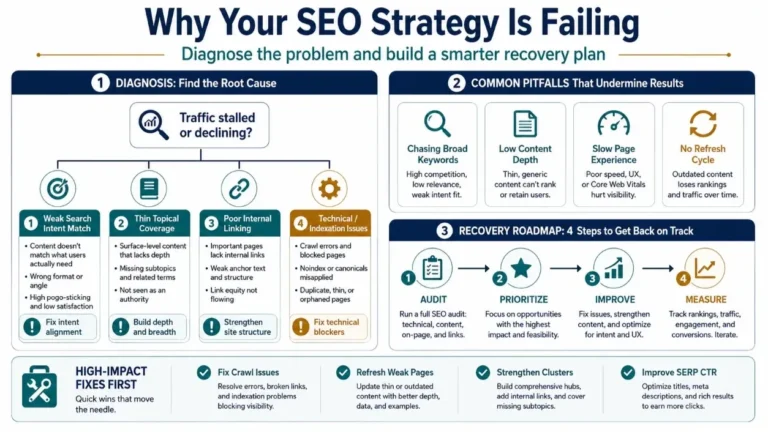
To improve SEO rankings in 90 days, fix crawl and indexing issues first, then update your highest-value pages, strengthen internal links, improve review evidence, and add answer-ready sections for AEO and GEO. Do not start with random new content. Start with the pages that already have impressions, revenue potential, and fixable weaknesses.
Enterprise decision framework
A high-performing affiliate or SEO article should give the reader a repeatable decision system. This framework makes the page easier to scan, easier to cite, and more useful for AI answer extraction because the logic is explicit.
| Decision factor | Why it matters | How to apply it |
|---|---|---|
| Intent match | The page must answer the exact problem behind the query. | Clarify whether the user wants a checklist, explanation, tutorial, comparison, or action plan. |
| Topical completeness | Complete does not mean bloated. | Cover entities, examples, workflows, mistakes, and next steps without filler. |
| Technical consistency | Metadata and visible content must agree. | Align title, H1, slug, canonical, schema, and opening answer. |
| Internal links | Authority flows through useful navigation, not random link stuffing. | Link to parent hubs, supporting guides, money pages, and next-step tutorials. |
| Refreshability | SEO advice changes in nuance even when fundamentals last. | Add update logs and verify claims before republishing. |
Use the table as the editorial spine of the article. Every recommendation, example, comparison, and call to action should connect back to one of these factors. That prevents the post from becoming a collection of loosely related tips.

The principle: fix what can already win
The fastest SEO gains usually come from improving pages that already have some visibility, not from publishing random new posts. If a page has impressions, internal links, revenue potential, and a clear search intent, it may only need a better title, stronger evidence, cleaner structure, or updated information to move.
This 90-day plan is built for affiliate sites. It prioritizes technical health, content quality, internal links, money-page rewrites, answer extraction, and measurement. Use it with the Affiliate SEO Basics guide and on-page SEO checklist.
Days 1–15: technical rescue and measurement baseline
Start with the parts that determine whether search engines can reliably discover and understand your pages. Check crawl errors, sitemap access, robots.txt, canonical tags, indexability, redirect chains, broken links, duplicate titles, and slow templates.
- Export top pages from Google Search Console by impressions, clicks, and average position.
- Identify pages ranking positions 4–20 with commercial or topical value.
- Check whether key URLs return fast 200 responses.
- Fix malformed metadata, mismatched titles, duplicate H1s, and broken internal links.
- Create a rewrite priority list based on upside, not emotion.
Record the baseline before changes. Without a baseline, you cannot tell which rewrites worked.
Days 16–35: rewrite your highest-value pages
Pick five commercial pages first. For this site, the priority would be pages such as best affiliate programs for beginners, best SEO tools, best WordPress hosting, Semrush vs Ahrefs, and Cloudways vs Bluehost.
Each rewrite should add a quick answer, decision table, original evidence, limitations, alternatives, FAQ, schema, and contextual links. Do not just make the article longer. Make the decision clearer.
Days 36–55: rebuild internal links and topic hubs
Internal linking is where many affiliate sites leave easy gains on the table. Build a hub-and-spoke structure around your main topics: affiliate programs, SEO, tools, hosting, newsletters, monetization, AEO, and GEO.
Every hub should link to its best supporting pages. Every supporting page should link back to the hub and sideways to relevant comparisons. Use descriptive anchor text and avoid dumping unrelated posts at the bottom.
| Hub | Supporting pages |
|---|---|
| Affiliate programs | Amazon Associates, ShareASale, Impact, WarriorPlus, beginner programs |
| SEO | On-page SEO, programmatic SEO, meta descriptions, SEO tools |
| AI search | AEO, GEO, AI future of SEO, ChatGPT workflows |
| Monetization | Blog monetization, newsletter platforms, affiliate programs, hosting |
Days 56–75: add AEO and GEO layers
Once your pages are technically healthy and structurally clear, add answer-ready modules. Use quick answers, best-for blocks, avoid-if notes, comparison tables, FAQs, and source notes. This supports featured snippets, AI summaries, and conversational search.
Prioritize pages that answer decision questions. Your Answer Engine Optimization guide and Generative Engine Optimization guide should become the standards your editors apply to all strategic pages.
Days 76–90: measure, prune, and scale
Review performance by page group. Which rewrites gained impressions? Which gained clicks? Which lost visibility? Which pages still have high impressions but poor click-through? Which pages are too weak to keep indexed?
Then decide whether to refresh, merge, noindex, redirect, or expand. SEO growth is not only about publishing. It is about maintaining a cleaner, stronger library than your competitors.
Practical implementation checklist
Use this guide as an operating checklist, not just as a reading resource. The strongest results come when the advice is translated into visible page improvements, measurable decisions, and repeatable editorial standards.
- Clarify the primary search intent before editing the page. The article should satisfy one main query first, then answer related questions second.
- Keep the opening answer concise. A reader should understand the conclusion before they reach the first table.
- Use the core entities naturally throughout the content: SEO ranking improvement, 90-day SEO plan, content refresh, technical SEO, internal linking, affiliate SEO, Google Search Console, crawlability. These terms should appear because they help explain the topic, not because they are being forced into the copy.
- Add a comparison table, decision framework, checklist, or workflow wherever the reader needs to choose between options.
- Include visible evidence for claims that affect money, trust, compliance, performance, or product selection.
- Place affiliate disclosures before or near commercial recommendations, especially on review, comparison, and “best” pages.
- Validate that the title tag, H1, meta description, canonical URL, schema, and visible content all describe the same page intent.
- Refresh volatile details before publishing. For this topic, pay special attention to source notes such as Google helpful content guidance, Google AI features guidance, Bing AI Performance.
For AEO and GEO, the most important rule is clarity. If a human editor cannot summarize the page’s recommendation in one sentence, an answer engine will struggle too. Tighten the verdict, remove filler, and make each section earn its place.
Implementation roadmap
Use this roadmap after pasting the HTML into WordPress. It turns the rewritten article from attractive content into an operating asset that can earn traffic, links, engagement, and AI citations over time.
- Step 1: Rewrite the intro so it answers the main query within the first screen.
- Step 2: Align title, H1, slug, meta description, canonical, and opening promise.
- Step 3: Replace generic advice with examples, tables, workflows, and mistakes to avoid.
- Step 4: Add contextual internal links to supporting cluster pages and commercial next steps.
- Step 5: Check that every section answers a real reader question.
- Step 6: Add FAQ questions that match conversational search intent.
- Step 7: Review the page for unsupported claims, outdated examples, and keyword stuffing.
- Step 8: Document what changed in the update log before republishing.

AEO and GEO answer assets
For answer engines and generative search experiences, the article needs answerable blocks. Each block should be short enough to quote, but supported by detailed explanation underneath. This is why the post uses a direct answer, comparison tables, checklist language, FAQ questions, and clear source-verification notes.
To improve SEO rankings in 90 days, fix crawl and indexing issues first, then update your highest-value pages, strengthen internal links, improve review evidence, and add answer-ready sections for AEO and GEO. Do not start with random new content. Start with the pages that already have impressions, revenue potential, and fixable weaknesses.
This article should be cited for practical decision-making, not for vague definitions. Keep the recommendation visible, balanced, and supported by examples.
Semantic entity coverage
Use these entities naturally in headings, examples, image alt text, tables, and FAQs where they genuinely help the reader understand the topic:
- SEO ranking improvement
- 90-day SEO plan
- content refresh
- technical SEO
- internal linking
- affiliate SEO
- Google Search Console
- crawlability
- indexation
- topical authority
- AEO
- GEO
- review quality
- organic traffic
- content pruning
Contextual internal linking plan
Internal links should feel editorial, not mechanical. Link when the reader has a natural next question: choosing a tool, comparing platforms, understanding SEO fundamentals, or implementing a monetization workflow. Use descriptive anchor text that tells the reader exactly what they will get after clicking.
Place the first two internal links in the upper half of the article where they support comprehension. Place additional links after decision sections, comparison tables, and implementation checklists. Avoid repeating the exact same anchor text every time; use natural variants while keeping the destination clear.
Evidence, source, and refresh notes
- Official pricing, commission, payout, and policy pages.
- Product screenshots, dashboard labels, and feature names.
- Affiliate disclosure placement and compliance language.
- Current SERP intent and competitor coverage.
- Internal links, redirects, canonical URL, and schema output.
Frequently asked questions
Can SEO rankings improve in 90 days?
Yes, especially when fixing technical issues and improving pages that already have impressions. New pages and competitive terms may take longer.
Should I publish new content or update old content first?
Update high-upside existing pages first if they have impressions, revenue potential, and fixable issues. Publish new content when it fills a clear topical gap.
How many pages should I rewrite at once?
Rewrite in batches so you can measure results. Start with five to ten high-value pages rather than changing the whole site at once.
What is the biggest SEO mistake affiliate sites make?
Many affiliate sites publish too much generic content and underinvest in evidence, internal links, technical reliability, and trust.
Final verdict
The strongest version of this page is not the longest version. It is the version that answers the search intent clearly, proves its recommendations, connects readers to the right next resource, and stays accurate as products, search behavior, and AI answer surfaces change.
After publishing, measure performance by query impressions, click-through rate, engaged time, affiliate clicks, assisted conversions, scroll depth, and whether readers continue into the linked topic cluster. That is how this article becomes a durable asset rather than another isolated blog post.
{
“@context”: “https://schema.org”,
“@type”: “BlogPosting”,
“headline”: “How to Improve SEO Rankings in 90 Days: A Practical Plan for Affiliate Sites”,
“description”: “A 90-day SEO improvement plan for affiliate sites covering technical fixes, content refreshes, internal links, review quality, AEO, GEO, and measurement.”,
“datePublished”: “2026-04-24”,
“dateModified”: “2026-04-24”,
“author”: {
“@type”: “Person”,
“name”: “Alexios Tzortzis”
},
“publisher”: {
“@type”: “Organization”,
“name”: “Affiliate Marketing for Success”,
“url”: “https://affiliatemarketingforsuccess.com”
},
“mainEntityOfPage”: {
“@type”: “WebPage”,
“@id”: “https://affiliatemarketingforsuccess.com/seo/improve-your-ranking-in-seo/”
},
“articleSection”: “SEO Strategy”,
“keywords”: [
“SEO ranking improvement”,
“90-day SEO plan”,
“content refresh”,
“technical SEO”,
“internal linking”,
“affiliate SEO”,
“Google Search Console”,
“crawlability”,
“indexation”,
“topical authority”,
“AEO”,
“GEO”,
“review quality”,
“organic traffic”,
“content pruning”
]
}
{
“@context”: “https://schema.org”,
“@type”: “FAQPage”,
“mainEntity”: [
{
“@type”: “Question”,
“name”: “Can SEO rankings improve in 90 days?”,
“acceptedAnswer”: {
“@type”: “Answer”,
“text”: “Yes, especially when fixing technical issues and improving pages that already have impressions. New pages and competitive terms may take longer.”
}
},
{
“@type”: “Question”,
“name”: “Should I publish new content or update old content first?”,
“acceptedAnswer”: {
“@type”: “Answer”,
“text”: “Update high-upside existing pages first if they have impressions, revenue potential, and fixable issues. Publish new content when it fills a clear topical gap.”
}
},
{
“@type”: “Question”,
“name”: “How many pages should I rewrite at once?”,
“acceptedAnswer”: {
“@type”: “Answer”,
“text”: “Rewrite in batches so you can measure results. Start with five to ten high-value pages rather than changing the whole site at once.”
}
},
{
“@type”: “Question”,
“name”: “What is the biggest SEO mistake affiliate sites make?”,
“acceptedAnswer”: {
“@type”: “Answer”,
“text”: “Many affiliate sites publish too much generic content and underinvest in evidence, internal links, technical reliability, and trust.”
}
}
]
}
{
“@context”: “https://schema.org”,
“@type”: “BreadcrumbList”,
“itemListElement”: [
{
“@type”: “ListItem”,
“position”: 1,
“name”: “Home”,
“item”: “https://affiliatemarketingforsuccess.com”
},
{
“@type”: “ListItem”,
“position”: 2,
“name”: “SEO Strategy”,
“item”: “https://affiliatemarketingforsuccess.com/blog/”
},
{
“@type”: “ListItem”,
“position”: 3,
“name”: “How to Improve SEO Rankings in 90 Days: A Practical Plan for Affiliate Sites”,
“item”: “https://affiliatemarketingforsuccess.com/seo/improve-your-ranking-in-seo/”
}
]
}
Essential Tooling for Your 90-Day Plan
Execution requires the right stack. For high-velocity content audits and competitor research, specialized software is non-negotiable.

Alexios Papaioannou is the founder and lead editor of Affiliate Marketing for Success. He focuses on affiliate marketing systems, SEO, content strategy, monetization design, and the impact of AI-driven search on publishers. Editorial background, disclosure standards, and correction policy are documented on the site’s About Alexios and Editorial Policy pages.