
12 Affiliate Marketing Mistakes and How to Fix Each One
Short answer: the affiliate marketing mistakes that cost the most are picking products before an audience, writing reviews without real evidence, hiding disclosures, breaking program terms you never read, and not tracking which pages earn. Each one is fixable. Below are 12 common mistakes, each with what it looks like, why it hurts, the fix, and a quick check, followed by a self-audit table and the order to fix things in.
Diagnose before you fix
Every mistake below has the same shape: what it looks like, why it hurts, the fix, and a quick check. Before you start fixing, read through all twelve and mark the ones you actually have — most sites have four or five, not all twelve. Fixing a mistake you don’t have wastes the time you need for the ones you do. The self-audit at the end turns the list into a score, so you can see where you stand in an hour.
Mistakes by stage: beginners most often have mistakes 1, 2, 4, 5, and 6 — no clear reader, too broad, hidden disclosures, unlabelled links, unread terms. Growing sites most often have 3, 7, 8, 9, 10, 11, and 12 — thin evidence, wrong commission chasing, duplicate pages, no tracking, single-source dependence, stale content, and premature ads.
Mistake 1: Choosing products before choosing an audience
What it looks like: the site promotes whatever pays well this month: a VPN, then a mattress, then a course. Nothing connects the pages.
Why it hurts: readers don’t come back to a site that has no clear subject, and search engines struggle to see expertise in one. Each page starts from zero.
Fix: write one sentence describing your reader and the decision you help them make (for example, “beginner home cooks choosing their first good knife”), then promote only products that serve that decision. Our affiliate strategy guide walks through it.
Quick check: could a stranger guess your site’s topic from any three random articles?
Mistake 2: A niche too broad to cover well
What it looks like: “fitness”, “tech”, or “home” on a one-person site.
Why it hurts: you compete with large publishers on every topic and can’t go deep enough on any of them to be the best answer.
Fix: narrow down until you can list 50 specific questions you can answer better than most: “strength training at home with limited space” instead of “fitness”. You can widen later, from a position of strength. See our niche list.
Quick check: can you name the five sites you’re competing with, and say what you do better?
Mistake 3: Reviews with no evidence, or fake “hands-on” claims
What it looks like: a review that restates the manufacturer’s feature list, or says “we tested this” without a single photo, measurement, or detail only a user would know.
Why it hurts: readers can tell, and so can search engines. Google’s guidance on high-quality reviews asks for evidence such as visuals, measurements, and first-hand experience. A false claim of personal use is also a problem under the FTC’s Endorsement Guides.
Fix: either get hands-on and show it (your own photos, recordings, measurements, screenshots), or write an openly research-based comparison: “We haven’t used these models; this comparison uses published specifications and verified owner reports.” Both are legitimate. Pretending is not.
How to spot it on your own site: open your top five reviews and cover the product names. If you can’t tell which product each review is about — no specific measurement, photo, quirk, or drawback — the review has no evidence in it. The fix isn’t longer reviews; it’s one concrete detail per product that only a user would know.
Quick check: does every review contain something a reader couldn’t get from the product page?
Mistake 4: Hiding the affiliate disclosure
What it looks like: a single “affiliate disclosure” link in the footer, or a disclosure placed after all the links.
Why it hurts: the FTC expects disclosures to be clear and conspicuous and placed where readers see them before they act. A footer link doesn’t meet that. Some programs also require specific wording; Amazon Associates requires “As an Amazon Associate I earn from qualifying purchases.”
Fix: add one plain-language line near the top of every page with affiliate links, before the first link: “We earn a commission if you buy through links on this page, at no extra cost to you.” Keep the full policy on a dedicated page, like our affiliate disclosure. See disclosure examples for wording.
Quick check: open any money page on a phone. Is the disclosure visible before the first affiliate link?
Mistake 5: Unlabelled affiliate links
What it looks like: affiliate links that look like ordinary editorial links to search engines.
Why it hurts: Google asks that paid and affiliate links be marked with rel="sponsored" (or rel="nofollow"). Its link guidance explains why: unlabelled paid links can be treated as link schemes.
Fix: set your link-management plugin to add rel="sponsored" to every affiliate link automatically, then spot-check the page source.
Quick check: view the source of one review and search for your affiliate domain. Does every link carry sponsored?
Mistake 6: Never reading the program terms
What it looks like: putting Amazon links in a printed guide or an ebook, showing product prices that were copied by hand weeks ago, or bidding on a merchant’s brand name in search ads.
Why it hurts: breaking terms can forfeit commissions or close your account. Amazon’s Associates Program Policies, for example, ban promotion in offline materials such as printed matter and ebooks, and only allow prices to be shown when they come from an Amazon-served link or from Amazon’s Creators or Product Advertising API. Amazon also only reviews a new account once it has driven at least three qualifying sales within the first 180 days, as its Application Review Process page states. Its attribution window is short, too: a sale counts only if the customer adds the product to their cart within 24 hours of the click (they then have up to 89 days to complete that order).
Fix: for each program, keep a one-line note of its key rules: where links are allowed, ad restrictions, required disclosures, and the attribution window. Review it when the program emails you about changes. For Amazon specifically, see our Amazon Associates guide. Rules change: Amazon now allows links in emails and direct messages that recipients have asked for, which it once restricted.
How to spot it: open your last three program emails. If any announced a rule change you didn’t act on — a new disclosure wording, a banned traffic source, a changed commission window — you’re running on old terms. Programs email about changes; the affiliates who get caught are the ones who never read them.
Quick check: can you state the three most important rules of each program you’re in?
Mistake 7: Chasing the highest commission instead of earnings per click
What it looks like: swapping a product readers love for one that pays twice the percentage.
Why it hurts: what you earn depends on commission × conversion rate, not commission alone. With made-up numbers: Product A pays $10 and 5% of clicks buy, so each click is worth $0.50. Product B pays $40, but only 1% of clicks buy because it suits fewer readers, so each click is worth $0.40. The “better” commission earns less, and your readers trust you less.
Fix: recommend the best fit for the reader first, then compare earnings per click (EPC) between merchants that sell equivalent products.
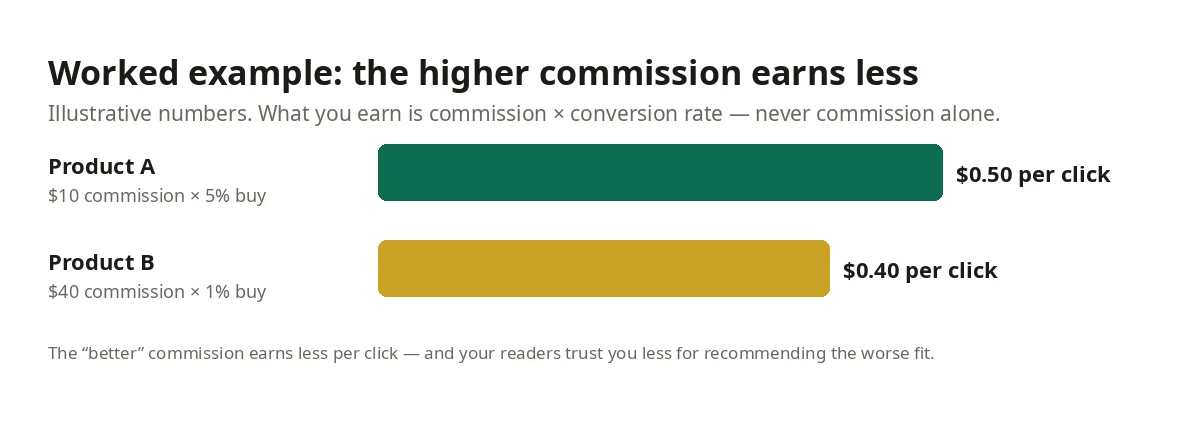
A second worked example: a page sends 1,000 clicks a month. Product A pays $5 and converts at 4% — $200. Product B pays $25 and converts at 0.5% — $125. Product B’s commission is five times higher and it earns nearly 40% less. Run this arithmetic on your own top pages before you swap any merchant.
Quick check: do you know the EPC of your top five pages?
Mistake 8: Many thin pages for the same search
What it looks like: “best budget headphones”, “best cheap headphones”, and “best affordable headphones” as three separate articles that say the same thing.
Why it hurts: the pages compete with each other, split the links and signals between them, and look like the “thin affiliate” content Google’s spam policies describe.
Fix: keep the strongest page, merge the useful parts of the others into it, and 301-redirect the old URLs. One substantial page beats three weak ones.
Quick check: search your own site for your main keywords. Does each one have exactly one obvious page?
Mistake 9: No tracking per page
What it looks like: you know your monthly total from the network but not which article produced it.
Why it hurts: you can’t tell which pages to update, which to merge, or which merchant to replace.
Fix: track outbound affiliate clicks per page in analytics, use sub-IDs (tracking IDs) per page where networks support them, and keep a monthly sheet: page, sessions, affiliate clicks, sales, commission.
Start with the cheapest version: you don’t need a dashboard. A monthly sheet with five columns — page, sessions, affiliate clicks, sales, commission — answers every question in this article. Add sub-IDs when you can; the sheet alone already tells you which pages to update, merge, or leave alone.
Quick check: can you name the single page that earned the most last month?
Mistake 10: Depending on one traffic source or one merchant
What it looks like: all traffic from one search engine or one social platform, and most income from one program.
Why it hurts: one algorithm update, policy change, or commission cut can wipe out income overnight. When Amazon cut commission rates in several categories in April 2020 — furniture and home improvement fell from 8% to 3% with about a week’s notice (announced 14 April, effective 21 April) — sites that depended on it alone lost income at once.
Fix: keep at least three programs per topic so you can switch links quickly, and build one owned channel, usually an email list, alongside search. See building an email list for affiliate marketing.
Quick check: what share of last quarter’s income came from your largest merchant?
Mistake 11: Publishing and never updating
What it looks like: “best” lists recommending discontinued products, dead affiliate links, out-of-date prices, and a “2026” title over content that hasn’t changed.
Why it hurts: readers who click a dead link don’t come back, merchants don’t pay for discontinued products, and changing the date without changing the content misleads readers.
Fix: schedule reviews by how fast the topic changes. Software and fast-moving product lists might need checking quarterly; evergreen how-tos once a year. Run a broken-link check monthly. Only change the “updated” date when the content materially changes. Our content upgrade checklist covers the process.
Quick check: when did you last check your top ten pages’ links and products?
Mistake 12: Buying traffic before you know your numbers
What it looks like: running ads to affiliate pages in the first month to “speed things up”.
Why it hurts: ads only pay when your cost per click is below your earnings per click. A new site doesn’t know its EPC yet, so it’s guessing with real money. Many programs also ban bidding on their brand names.
Fix: learn your EPC from organic traffic first. If you do test ads, set the maximum cost per click below that EPC and check every program’s ad rules first.
Quick check: do you know the break-even cost per click for the page you want to advertise?
Self-audit: score your site in an hour
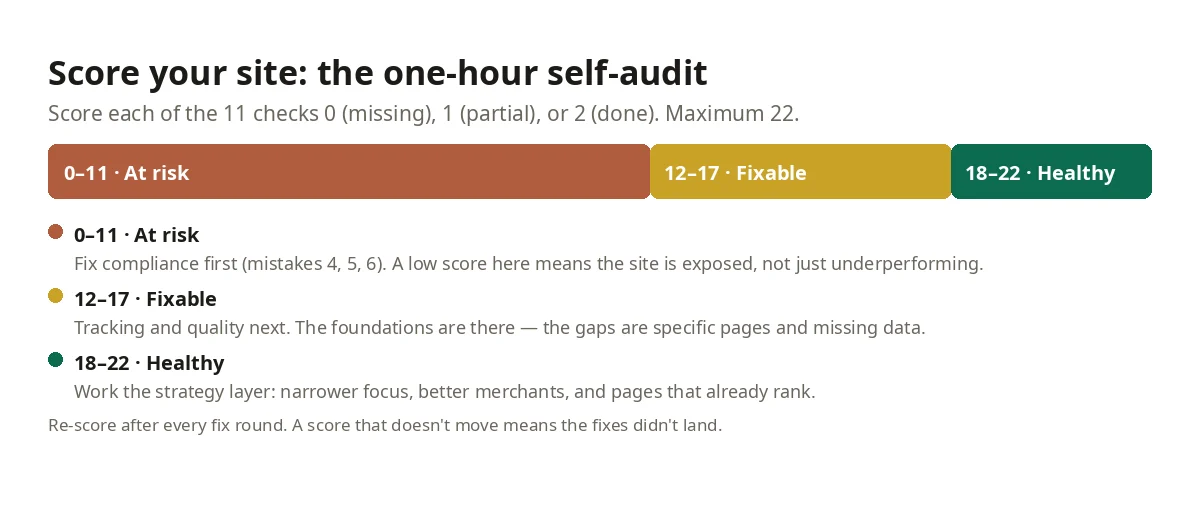
Score each check 0 (missing), 1 (partial), or 2 (done). Maximum 22.
| Check | How to verify | What “done” looks like |
|---|---|---|
| Disclosure visible before the first link (4) | Open 5 money pages on a phone | Disclosure seen before the first affiliate link on all 5 |
| Affiliate links carry rel=”sponsored” (5) | View page source | Every affiliate link labelled |
| Program rules noted and followed (6) | One line per program | You can state each program’s key rules |
| Per-page click and sale tracking (9) | Name last month’s top page | Monthly sheet + sub-IDs running |
| No dead links or discontinued products (11) | Broken-link scan of top 10 pages | All links work, all products current |
| One page per search intent (8) | Search your site for main keywords | Exactly one obvious page per keyword |
| Every review has original evidence (3) | Read your top 5 reviews as a buyer would | Something in each review the product page doesn’t have |
| EPC known for top pages (7) | Monthly sheet | EPC known for the top 5 pages |
| No single merchant or channel dominates (10) | Share of income by merchant | Largest merchant under half of income |
| Clear reader and focused niche (1–2) | Three random articles test | A stranger guesses the topic from any three |
| No paid traffic without a known EPC (12) | Compare ad CPC with page EPC | No ads running above break-even |
What your score means: 0–11, at risk — fix compliance first (mistakes 4, 5, 6); a low score here means the site is exposed, not just underperforming. 12–17, fixable — tracking and quality next; the foundations are there, the gaps are specific pages and missing data. 18–22, healthy — work the strategy layer: narrower focus, better merchants, and pages that already rank. Re-score after every fix round. A score that doesn’t move means the fixes didn’t land.
What to fix first
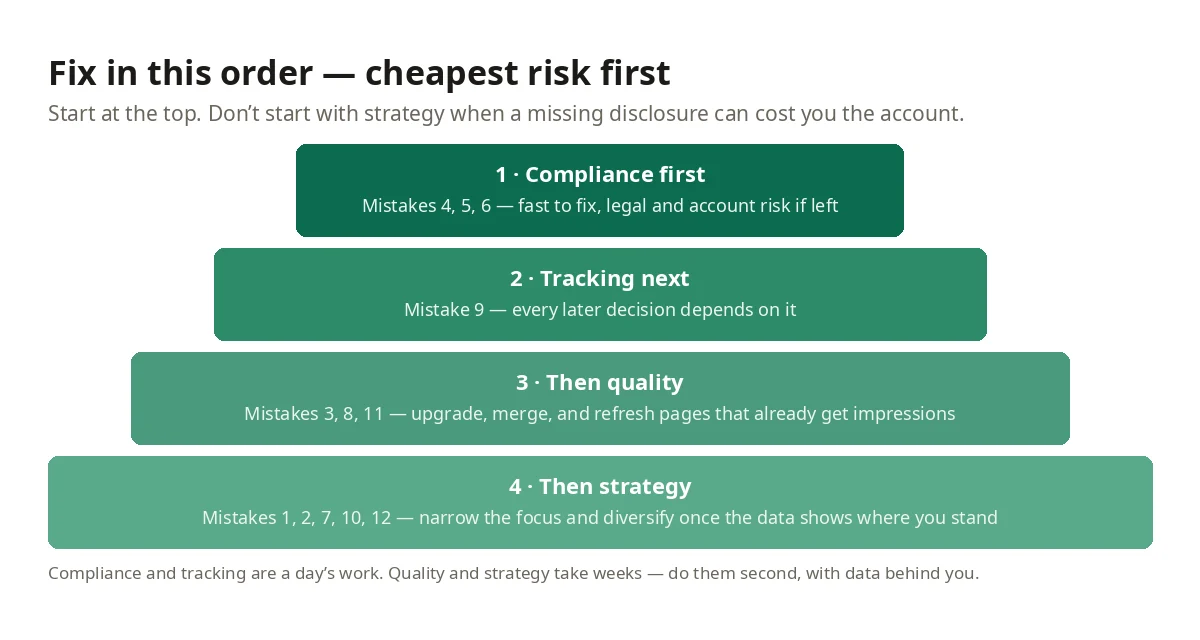
- Compliance first (mistakes 4, 5, 6): fast to fix, and leaving them carries legal and account risk.
- Tracking next (mistake 9): every later decision depends on it.
- Then quality (mistakes 3, 8, 11): upgrade, merge, and refresh the pages that already get impressions.
- Then strategy (mistakes 1, 2, 7, 10, 12): narrow the focus and diversify once the data shows where you stand.
Starting from scratch? Avoid most of these from day one with how to build an affiliate marketing website, and see the affiliate marketing hub for the full series.
The three mistakes that cost the most
Not all twelve mistakes cost the same. Three of them can end a site; the rest slow it down:
- Mistake 4 — hidden disclosure (legal risk). The FTC’s Endorsement Guides require the commercial relationship to be disclosed clearly and conspicuously, and affiliate programs require disclosure in their terms too. A disclosure costs ten minutes a page; a regulatory problem or a closed account costs far more.
- Mistake 6 — unread terms (account loss). A program can close your account and keep the unpaid commission. That’s not a slow decline; it’s income stopping overnight. Read the terms of every program you’re in, and re-read them when they email about changes.
- Mistake 9 — no tracking (every decision blind). Without per-page tracking you can’t tell which pages earn, which merchants pay, or whether an upgrade worked. Every other fix in this article depends on the data this mistake removes.
If you only have an hour, fix these three in the order above: disclosure, then terms, then tracking. It’s the same order as the pyramid. Then run the self-audit.
FAQ
What is the biggest mistake new affiliate marketers make?
Promoting products before understanding an audience. Almost every other problem, from thin content and low conversions to no repeat visitors, traces back to not knowing who the site is for.
Is it illegal to not disclose affiliate links?
In the US, the FTC treats undisclosed material connections in endorsements as potentially deceptive, and it has taken action against advertisers and influencers. Other countries have similar consumer-protection rules. Affiliate programs also require disclosure in their terms. Disclose clearly on every page with affiliate links.
Can these mistakes get my site penalised by Google?
Some can. Unlabelled paid links and thin affiliate pages that add nothing beyond the merchant’s content are named in Google’s spam policies. Others, like poor tracking, won’t trigger a penalty but will stop you from improving.
Which mistake should I fix today?
The disclosure (mistake 4). It takes ten minutes per page, and it’s the one with legal and account risk attached. Do that before anything strategic.
I made all twelve — where do I start?
In the pyramid order at the end of this article: compliance first, then tracking, then quality, then strategy. Don’t try to fix everything at once — one fix round a week gets most sites through the list in about a month, re-scored with the audit above after each round.