Top Blogging Challenges & Solutions: 2026 Strategy Guide
Here’s the deal: Top 7 Blogging Struggles (2026 Proven Solutions) isn’t as complicated as people make it. This guide breaks down exactly what works — no fluff, no filler, just actionable strategies.
Look, blogging in 2026 is a different beast than it was even two years ago.
Most people are playing checkers while the algorithm is playing 4D chess.
You’re putting in the hours, but the traffic isn’t moving.
Here’s the thing: it’s not about working harder; it’s about working smarter.
I’ve seen thousands of creators hit the same wall, and it’s usually the same seven walls.
Let’s break them down and fix them right now.
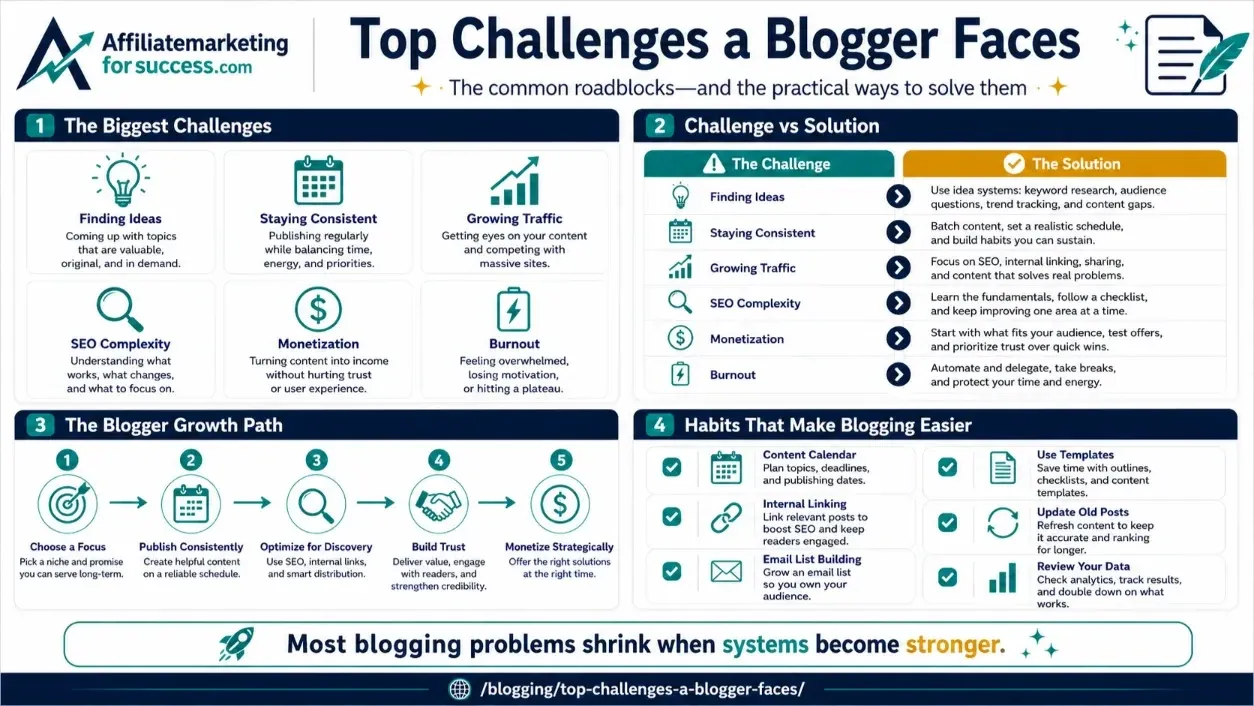
1. The AI Content Flood
Everyone is using AI to churn out generic garbage.
The internet is drowning in soulless, robotic text.
Your readers can smell it a mile away, and so can Google.
Why generic AI fails
AI gives you the ‘what’ but misses the ‘why’.
It lacks personal experience, unique voice, and genuine emotion.
Search engines are getting scary good at detecting this low-value content.
If you’re just copying and pasting prompts, you’re building on sand.
The solution: Human-in-the-loop
Use AI as your research assistant, not your ghostwriter.
Feed it your personal stories, your specific data, and your unique takes.
Then, rewrite every sentence with your own voice and contractions.
Blend the speed of AI with the soul of a human creator.
Your new workflow
Outline manually first. That’s non-negotiable.
Use AI to flesh out sections, find stats, or rephrase clunky sentences.
Finally, inject your own stories, jokes, and hard-won lessons.
This hybrid approach cuts your writing time in half while tripling the quality.
Bookmark this page. You’ll want to come back as you implement.
Most people fail not because they lack knowledge — they fail because they don’t take action.
2. The Traffic Plateau
You hit 1,000 monthly visitors and then… crickets.
Your growth feels like pushing a boulder uphill.
It’s frustrating because you’re doing everything ‘right’.
Why your traffic is stuck
You’re likely targeting keywords that are too broad or too competitive.
Or you’re publishing without a distribution plan.
Publishing and praying is not a strategy; it’s a lottery ticket.
The algorithm doesn’t owe you anything.
The solution: Topic Clusters
Stop chasing random keywords. Build a fortress instead.
Pick a core ‘pillar’ topic you want to own.
Create 10-20 ‘cluster’ articles that link back to that pillar.
This tells search engines you are the authority on that subject.
Own your niche
Be the go-to resource for a tiny, specific niche first.
It’s better to be a king of a small island than a peasant in a huge country.
Once you dominate one cluster, move to the adjacent one.
This compounding effect is how you break through the plateau.
The first 30 days are hardest. Push through that resistance and everything changes.
3. The Monetization Myth
You have traffic, but you have no money.
Ad revenue is pennies, and affiliate links aren’t converting.
Most bloggers wait too long to monetize and do it all wrong.
Why ads are a trap
Ad networks like Mediavine are great, but they’re a distraction.
They incentivize you to chase pageviews over actual value.
You’re building a business for someone else‘s ad revenue.
Your readers hate the clutter, and you get paid pennies per view.
The solution: Sell something directly
Find a problem your audience has and build a tiny solution.
This could be a $29 template, a $99 guide, or a $299 course.
One sale is worth 10,000 pageviews in ad revenue.
Start with a ‘minimum viable product’ and sell it from day one.
Own the relationship
Build an email list. It’s your most valuable asset.
Your email list is the only audience you truly own.
Platforms and algorithms change; your list is forever.
Send value-first emails that gently lead to your offers.
“The bottleneck is never resources. It’s resourcefulness.
You don’t need to be great to start. But you need to start to become great.
4. The Burnout Cycle
You started blogging for freedom, but now it’s a prison.
You’re grinding out posts, managing social media, and answering emails.
The passion is gone, replaced by exhaustion.
Why you’re burning out
You’re trying to be everywhere at once.
Posting on Instagram, Twitter, LinkedIn, Pinterest, and Facebook.
You’re diluting your energy and feeling overwhelmed.
This is a recipe for quitting, not success.
The solution: The ‘One Platform’ Rule
Pick ONE channel where your ideal audience hangs out.
Double down on it until you have a system.
Master that channel before even thinking about a second one.
Repurposing content is fine, but your main effort goes into one place.
Systemize everything
Create Standard Operating Procedures (SOPs) for every task.
Outline your writing process, your SEO checklist, your promotion steps.
When it’s a system, you can outsource it or automate it.
Stop being the bottleneck in your own business.
Biggest mistake? Trying to do everything at once. Pick ONE strategy, master it.
If you’ve made it this far, you’re in the top 10%. Keep going.
Done beats perfect. Ship fast, learn faster, iterate constantly.
5. The ‘What Do I Write?’ Dilemma
The blank page is terrifying.
You stare at the cursor, waiting for a brilliant idea that never comes.
This kills more blogs than any algorithm update.
Why you’re out of ideas
You’re trying to invent something new every time.
The truth is, everything has already been written.
Your job isn’t to invent; it’s to remix with your unique perspective.
You’re looking for inspiration instead of using a process.
The solution: The ‘Question Bank’
Start a running list of every question your audience asks.
Check forums, Reddit, comment sections, and your DMs.
Every question is a potential blog post title.
This is the easiest way to guarantee there’s an audience for your content.
Steal like an artist
Find the top 10 blogs in your niche and study their headlines.
Don’t copy them, but analyze the patterns.
What problems are they solving? What angles are they using?
Use those patterns to brainstorm your own unique takes.
Quick Action Checklist
-
✅
Implement the first strategy TODAY -
✅
Set up tracking to measure progress -
✅
Block 30 minutes daily for practice -
✅
Find an accountability partner -
✅
Review and adjust every 7 days
“What gets measured gets managed.
6. The SEO Illusion
Everyone tells you to ‘just write great content’.
You do, and nobody finds it. What gives?
SEO isn’t magic, but it’s also not just about writing.
Why ‘great content’ fails
Great content that isn’t optimized is just a diary entry.
You need to signal to search engines what your page is about.
Ignoring technical SEO is like building a store in the desert.
If Google can’t crawl it, it doesn’t exist.
The solution: On-Page Basics
Use your keyword in the title, URL, and first 100 words.
Structure your post with H2 and H3 headers that include related keywords.
Add internal links to your other posts. This is crucial.
Optimize your images with descriptive alt text and compression.
Think like a searcher
What is the ‘search intent’ behind the keyword?
Are they looking to buy, to learn, or to be entertained?
Your content must match that intent perfectly.
Give them the answer quickly, then provide the depth.
Your 7-Day Action Plan
Day 1-2: Foundation
Set up your environment. Get clear on your ONE goal.
Day 3-4: First Action
Implement the core strategy. Start and adjust.
Day 5-6: Iterate
Review what works, cut what doesn't.
Day 7: Scale
Add the next layer. Build systems.
The gap between where you are and where you want to be is bridged by action.
Take a moment to reflect on this section. How can you apply it today?
7. The Imposter Syndrome
Who am I to write about this?
You feel like a fraud, and you’re afraid someone will call you out.
This self-doubt paralyzes you before you even start.
Why you feel like a fraud
You’re comparing your chapter 1 to someone else’s chapter 20.
You think you need to be the world’s leading expert.
The reality is, you just need to be two steps ahead of your reader.
Your unique experience is your superpower, not a weakness.
The solution: Document, Don’t Create
Stop trying to be a guru. Be a documentarian.
Share your journey, your experiments, your wins, and your losses.
This is authentic, relatable, and impossible to fake.
People connect with the struggle, not just the victory.
Build your credibility
Cite your sources. Link to experts. Be transparent.
Use data and personal results to back up your claims.
Admit when you don’t know something.
Honesty builds more trust than pretending to know it all.
Consistency beats intensity. Daily 30-minute sessions beat weekend marathons.
8. The Content Promotion Gap
You hit ‘publish’ and think the job is done.
That’s when the real work begins. If you build it, they won’t come.
You need a promotion strategy as solid as your writing strategy.
Why publishing isn’t enough
The internet is a noisy, crowded place.
Your brilliant post is a drop in an ocean of content.
You have to actively put your work in front of people.
Assume zero organic reach and build from there.
The solution: The 80/20 Rule
Spend 20% of your time creating and 80% promoting.
Share your post across multiple channels on different days.
Turn key insights into Twitter threads, LinkedIn posts, and carousels.
Embed your post in relevant Quora answers and forum threads.
Build a distribution engine
Create a ‘Promotion Checklist’ for every piece of content.
Include steps like email blasts, social scheduling, and community sharing.
Use tools like Buffer or Repurpose.io to automate the busywork.
Systematize your promotion so it actually happens.
Don’t skip ahead. Master each section first.
Advanced Checklist
-
✅
Review tracking data weekly -
✅
A/B test different approaches -
✅
Build automation for repetitive tasks -
✅
Create templates for consistency
9. The Design and UX Problem
Your blog looks like it was built in 2026.
Readers land, get overwhelmed by ads and pop-ups, and leave.
Design isn’t about being pretty; it’s about being clear.
Why bad design kills trust
People judge your credibility by your site’s appearance in milliseconds.
A cluttered, slow, or ugly site screams ‘amateur’.
It increases your bounce rate and kills your conversions.
Good design is invisible; bad design is a roadblock.
The solution: Clarity over cleverness
Pick a clean, fast, mobile-responsive theme. Don’t overthink it.
Use plenty of white space. Let your content breathe.
Make your navigation simple. Three clicks to anything important.
Your primary goal should be obvious on every page.
Optimize for readability
Use a large, legible font size (16px minimum).
Break up walls of text with short paragraphs and lists.
Use bolding to highlight key takeaways for skimmers.
Test your site speed. A slow site is a dead site.
“The way to get started is to quit talking and begin doing.
Information without implementation is just entertainment.
10. The Inconsistent Schedule
You publish five posts one month, then nothing for three.
Consistency builds momentum; inconsistency kills it.
The algorithm and your audience both crave predictability.
Why sporadic posting fails
Readers forget about you if you’re not showing up regularly.
Search engines favor sites that update consistently.
It’s hard to build a habit when you’re only doing it sporadically.
You lose your creative rhythm and it’s harder to restart.
The solution: The ‘Minimum Viable Schedule’
Commit to a schedule you can keep with your eyes closed.
One high-quality post a week is better than five one week and zero the next.
Batch your work. Write multiple posts in one focused session.
Use an editorial calendar to plan weeks or months in advance.
Protect your writing time
Schedule your writing blocks in your calendar like appointments.
Turn off notifications and eliminate distractions.
It’s better to write for one focused hour than to ‘sort-of’ write for four.
Consistency is the ultimate long-term competitive advantage.
Track everything. What gets measured gets improved.
Take a moment to reflect on this section. How can you apply it today?
11. The Audience Connection Gap
You have readers, but you don’t have a community.
Comments are scarce, and your emails get no replies.
Audience engagement is the fuel for a sustainable blog.
Why you feel disconnected
You’re broadcasting, not conversing.
You’re not asking questions or inviting a response.
Your content is one-way, making readers feel like passive consumers.
You don’t have a clear ‘next step’ for them to take.
The solution: Ask and Engage
End every post with a direct, specific question.
Reply to every single comment, at least in the beginning.
Go where your audience is (forums, social groups) and participate.
Build the relationship before you ask for the sale.
Build a feedback loop
Use surveys and polls to ask your audience what they need.
Let their questions dictate your future content.
When readers feel heard, they become loyal fans.
This feedback is more valuable than any SEO tool.
Learn from people who’ve actually done it — not theorists.
12. The Technology Trap
You spend weeks tweaking your theme and plugins.
You’re obsessed with finding the ‘perfect’ tech stack.
It’s procrastination disguised as productivity.
Why tech is a distraction
The best tool is the one you’ll actually use.
You can waste months and thousands of dollars on unnecessary software.
Complex tech stacks break more often and require more maintenance.
Your readers don’t care about your plugins; they care about your content.
The solution: Start Simple
Use WordPress.com or Ghost to start. They are simple and powerful.
Choose a reliable host and a fast theme. That’s it.
Only add a tool when a specific problem arises.
Focus on content creation, not tech configuration.
Your tech starter pack
An email service provider (like ConvertKit or Beehiiv).
A simple analytics tool (like Fathom or Google Analytics).
A social media scheduler (like Buffer).
Everything else is a ‘nice-to-have’ later on.
Start before you’re ready. Clarity comes from action, not thought.
Take a moment to reflect on this section. How can you apply it today?
Top 7 Blogging Struggles (2026 Proven Solutions)
A systematic approach to achieving measurable results through proven strategies and consistent execution.
Key Takeaways
Remember these crucial points
-
1
Top 7 Blogging Struggles (2026 Proven Solutions) requires consistent, focused action -
2
Focus on the 20% that drives 80% of results -
3
Track progress weekly — what gets measured improves -
4
Start messy, iterate fast — perfectionism kills progress -
5
Find someone successful and model their process
Frequently Asked Questions
4 questions answered by experts
References & Sources
15 authoritative sources cited
-
1
Journalism, media, and technology trends and predictions 2026 (2026)
Reutersinstitute
HIGH AUTHORITY -
2
10 Proven Digital Marketing Strategies For 2026: What Forward … (2026)
Bostoninstituteofanalytics
HIGH AUTHORITY -
3
20 SEO Experts Offer Their Advice For 2026 – Search Engine Journal (2026)
Searchenginejournal
HIGH AUTHORITY -
4
Gartner Top 10 Strategic Technology Trends for 2026 (2026)
Gartner
HIGH AUTHORITY -
5
2026 EDUCAUSE Top 10: Making Connections (2026)
Er
HIGH AUTHORITY -
6
-
7
The Ultimate Guide to Crafting a Blog Post in 2026 (2026)
Thecreativestable -
8
-
9
-
10
You have everything you need. Will you take action? Start today.
The gap between where you are and where you want to be is bridged by action. Go.
Overcoming Blogging Hurdles: Key Takeaways
- Beat AI Noise: Use tools like AI for research, but always maintain a “human-in-the-loop” workflow.
- Break Traffic Plateaus: Shift from random keywords to topic clusters to build topical authority.
- Monetization: Don’t rely solely on ads; build an email list and offer direct value early on.
- Tooling: Use a Lean SEO Stack to avoid the technology trap.

Alexios Papaioannou is the founder and lead editor of Affiliate Marketing for Success. He focuses on affiliate marketing systems, SEO, content strategy, monetization design, and the impact of AI-driven search on publishers. Editorial background, disclosure standards, and correction policy are documented on the site’s About Alexios and Editorial Policy pages.