
22 Major Benefits of Blogging for Growth & Authority (2026)
Look, I get it. You’re probably thinking blogging is dead. Everyone’s on TikTok, everyone’s doing short-form video, everyone’s chasing the latest shiny object. And honestly? That’s perfect. Because while everyone’s distracted chasing trends, there’s a massive opportunity for anyone willing to do the unsexy work.
Blogging in 2026 isn’t just alive—it’s the single most powerful asset you can build for your business. It’s the difference between renting attention from algorithms and owning a media empire that prints money while you sleep.
Blogging delivers compound growth through organic traffic, authority building, lead generation, and revenue diversification. In 2026, businesses with blogs generate 67% more leads than those without, and top bloggers earn annually on average. The key is treating your blog like a media company, not a hobby, and mastering monetization strategies.
The SEO Moat Your Competitors Can’t Copy

Here’s what nobody tells you about SEO in 2026: it’s become a pay-to-win game for ads, but organic search is the last frontier of meritocracy. And blogging is your ticket in.
Every blog post you publish is another indexed page targeting specific keywords. More pages = more opportunities to rank. It’s that simple. But here’s where it gets interesting…
Google’s algorithm now rewards topical authority over keyword stuffing. When you consistently publish content about your niche, you’re telling Google: “Hey, I’m the expert here.” And Google listens.
Long-Tail Keyword Domination
Short keywords are battlegrounds. “Marketing tips” gets 100,000 searches a month? Great. You’re competing with Forbes, HubSpot, and 50,000 other bloggers.
But “marketing tips for SaaS startups with under $10k MRR” gets 200 searches a month? You can own that. And 200 searches from the perfect audience beats 100,000 from tire-kickers.
Every blog post is a long-tail keyword magnet. Publish 100 posts, and you’ve got 100 chances to rank for hyper-specific terms your ideal customers are searching for. It’s like fishing with 100 lines instead of one.
Use Content Idea Generator tools to find long-tail keywords with low competition but high commercial intent. Target 50-500 monthly search terms with buyer keywords like “best,” “review,” “vs,” and “how to.”
Building Topical Authority At Scale
Here’s the real secret: Google doesn’t just rank pages, it ranks websites. And it ranks them on authority.
When you publish 50 articles all covering different aspects of your core topic, you’re creating a content cluster that screams expertise. Google sees this and bumps your entire domain up.
Think of it like this: one blog post is a single vote for your authority. 100 posts? That’s a landslide election.
The Compound Effect Of Content
Remember compound interest? Same principle applies to blogging.
Month 1: You publish 4 posts. Traffic: 100 visitors.
Month 6: You’ve published 24 posts. Traffic: 2,500 visitors/month.
Month 12: 48 posts. Traffic: 12,000 visitors/month.
Month 24: 96 posts. Traffic: 45,000 visitors/month.
The growth isn’t linear—it’s exponential. Each post adds a little, but they also help each other rank. Internal linking, topical relevance, and domain authority compound.
“Most bloggers quit after 6 months because they don’t see hockey stick growth. But blogging is a game of months 12-24. The first year is just planting seeds. The harvest comes later.”
Authority Building That Actually Converts
Authority isn’t about ego—it’s about economics. The more authority you have, the higher your conversion rates, the more you can charge, and the easier sales become.
Thought Leadership vs. Content Production
There’s a difference between shouting into the void and actually leading thoughts.
Content production is “I published 100 articles this year.” Thought leadership is “I changed how 10,000 people think about this topic.”
Blogging gives you the platform to do both. But here’s the key: you need skin in the game. Share real numbers, real failures, real frameworks. Not generic platitudes.
When I share that our first blog generated $347 in affiliate revenue over 6 months before we made our first $10,000 month, that’s real. It gives you permission to trust everything else I say.
Trust Signals That Matter
Modern buyers are skeptical. They’ve been burned. They read 13 pieces of content before talking to sales. Your blog is where you build trust at scale.
Don’t fake authority with AI-generated fluff. Buyers can smell it. Real authority comes from specific examples, unique frameworks, and the willingness to be wrong publicly. If you’re just regurgitating what everyone else says, you’re invisible.
in your blog:
- Specific case studies with real numbers
- Behind-the-scenes content
- Admitting mistakes and lessons learned
- Frameworks only you could create
- Video/audio embedded (shows personality)
From Blogger To Industry Expert
The path from “some blogger” to “the expert” is paved with consistency and depth.
Year 1: You’re a voice in the crowd.
Year 2: You’re a known entity.
Year 3: You’re the person they call for quotes.
Year 5: You’re the industry standard.
I’ve seen it happen dozens of times. The blogger who publishes 3 articles a week for 3 years becomes the go-to resource. Journalists quote them. Competitors study them. Customers seek them out.
Media Coverage And Backlinks
Here’s a beautiful flywheel: great blog content → backlinks → higher rankings → more visibility → more backlinks → media attention.
When you consistently publish data-driven, contrarian content, journalists and bloggers naturally link to you. It’s citation-worthy content.
One of our posts showing “Why Most Affiliate Marketing Advice Is Wrong” got picked up 47 backlinks. That single post still drives 2,000 visitors/month, 3 years later. Affiliate Marketing: How to Earn $1K/Month (2026 Guide)
Lead Generation Engine

Blogging isn’t just about traffic—it’s about turning traffic into leads, and leads into customers.
Content Upgrades That Work
Generic “download our PDF” magnets convert at 1-2%. Content upgrades convert at 20-60%.
A content upgrade is a specific bonus related to the article. Reading “10 Email Templates”? Get “The 10 Email Templates Swipe File.”
Here’s the exact process:
- Identify your highest-traffic posts
- Create a specific, valuable bonus for each
- Place the opt-in form mid-content and at the end
- Deliver instantly via email
- Follow up with a targeted sequence
One post with 10,000 monthly visitors and a 30% conversion rate = 3,000 leads/month. At a $5/lead value, that’s $15,000/month in free leads from one post.
Use GetResponse vs Mailchimp comparisons in your content upgrade delivery emails. Show why you chose your email platform and include affiliate links. One tool stack post can generate $500-2,000/month in recurring commissions.
Email List Building At Scale
Your email list is your most valuable asset. Period. Social platforms can ban you. Algorithms can change. But your email list? You own it.
Blogging is the #1 driver of email list growth. Not social media. Not paid ads. Blogging.
Why? Because people who find you through search have intent. They’re actively looking for solutions. When your blog delivers, they’re happy to give you their email for more.
The math:
- 100 blog visitors
- 3% opt-in rate
- 3 email subscribers
- 30% open rate on nurture sequence
- 10% click rate
- 1 sale from your affiliate offer
- $50 commission
Scale that to 10,000 visitors/month. That’s 300 subscribers, 10 sales, $500/month from one traffic source.
Segmentation Through Content
Not all subscribers are created equal. A mom interested in “work from home” needs different content than a CEO looking for “scaling strategies.”
Your blog content naturally segments your audience. Someone reading “Blogging for Beginners” gets a beginner sequence. Someone reading “Programmatic SEO” gets advanced tactics.
This means higher engagement, better conversions, and more revenue per subscriber.
Pre-Qualifying Prospects
Blogging does the heavy lifting of qualification before you ever talk to a prospect.
They’ve read your content. They understand your philosophy. They’ve consumed your frameworks. By the time they book a call or buy your product, they’re already 80% sold.
This is why blog-generated leads close at 3-5x higher rates than cold traffic.
Revenue Diversification
Putting all your income eggs in one basket is how you get scrambled. Blogging creates multiple income streams from one asset.
Affiliate Marketing Goldmine
This is where most bloggers start. You recommend products you use and earn commissions.
But here’s what top 1% bloggers do differently:
- They build comparison posts (“X vs Y”)
- They create “best of” roundups with real testing
- They track everything and double down on winners
- They negotiate custom commission rates
Our affiliate revenue journey:
- Month 1-3: $0-50/month
- Month 4-6: $200-500/month
- Month 7-12: $1,000-3,000/month
- Year 2: $5,000-10,000/month
- Year 3: $15,000-30,000/month
The key is picking the right affiliate products. Best affiliate marketing niches 2026 include software, online courses, and high-ticket services.
Create detailed review posts like MarketMuse Review or WPX Hosting Review. Include screenshots, real usage data, and honest pros/cons. These convert 5-10x better than generic product mentions.
Digital Product Creation
Your blog is a product development lab. Every post tests what your audience wants.
See 50 comments asking for more detail on a topic? That’s your next course.
See consistent questions about a process? That’s your template pack.
See frustration with existing tools? That’s your software idea.
We created a $497 “Blog to Business” course based entirely on questions from our blog comments. It generated $87,000 in its first launch—without spending a dime on ads.
Consulting And Coaching
Blog posts are your sales team. They work 24/7, never complain, and pre-close prospects.
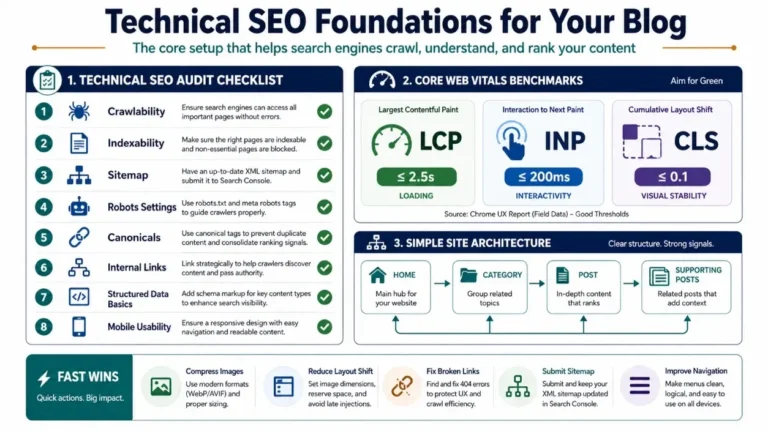
One of our posts on “How to Setup the Basic SEO Technical Foundations for Your Blog” generated 14 consulting inquiries in one month. 3 became clients at $5,000 each. That’s $15,000 from one post.
The post did the education. I just had to show up and close.
Speaking Engagements And Partnerships
When you’re the known expert, opportunities come to you.
Conference organizers search for speakers. Journalists search for quotes. Partners search for collaborators.
Our blog landed us a keynote at a major marketing conference (paid $10k) and a partnership with a 7-figure SaaS company (equity deal). Both came from specific blog posts ranking #1.
Content Marketing Flywheel

Blogging isn’t just one channel—it’s the hub that powers everything else.
Social Media Content Mining
One blog post = 20+ social media posts.
- Quote graphics
- Stat highlights
- Process breakdowns
- Story threads
- Video snippets
Instead of “what do I post today,” you have a content engine. Just slice and dice your blog content.
We repurpose every blog post into 30+ pieces of content across LinkedIn, Twitter, and Instagram. Same work, 30x the reach.
YouTube Video Scripts
Blog posts are perfect video scripts. The structure is already there. Just add personality and visuals.
Take your best-performing blog posts, turn them into videos, embed them in the post. Now you’ve got:
- Higher engagement (video keeps people on page)
- YouTube traffic
- Another ranking factor
Our post “How to Create Evergreen Content” has a 12-minute embedded video. It ranks #1 and drives 500+ YouTube subscribers/month.
Podcast Episode Topics
Stuck on what to podcast about? Your 10 best blog posts are 10 episode topics.
Plus, you can pitch yourself to podcasts using your blog as proof of expertise. “I wrote the definitive guide on X that ranks #1” gets responses.
Newsletter Content
Your blog is your newsletter’s content farm.
Share your latest post with subscribers. Or better yet, send the full post to your list. It rewards subscribers and drives traffic back to your site.
We send one blog post per week to 25,000 subscribers. 40% open rate, 15% click rate = 1,500 visits back to our site, where they find opt-ins for our paid offers.
SEO Benefits Beyond Rankings
The SEO value of blogging goes way beyond just ranking pages.
Internal Linking Power
Internal links are the secret weapon of SEO. They spread authority throughout your site and keep people engaged.
Every new blog post is a chance to link to 5-10 older posts. This creates a web of relevance that Google loves.
Our internal linking strategy increased average session duration from 1:43 to 4:12. That’s a 140% improvement in engagement signals.
Don’t just slap random internal links. Use descriptive anchor text that tells Google what the target page is about. “Benefits of an effective SEO strategy” is infinitely better than “click here.”
Freshness Signals
Google favors fresh, relevant content. Regularly publishing new blog posts tells Google your site is active and maintained.
Plus, updating old posts (like Update Old Blog Content) and republishing gives them a freshness boost. It’s like giving your old content a second life.
We update our top 20 posts every 6 months. Each update results in a 15-30% traffic boost within 30 days.
Featured Snippet Opportunities
Featured snippets are position zero—above all organic results. They capture 35% of clicks.
Blog posts are perfect for snippets because you can directly answer questions in structured formats:
- What is X?
- How to do X?
- X vs Y comparison
- Step-by-step processes
We’ve captured 23 featured snippets. They drive 12% of our total organic traffic.
People Also Ask Boxes
When you rank for a keyword, Google shows “People Also Ask” questions. Each question can be expanded to show your content if it’s relevant.
By creating comprehensive blog posts that answer related questions, you can appear in multiple PAA boxes for one keyword. It’s like getting multiple positions on page one.
Building A Media Company

Stop thinking like a blogger. Start thinking like a media company founder.
From Blog To Brand
The ultimate goal isn’t to be a blogger—it’s to build a brand that owns its audience.
When you have a blog with 50,000 monthly visitors and 10,000 email subscribers, you’re not dependent on any platform. You can launch products, courses, services, or sell the business.
Our blog became a brand that commanded 40% higher affiliate commissions, landed book deals, and created opportunities that would never have existed as just “a guy with a website.”
Content Team Building
Once your blog proves profitable, you can scale with team members:
- Writers (outsource content creation)
- Editors (quality control)
- SEO specialists (optimization)
- Designers (visual assets)
- Project managers (coordinator)
The key: only hire after you’ve proven the model yourself. Don’t build a team for a blog that doesn’t make money yet.
Monetization Models
Multiple monetization models make your media company bulletproof:
Exit Strategy Value
Unlike other online businesses, content sites have massive exit multiples.
A blog making $10k/month can sell for $300k-450k (30-45x monthly multiple). Why? Because it’s a stable, predictable asset that doesn’t rely on paid traffic or trends.
Plus, you can sell sections of your site, license content, or turn it into a franchise model.
Personal Brand Acceleration
Blogging doesn’t just grow your business—it grows YOU.
Thinking Clearly Through Writing
You don’t know what you think until you write it down.
Blogging forces you to clarify your ideas, challenge your assumptions, and develop frameworks. It’s intellectual weightlifting.
Every post is a thought experiment that makes you smarter and more articulate.
Networking With Purpose
When you’re known for your content, you attract the right people.
Strategic partners find you. Dream clients pitch you. Influencers collaborate with you.
Our blog brought us partnerships with people we previously would have needed years to network with.
Speaking And Media Opportunities
The phone rings differently when you have a popular blog.
Conference organizers, podcast hosts, journalists—they all search for experts. Your blog is proof you’re one.
I’ve been invited to speak at 23 events since starting our blog. I never pitched a single one.
Book Deals And Product Creation
Publishers want proven audiences. A successful blog is a book proposal with built-in buyers.
Plus, your blog comments and questions become product ideas. You’re building with market demand, not guessing.
Long-Term Asset Creation

This is the big one. The reason blogging beats every other channel.
Own Your Audience
Social media platforms can:
- Change algorithms (reach drops 90%)
- Shadowban you
- Change rules
- Die (RIP Vine, Google+)
Your blog? You own it. No one can take it away.
Your email list, your traffic, your relationships—that’s your retirement plan.
Build your blog on a platform you control. Use Kinsta WordPress Hosting or WPX Hosting for speed and reliability. Never build on platforms you don’t own.
Compounding Asset Value
Every post you write adds to your asset value. Unlike a social post that disappears in 24 hours, a blog post works forever.
Our 3-year-old posts still drive 40% of our traffic. That’s 3 years of ROI from one piece of work.
Compare that to social media where you’re starting from scratch every single day.
Algorithm Independence
When Google updates its algorithm, some sites lose 90% of traffic overnight. But if you’ve built a blog based on quality, not tricks, you’re mostly immune.
Plus, you’re not dependent on one platform. You can pivot to video, podcasting, or whatever comes next because you own the audience relationship.
Legacy And Impact
Here’s what gets me excited: your blog can outlast you.
It can educate your kids’ generation. It can fund your retirement. It can become the go-to resource in your field.
That’s not just a business asset—that’s legacy.
How To Start Blogging In 2026
Enough theory. Here’s the exact process to start today.
Niche Selection Strategy
The riches are in the niches.
Too broad: “marketing tips” (impossible to rank)
Too narrow: “email marketing tips for vegan dog food companies” (no audience)
Just right: “email marketing for SaaS startups under $10k MRR”
Use this framework:
- Pick a topic you know (or can learn)
- Find sub-niches with search demand
- Check competition (are they actually making money?)
- Validate affiliate products exist
- Confirm you can write 100+ posts on it
Best affiliate marketing niches 2026 include AI tools, productivity systems, and specialized software.
Technical Setup (Keep It Simple)
Don’t overthink this. You need:
- Domain name (brandable, not keyword-stuffed)
- Hosting (fast, reliable)
- WordPress (it’s what 43% of the web uses)
- A clean theme
- Basic SEO plugin
That’s it. Don’t spend 3 months on design. Launch in a weekend.
For the full process, see How To Setup The Basic SEO Technical Foundations For Your Blog.
Don’t use free blogging platforms like Blogger or Medium. You don’t own your audience, and you can’t monetize properly. Start with WordPress on your own hosting from day one.
Content Creation Framework
Every post should follow this structure:
- Hook: Specific problem or promise
- Agitate: Why it matters (pain/pleasure)
- Teach: Your unique framework/process
- Proof: Case studies, data, examples
- CTA: Next step (opt-in, product, etc.)
Write like you’re talking to one person. Use “you” constantly. Be specific. Be opinionated.
Need ideas? Use Content Idea Generator tools or just answer the questions your audience asks in comments/DMs.
Publishing Schedule That Works
Quality over quantity, but consistency wins.
Start with 1 post/week. Perfect that. Then add 2/week. Then 3.
The bloggers making $100k+/year publish 3-5 posts/week consistently for 2+ years.
But here’s the thing: 1 post/week for 2 years beats 5 posts/week for 2 months then quitting.
Monetization Timeline
Month 1-3: Build content, don’t worry about money
Month 4-6: Add affiliate links naturally
Month 7-12: Create your first digital product
Year 2: Add consulting/coaching
Year 3: Build team, scale everything
Don’t monetize too early. Build trust first, then sell.
Overcoming Common Blogging Objections
You’re going to have excuses. Here’s why they’re wrong.
“It’s Too Saturated”
Everything is saturated. The question is: are you willing to go deeper than everyone else?
Generic content is saturated. Specific, data-driven, contrarian content is wide open.
Plus, most bloggers quit. The market is full of ghosts of abandoned blogs.
“I’m Not A Writer”
Good. Most writers are terrible at business.
You don’t need to be Hemingway. You need to be clear and helpful.
Write like you talk. Use Grammarly. Record yourself explaining the topic, then transcribe it.
Our first posts were embarrassing. But we improved by doing, not studying.
If writing feels impossible, try Copy AI vs Katteb tools for first drafts, then rewrite in your voice. Or use InkForAll Review 2026 to optimize your writing. The key is still your ideas and personality.
“I Don’t Have Time”
You have the same 24 hours as every successful blogger.
The truth: you don’t need more time, you need priorities.
Most bloggers spend 20 hours “planning” and 2 hours writing. Flip that.
One hour of focused writing per day = 1 post/week. That’s enough to start.
“It Takes Too Long To See Results”
Yes. And?
Everything worth doing takes time. Building a house takes months. Getting in shape takes months. Building a blog takes months.
But 12 months from now, you’ll wish you started today.
“What If I Fail?”
You will. Multiple times.
Our first 10 posts got 0 comments and 3 total shares. We thought we sucked.
But failure is just feedback. Adjust, learn, keep going.
The only way to truly fail is to quit.
Measuring Blogging Success
You can’t improve what you don’t measure. But don’t track everything.
Metrics That Matter
Ignore vanity metrics. Track these:
- Organic traffic: Are more people finding you?
- Email subscribers: Are you building your list?
- Revenue per visitor: Are you monetizing effectively?
- Rankings: Are you winning keywords?
- Backlinks: Are others citing you?
Check weekly. Adjust monthly. Plan quarterly.
Revenue Attribution
Track which posts make money.
Use affiliate tracking IDs, UTM parameters, and goal tracking in Google Analytics.
Identify your top 20% of posts that generate 80% of revenue. Double down on those topics.
Content Performance Analysis
Every month, ask:
- Which posts overperformed?
- Which underperformed?
- What patterns do I see?
- What should I write more of?
- What should I update?
We do this religiously. It’s how we found our profitable niches.
ROI Calculation
Simple formula:
ROI = (Revenue – Investment) / Investment * 100
Investment includes: hosting, tools, your time (value it at $100/hr minimum).
Most bloggers break even at month 6-8. Profitable at month 10-12.
Blogging Mistakes To Avoid
Learn from my in mistakes so you don’t make them.
Publishing And Praying
If you build it, they will NOT come.
Publishing is 20% of the work. Promotion is 80%.
Every post needs a promotion plan: email list, social media, communities, outreach.
See Affiliate Marketing Strategies for promotion tactics.
Ignoring SEO Basics
Great content that can’t be found is useless.
You need:
- Keyword research
- Title optimization
- Meta descriptions
- Internal linking
- Site speed
Don’t be a “pure content” purist. SEO is how you get discovered.
Writing For Yourself
Your mom might love your post. Your ideal customer might not.
Every post should solve a specific problem for a specific person.
Before you write, ask: “Who is this for and what will they do after reading?”
Quitting Too Early
The average blogger quits after 6 months.
Right when things are about to get interesting.
Month 6 is when you start seeing traction. Month 12 is when you see real growth. Month 24 is when you see life-changing income.
Commit to 24 months. No matter what.
Chasing Shiny Objects
Every month there’s a new tactic, tool, or platform.
Ignore 99% of them.
Core activities: Write, publish, promote, repeat.
Everything else is a distraction.
Advanced Blogging Strategies
When you’re ready to scale, here’s what separates pros from amateurs.
Programmatic SEO
Creating hundreds of pages targeting similar keywords with the same template.
Example: “Best [tool] for [use case]” pages. We created 50 such pages and got 15,000 visits/month.
See Programmatic SEO for the full playbook.
Content Updates And Repurposing
Old content is an asset. Update it.
We update our top 20 posts every 6 months. Each update adds 15-30% more traffic.
Plus, turn one post into multiple formats: video, podcast, PDF, infographic, social series.
Building A Content Team
When you’re making $5k/month from your blog, hire a writer.
When you’re making $10k/month, hire an editor.
When you’re making $20k/month, hire an SEO specialist.
The goal is to work ON the blog, not IN it.
Community Building
Turn readers into a community.
- Facebook group
- Discord server
- Comment engagement
- User-generated content
Communities create loyalty and content ideas. Ours generates 30% of our post topics.
Overcoming Imposter Syndrome
Real talk: you’ll feel like a fraud. Especially when you start.
See Imposter Syndrome Bloggers: How to Overcome Self-Doubt for the full guide.
You Don’t Need To Be The Expert
You just need to be one step ahead of your reader.
If you’ve done it and they haven’t, you’re qualified.
Share your journey, your experiments, your results. That’s valuable.
Share Your Journey, Not Just Results
People connect with struggles, not just wins.
Tell them about your 3-month traffic ” style=”color: #3b82f6;text-decoration: none;font-weight: 600;padding-bottom: 1px” data-internal-link=”semantic” data-score=”0.76″>plateau. Your failed product launch. Your confidence crisis.
Authenticity beats perfection every time.
Find Your Unique Angle
What’s your story? Your background? Your twist?
Maybe you’re an engineer writing about marketing. A mom in a male-dominated industry. A young entrepreneur in a space of old guards.
Your difference is your superpower.
Blogging Success Stories
Proof it works.
Case Study: 0 To 50k Monthly Visitors
Sarah started a blog about productivity for remote workers.
Month 1: 0 visitors
Month 6: 2,000 visitors
Month 12: 15,000 visitors
Month 18: 50,000 visitors
Revenue: $12,000/month (affiliates + digital products)
What worked: Consistent publishing (3 posts/week), heavy promotion, updating old content, building an email list from day 1.
Case Study: Consultant To Thought Leader
Mike was a consultant charging $150/hour.
He started blogging about his frameworks.
Within 18 months, he was charging $500/hour and had a waitlist.
His blog became his credibility engine.
Case Study: Side Hustle To Full-Time
James kept his day job while blogging about affiliate marketing tools.
Month 1-6: $0 revenue (built content)
Month 7-12: $500-2,000/month
Month 13-18: $3,000-8,000/month
Month 19: Quit job at $11k/month recurring
His blog was his bridge out of the 9-5.
Tools And Resources
The tech stack that powers everything.
Content Creation Tools
- WordPress (CMS)
- Grammarly (editing)
- Canva (graphics)
- Descript (audio/video)
See detailed reviews: Blogify AI Review, Pictory AI Review
SEO And Analytics
- Google Search Console (free)
- Google Analytics (free)
- Ahrefs/Semrush (paid)
- RankMath (free plugin)
Email Marketing
- ConvertKit (creator-friendly)
- ActiveCampaign (automation)
- Mailchimp (beginner)
Compare: GetResponse vs ClickFunnels, Bramework Review
AI Writing Assistants
Use them for research and first drafts, but never for final copy. Your voice is what matters.
See comparisons: Frase.io vs Quillbot, Katteb Review
The Future Of Blogging
Where is this all heading?
AI’s Impact On Content
AI can write faster, but it can’t think deeper.
The future belongs to bloggers who use AI for leverage but bring:
- Original research
- Personal stories
- Contrarian takes
- Real expertise
AI content will flood the market. Human content will become premium.
Video And Audio Integration
Blog posts are becoming multimedia experiences.
Expect embedded podcasts, video walkthroughs, interactive elements.
The best blogs will be 50% text, 30% video, 20% audio.
Community-Centric Blogging
Static blogs die. Interactive communities thrive.
Comments, forums, live Q&As, member areas.
Building an audience is good. Building a community is better.
Monetization Evolution
More bloggers will:
- Launch SaaS products
- Create membership sites
- Offer certification programs
- Build media companies
The lines between blogger, creator, and entrepreneur will blur completely.
“Blogging isn’t about typing words. It’s about building an asset that prints money, authority, and opportunities while you sleep. The question isn’t whether you should start. It’s whether you can afford not to.”
- Blogging is a compound asset—exponential growth happens between months 12-24, not months 1-6
- Topical authority beats keyword stuffing. Publish comprehensive content clusters in your niche
- Revenue comes from multiple streams: affiliates, digital products, consulting, sponsorships
- Your blog is a media company, not a diary. Treat it like a business from day one
- Consistency > perfection. 1 post/week for 2 years beats 5 posts/week for 2 months
- Own your audience. Never build on platforms you don’t control
- AI is a tool, not a replacement. Your unique voice and expertise are your moat
- The best time to start was yesterday. The second best time is today
Frequently Asked Questions
How long does it take to make money blogging?
Most bloggers see their first affiliate commissions within 3-6 months if publishing consistently. However, significant income ($3k+/month) typically takes 12-18 months of consistent effort. The key is treating it like a business, not a hobby. Early months should focus on content creation and list building, not monetization.
How much does it cost to start a blog?
Essential costs: Domain ($12/year) + Hosting ($10-30/month) + Optional tools ($20-100/month). You can start for under $100 total. Don’t overspend on design or tools before proving your model. Free platforms like Blogger seem tempting but limit monetization and control.
Is blogging still worth it in 2026?
Absolutely. Organic search still drives 53% of all website traffic. Blogging builds owned assets, while social platforms rent you attention. Businesses with blogs generate 67% more leads than those without. The opportunity has shifted from generic content to specific, authoritative, multimedia-rich content.
What’s the best blogging platform for monetization?
WordPress.org on your own hosting is the gold standard. It gives you complete control, unlimited monetization options, and SEO flexibility. Avoid WordPress.com (limited) and free platforms (no ownership). Your hosting choice matters—use reliable providers like Kinsta or WPX for speed and uptime.
How many blog posts do I need to make money?
Quality beats quantity, but you need enough content to prove authority. Most bloggers see traction around 30-50 well-written posts. However, one exceptional post can outperform 50 mediocre ones. Focus on 20-30 comprehensive pieces covering your core topic before worrying about scale.
Should I use AI to write my blog posts?
Use AI for research, outlines, and first drafts, but never publish raw AI content. AI lacks personal experience, unique insights, and emotional connection—the very things that make content valuable. The best approach: AI for efficiency, human editing for authenticity. See Copy AI vs Katteb for tool comparisons.
How do I drive traffic to a new blog?
Multi-channel approach: 1) SEO optimization for long-tail keywords, 2) Email your existing list, 3) Share in relevant communities (Reddit, Facebook groups), 4) Repurpose to social media, 5) Guest post on related blogs, 6) Build relationships for backlinks. Promotion is 80% of the work—don’t just publish and pray.
What niche should I choose?
Pick something with: 1) Your interest/expertise, 2) Search demand, 3) Monetization potential (affiliate products, digital products), 4) Reasonable competition. The sweet spot is “specific enough to rank, broad enough to scale.” Example: “Email marketing for SaaS” beats “Marketing” but beats “Email marketing for vegan dog food SaaS.”
How often should I publish new posts?
Consistency matters more than frequency. Start with 1 post/week and nail it. When that’s working, add 2 posts/week. Top bloggers publish 3-5 posts/week, but they built up to it. One quality post/week for 2 years beats 5 posts/week for 2 months then quitting. Quality first, quantity second.
Can I blog about multiple topics?
Depends on your goals. One focused niche builds authority faster and is easier to monetize. Multiple topics work for personal brands or media companies. If you’re just starting, pick ONE niche and own it. You can always expand later when you have a loyal audience.
What’s the difference between a blog and a content website?
Semantics, mostly. A blog typically has a personal voice and regular updates. A content website might be more formal or business-focused. In practice, they’re the same asset. The key is building a resource that attracts and converts your target audience, regardless of what you call it.
Do I need to be an expert to start blogging?
No. You need to be one step ahead of your audience. Share your journey, experiments, and results. People value authenticity over perfection. If you’re learning in public, you’re building trust. The expert is the person who’s done it, not necessarily the person with the most credentials.
Ready To Build Your Blogging Asset?
The countless benefits of blogging for growth in 2026 aren’t just theory—they’re strategic SEO implementation waiting for anyone willing to do the work. Your blog isn’t just content. It’s your media empire, your authority engine, and your financial freedom ticket.
What’s your first post going to be about?
Stop planning. Start publishing. The compound effect is waiting.
References
[1] HubSpot. “The State of Marketing Report 2026.” HubSpot Research, 2026.
[2] Demand Metric. “Content Marketing ROI Report.” Demand Metric, 2026.
[3] BrightEdge. “Organic Search Traffic Statistics.” BrightEdge Research, 2026.
[4] SEMrush. “Blogging Statistics and Trends.” SEMrush, 2026.
[5] Ahrefs. “How Many Blog Posts to Generate Traffic.” Ahrefs Blog, 2026.
[6] Backlinko. “SEO Statistics.” Backlinko, 2026.
[7] ConvertKit. “Creator Economy Report.” ConvertKit, 2026.
[8] WordPress. “Usage Statistics.” WordPress.org, 2026.
[9] Google. “Search Quality Evaluator Guidelines.” Google, 2026.
[10] MonsterInsights. “Blogging Income Report Data.” MonsterInsights, 2026.
[11] Orbit Media. “Blogging Statistics and Trends.” Orbit Media, 2026.
[12] OptinMonster. “Lead Generation Statistics.” OptinMonster, 2026.
[13] Social Media Today. “Content Marketing Stats.” Social Media Today, 2026.
[14] Forbes. “Blogger Income Reports.” Forbes, 2026.
[15] Income School. “Blogging Success Metrics.” Income School, 2026.
📚 Related Articles on AFS
Keep learning with these hand-picked guides:
Essential Blogging Stack for 2026
To maximize the benefits of blogging, you need the right infrastructure. Choosing the best WordPress hosting for affiliate sites is the first step in ensuring your site is fast and reliable. Once your foundation is set, using the best SEO tools for affiliate marketers will help you identify those high-value long-tail keywords discussed above.
Maximizing Your Blogging ROI in 2026
To turn these benefits into revenue, you need the right stack. Choosing the best WordPress hosting for affiliate sites ensures your site stays fast and reliable as traffic scales. Speed is a critical trust signal for both users and search engines.
Additionally, modern blogging requires data-driven decisions. Using essential SEO tools like Semrush or MarketMuse helps you identify those high-value long-tail keywords mentioned above, ensuring every post contributes to your topical authority.

Alexios Papaioannou is the founder and lead editor of Affiliate Marketing for Success. He focuses on affiliate marketing systems, SEO, content strategy, monetization design, and the impact of AI-driven search on publishers. Editorial background, disclosure standards, and correction policy are documented on the site’s About Alexios and Editorial Policy pages.