
How to Improve Your Content Marketing Strategy in 2026
Quick Answer
How to Improve Your Content Marketing Strategy in 2026: choose one monetization path, publish intent-matched content, and optimize offers based on weekly conversion data.
Most affiliate marketers think their content marketing strategy is fine. They publish blog posts. They share on social media. They wait for traffic that never comes. Here’s the brutal truth: if your content isn’t generating leads and sales right now, your strategy is broken—and throwing more content at the problem only makes it worse. Read the full review
The good news? Fixing it doesn’t require more work. It requires different work. This guide gives you the exact framework affiliate marketers are using in 2026 to turn underperforming content into conversion machines. No theory. No fluff. Just what works.
⚡
Quick Takeaways
Bottom Line: Content marketing success in 2026 requires a strategic shift from volume-based publishing to intent-driven, conversion-optimized content that serves specific buyer journey stages.
✓ This Guide Is For You If:
- Your content gets traffic but no conversions
- You’re stuck in the “publish and pray” cycle
- Your competitors outrank you consistently
✗ Skip This If:
- You haven’t started content marketing yet
- You’re looking for overnight results
- You won’t commit to strategic changes
🛠️ What You’ll Need to Improve Your Strategy
⏱️ Time Investment
4-6 hours for initial audit
📊 Analytics Access
Google Analytics + Search Console
🎯 Content Inventory
List of all published content
📝 SEO Tool
Semrush, Ahrefs, or free alternatives

Step 1: Audit Your Existing Content (The Truth Hurts)
Before you create anything new, you need to know what’s actually working. Most affiliate marketers skip this step and keep producing content that fails the same way their old content failed.
⚠️ The Brutal Reality
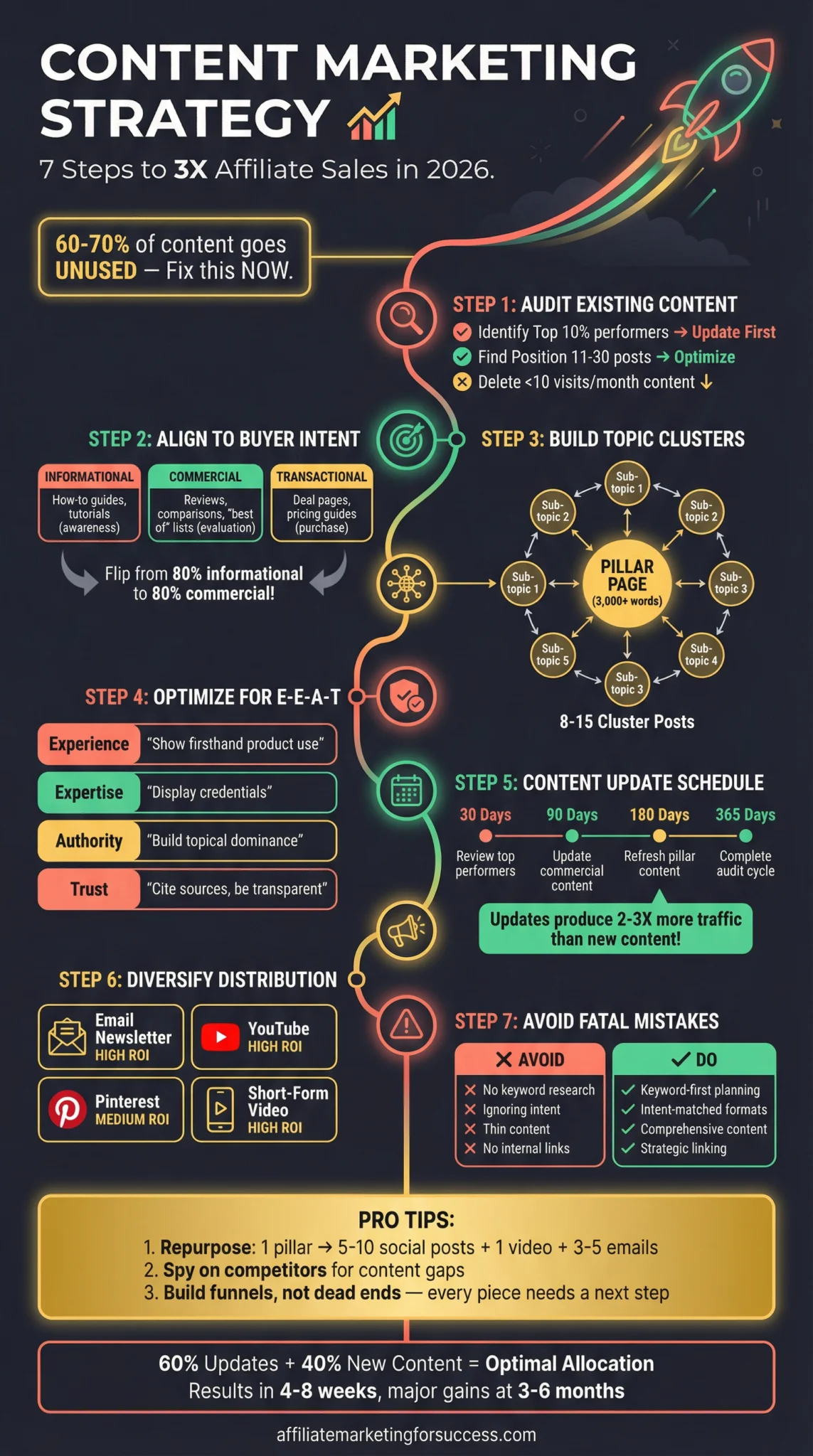
According to content marketing research, 60-70% of B2B content goes completely unused. For affiliate sites, this number is often higher. You’re likely sitting on dead content that’s diluting your site’s authority.
Here’s your audit framework:
Learning how to analyze your blog’s user behavior metrics is essential before you can meaningfully improve your content strategy.
Step 2: Align Content to Buyer Intent (Not Just Keywords)
This is where 90% of affiliate marketers go wrong. They chase keywords without understanding why someone is searching. Intent alignment is the single biggest lever you can pull to improve conversions.
🔍
Informational Intent
Learning & Research Phase
User wants to understand a topic, solve a problem, or learn something new. Not ready to buy.
📝 Content Types:
How-to guides, explanations, tutorials, educational posts
⚖️
Commercial Intent
Comparison & Evaluation Phase
User is comparing options, reading reviews, evaluating products. Getting closer to purchase.
📝 Content Types:
Product comparisons, reviews, “best of” roundups, alternatives
💰
Transactional Intent
Ready to Purchase Phase
User has decided and wants to buy. Looking for the best deal or where to purchase.
📝 Content Types:
Deal pages, discount posts, landing pages, pricing guides
💡 The Money Move
Map your existing content to these three intent buckets. Most affiliate sites have 80% informational content and 20% commercial/transactional. Flip that ratio. Your highest-converting content should be commercial intent—product reviews, comparisons, and “best” lists.
Step 3: Build Topic Clusters (Not Random Posts)
Google’s algorithm rewards topical authority. Publishing scattered posts on random topics tells search engines you’re not an expert on anything. Topic clusters fix this by organizing your content around pillar pages connected to related subtopics.
Understanding AI-powered semantic clustering can dramatically accelerate how you organize and interlink your content for maximum topical authority.
🏗️ Topic Cluster Architecture
🎯
Pillar Page
- ✓ Comprehensive guide (3,000+ words)
- ✓ Targets main keyword
- ✓ Links to all cluster content
- ✓ Evergreen, regularly updated
🔗
Cluster Content
- ✓ Covers specific subtopics
- ✓ Targets long-tail keywords
- ✓ Links back to pillar page
- ✓ 8-15 pieces per cluster
Step 4: Optimize for E-E-A-T (Experience, Expertise, Authority, Trust)
Google’s quality rater guidelines prioritize E-E-A-T signals. For affiliate content—especially in YMYL (Your Money, Your Life) niches—this isn’t optional. Without demonstrated expertise, your content won’t rank regardless of optimization.
E
Experience
- +
Show firsthand use
Include original photos, screenshots, and personal anecdotes from actually using products
- +
Document your process
Share testing methodology, timeframes, and real results
E
Expertise
- +
Author credentials
Display relevant qualifications, certifications, and years of experience
- +
Technical depth
Go beyond surface-level information with nuanced insights
Step 5: Implement a Content Update Schedule
Here’s a stat that should change how you allocate your time: updating existing content produces 2-3x more traffic gains than creating new content for the same effort. Most affiliate marketers ignore their old posts while competitors swoop in and steal rankings with fresher content.
Learn the exact process for updating old blog content to recapture lost rankings and boost conversions from posts already indexed.
📅 Content Refresh Schedule
30
Days
Review top performers for quick wins
90
Days
Full update on commercial content
180
Days
Deep refresh on pillar content
365
Days
Complete content audit cycle
Step 6: Diversify Your Content Distribution
Creating content is half the battle. If you’re only relying on organic search, you’re leaving traffic—and money—on the table. A modern content marketing strategy requires multi-channel distribution.
Email remains the highest-converting channel for affiliate marketers. If you’re not building a list, start now. Check out effective email marketing strategies for affiliate marketers to maximize this channel.
🚀 Pro Tips from the Trenches
1. Repurpose Ruthlessly
One pillar post should become: 5-10 social posts, 1 YouTube video, 3-5 email sequences, and multiple Pinterest pins. Stop creating from scratch every time.
2. Spy on Your Competitors
Use tools like Semrush or Ahrefs to find competitor content gaps. What questions are they not answering? What keywords are they ignoring? That’s your opportunity.
3. Focus on Conversion Architecture
Every piece of content needs a clear next step. Informational content → commercial content → transactional page. Build funnels, not dead ends.
Common Mistakes That Kill Content Marketing ROI
✗
What to Avoid
- −
Publishing without keyword research
Writing what you think people want vs. what they’re actually searching for
- −
Ignoring search intent
Creating informational content for transactional keywords (or vice versa)
- −
Thin, low-value content
500-word posts that don’t answer questions better than competitors
- −
No internal linking strategy
Creating orphan pages that never get found by users or search engines
✓
What to Do Instead
- +
Keyword-first content planning
Start with search data, validate demand, then create
- +
Intent-matched formats
Match content type to user goal at each funnel stage
- +
Comprehensive, value-dense content
Be the best answer for every keyword you target
- +
Strategic internal linking
Every post links to 3-5 related posts with contextual anchors
❓ Frequently Asked Questions
📚 Sources & Further Reading
Official resources and related guides on our site:
- Google’s Helpful Content Guidelines
Official documentation on creating people-first content - Building a Winning Content Strategy
Our comprehensive guide to content planning fundamentals - Google Page Experience Documentation
Understanding how user experience affects search rankings - Google Search Console Help
Official guide to monitoring your site’s search performance
Written By
Alexios Papaioannou
Affiliate marketing strategist with expertise in SEO, content strategy, and conversion optimization. Founder of Affiliate Marketing for Success.
Last Updated: January 2026
Our Editorial Standards:
- No paid placements or rankings
- We never claim to test products we haven’t personally evaluated
- All affiliate relationships are clearly disclosed
- Facts are verified against official sources
📚 Related Articles on AFS
Keep learning with these hand-picked guides:

I’m Alexios Papaioannou, an experienced affiliate marketer and content creator. With a decade of expertise, I excel in crafting engaging blog posts to boost your brand. My love for running fuels my creativity. Let’s create exceptional content together!